
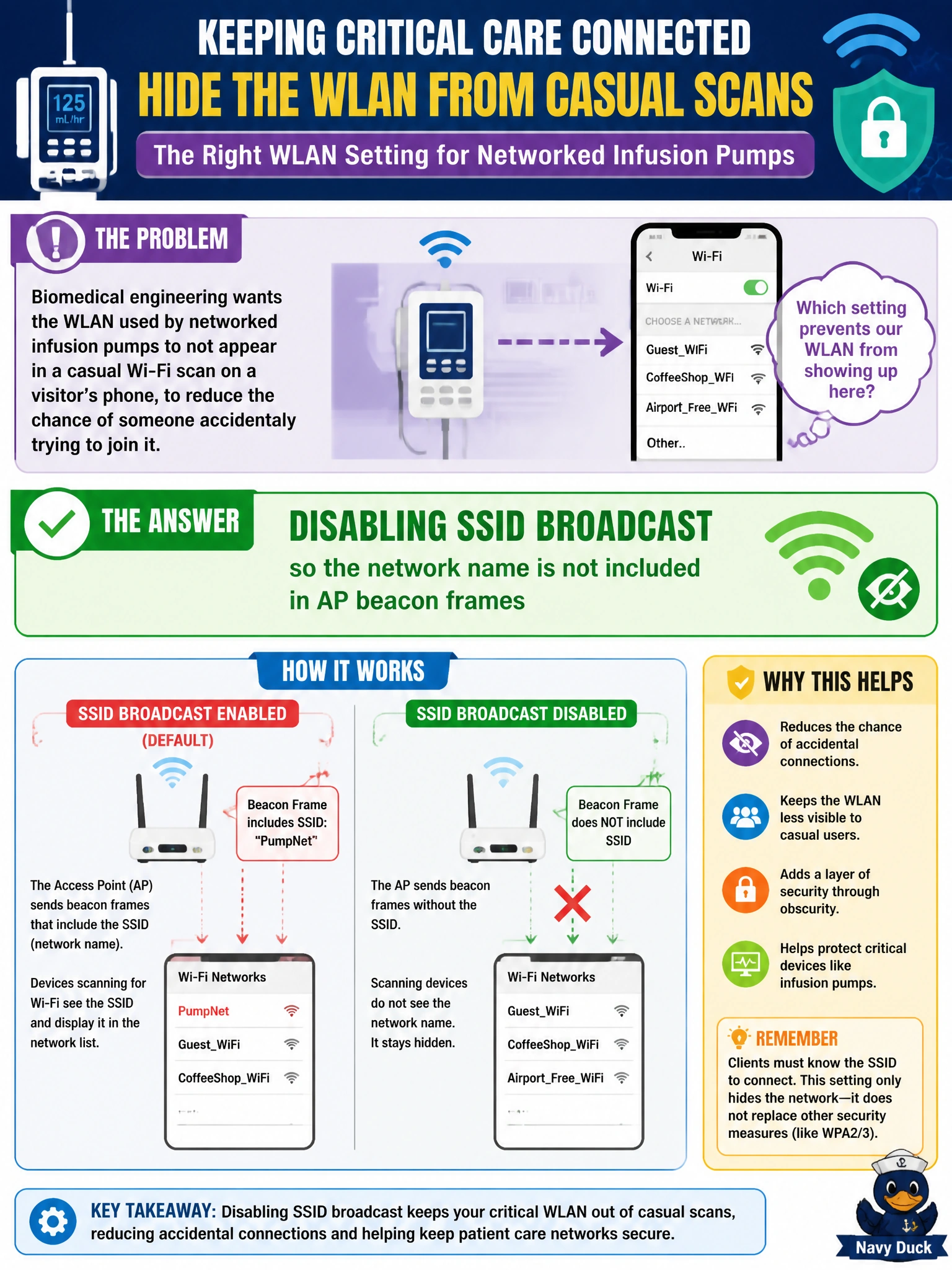
Biomedical engineering wants the WLAN used by networked infusion pumps to not appear in a casual Wi-Fi scan on a visitor's phone, to reduce the chance of someone accidentally trying to join it. Which WLAN setting addresses this specific concern?
Select an answer to reveal the explanation.
Short Explanation
A network can still broadcast its beacon without announcing its name out loud — that's the idea behind a hidden SSID. It won't show up in a casual scan, though anyone who already knows the exact name can still type it in and connect.
Full Explanation
Disabling SSID broadcast removes the network name from the AP's periodic beacon frames, which is exactly why a hidden WLAN does not appear in the list of nearby networks on a typical phone's Wi-Fi scan — it directly addresses 'reduce casual discovery,' which is the stated concern here. Encryption strength governs whether traffic or the key can be cracked, but it has no bearing on whether the SSID name itself is visible in a scan; a strongly-encrypted SSID can still broadcast its name openly. VLAN assignment is a Layer 2 forwarding construct entirely separate from beacon behavior — moving traffic to another VLAN changes nothing about what a nearby device sees when scanning for networks. Reducing transmit power might shrink the coverage area, but any device still within range would see the SSID exactly as before; power has nothing to do with name visibility. A caveat worth flagging: hiding an SSID is a mild deterrent, not a security control — the name still appears in a client's own probe requests and in more thorough scanning tools, so it should never be relied on in place of proper WLAN security settings. Operational check: confirm the SSID does not appear in a standard phone's available-networks list while a device already configured with the exact name can still connect.