
After deploying VLANs, trunk uplinks, and a LAG for a newly built ward, the technician wants to validate the configuration before declaring the rollout complete. Which check most directly confirms the deployment is working as intended?
Select an answer to reveal the explanation.
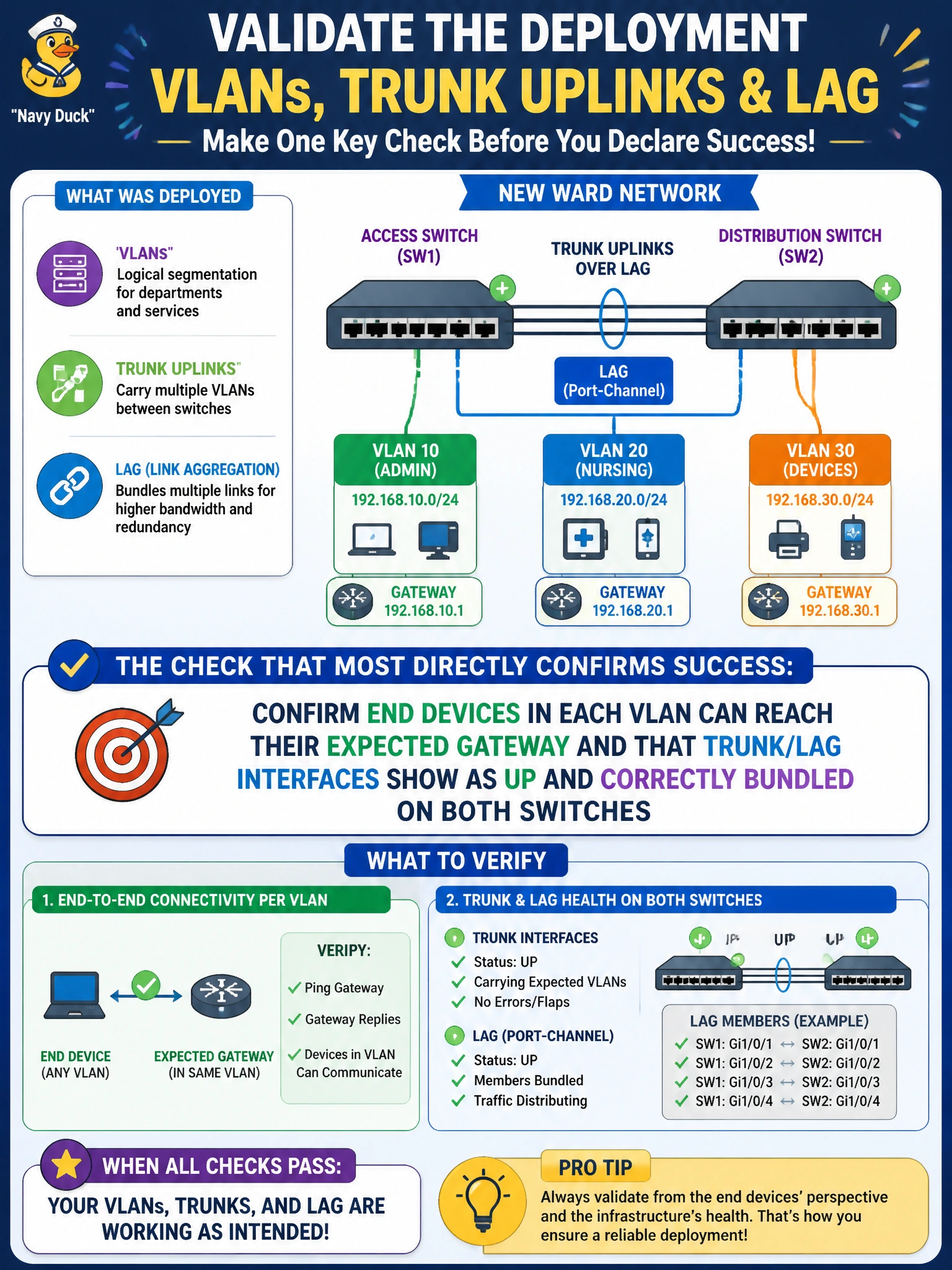
Short Explanation
Naming standards, matching configs, and blinking link lights all look reassuring, but none of them prove the network actually carries traffic. Check that a device on each new VLAN can reach its gateway and that the trunk and LAG really are up and bundled on both ends — that's the direct test of what you just deployed.
Full Explanation
Validating a deployment means confirming the functional outcome the configuration was meant to achieve: end devices in each VLAN successfully reaching their gateway, and the trunk and LAG interfaces showing an operational, correctly bundled state on both switches, which together demonstrate that VLANs, trunking, and aggregation are all actually working rather than just administratively configured. Reading the running configuration back only proves the intent was typed in correctly; a VLAN can exist on both switches and a LAG can list the right members while the link still never forwards a frame, which is the difference between administratively configured and operational. Learned MAC addresses are a genuine signal that something is alive on the access ports, but they only prove local Layer 2 learning inside one broadcast domain — they say nothing about whether the trunk carries that VLAN upstream or whether the client can reach its gateway. Treating individual member links being up as proof the aggregation works is the most tempting mistake here: members can each show link up while LACP fails to negotiate because of a speed, duplex, or configuration mismatch, leaving the bundle down or running on a single link. Caveat: validation should also include checking for any interface errors or discards on the new trunk and LAG members, not just an 'up' state, since a link can be up but still misbehaving. Operational check: from a test device on each new VLAN, ping the VLAN's gateway and confirm the LAG and trunk interfaces report as bundled/up with no incrementing error counters on both switches.