
A VSX pair at the aggregation layer serves as the default gateway for several ward VLANs. The hospital wants both switches to share a single virtual gateway IP and MAC address per VLAN, so an end device only needs one gateway configured regardless of which physical switch actually forwards its traffic. Which VSX feature provides this?
Select an answer to reveal the explanation.
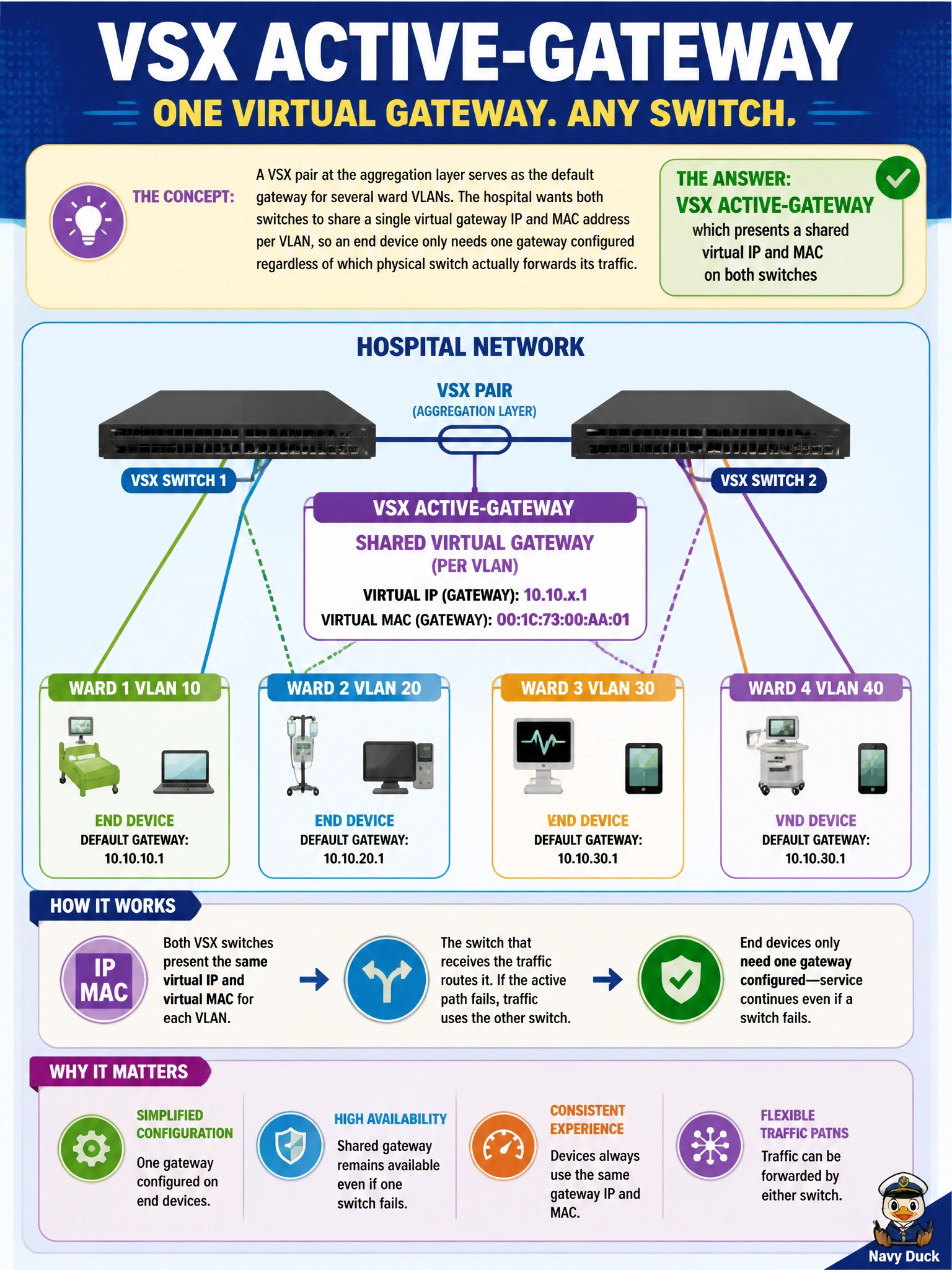
Short Explanation
End devices shouldn't have to care which physical switch is actually alive at any given moment — they just want one gateway address that always works. VSX active-gateway makes that possible by having both switches answer as the same virtual IP and MAC, so failover is invisible to anything downstream.
Full Explanation
VSX active-gateway lets both switches in a VSX pair simultaneously answer as the same virtual gateway IP and MAC address per VLAN, so an end device configures a single gateway and traffic is forwarded correctly regardless of which physical switch handles it at any moment, including transparently across a switch failure. VSF stacking merges switches into one logical control plane, which is a different architecture than VSX entirely, and describing it as automatically providing a shared gateway conflates two distinct technologies rather than describing an actual VSX feature. Static routes configured identically on both switches would still require each switch to have its own distinct gateway IP unless a shared virtual IP mechanism is layered on top — plain static routing by itself does not create one common gateway address that both switches answer to. LACP virtualizes only physical links into a logical aggregate interface between two directly connected devices; it has no role in providing a shared Layer 3 gateway identity and would not achieve the stated goal at all. Caveat: active-gateway configuration must be applied consistently per VLAN on both VSX members, and end devices still need correct default-gateway configuration pointing at that shared virtual IP. Operational check: from an end device on the VLAN, confirm ARP resolves the gateway IP to the shared virtual MAC, and verify traffic continues after failing over the active switch.