
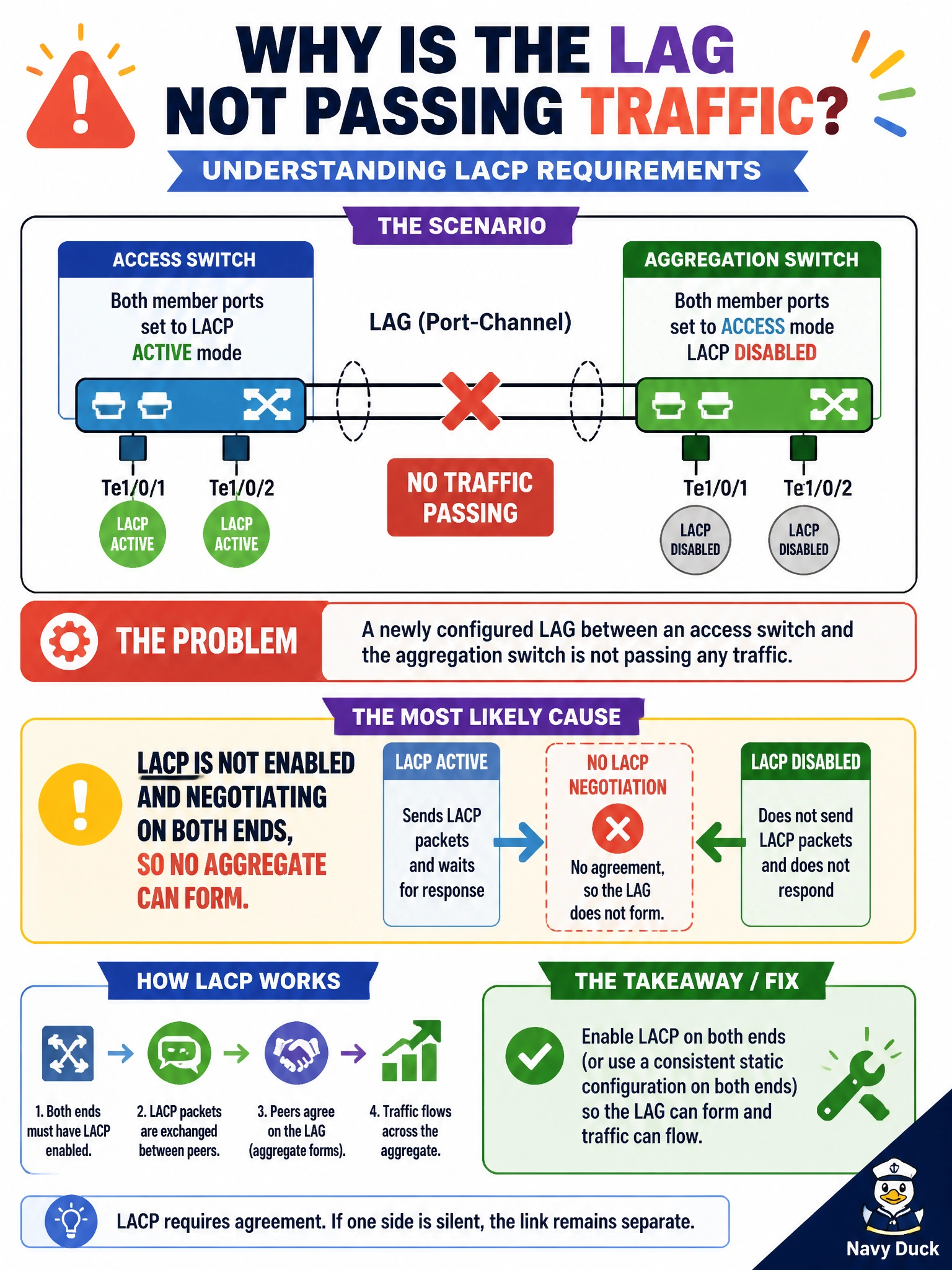
A newly configured LAG between an access switch and the aggregation switch is not passing any traffic. One switch has both member ports set to LACP active mode, and the other switch has both member ports administratively set to access mode with LACP disabled. What is the most likely cause of the failure?
Select an answer to reveal the explanation.
Short Explanation
A LAG is a negotiated agreement, not something you can declare unilaterally on just one side. If one switch is actively speaking LACP and the other has it turned off entirely, there's no conversation happening, so the two links stay as individual ports instead of becoming a bundle.
Full Explanation
LACP requires participation on both ends to form an aggregate — one side sending active LACP packets is not enough if the other side has LACP disabled entirely and the ports are just set to plain access mode; with no LACP running on that side, the two switches never agree to bundle the links, so they remain independent, non-aggregated interfaces. Cable length exceeding a supported maximum would typically show as a link-down or signal-integrity problem on the physical interfaces themselves, not specifically a failure to bundle two otherwise-up links into a LAG — the scenario does not mention any link-state or signal issue. A VLAN ID mismatch would cause traffic on those VLANs to be dropped or misdirected after a LAG is already up, but it does not prevent the LAG itself from forming, since LACP negotiation happens independently of which VLANs are eventually carried over the bundle. Spanning tree can put a port into a blocking state, but that assumes a loop condition exists and a port role has been assigned within a formed topology — it does not explain why the LAG itself never came up, which is a link-aggregation negotiation issue, not a loop-prevention one. Caveat: mismatched port modes (access vs. trunk) between two switches sharing a LAG is also a real problem, but it is secondary to the more fundamental issue that one side is not running LACP at all. Operational check: verify LACP is enabled and in active or passive mode on both switches' member interfaces before checking VLAN or trunk settings.