
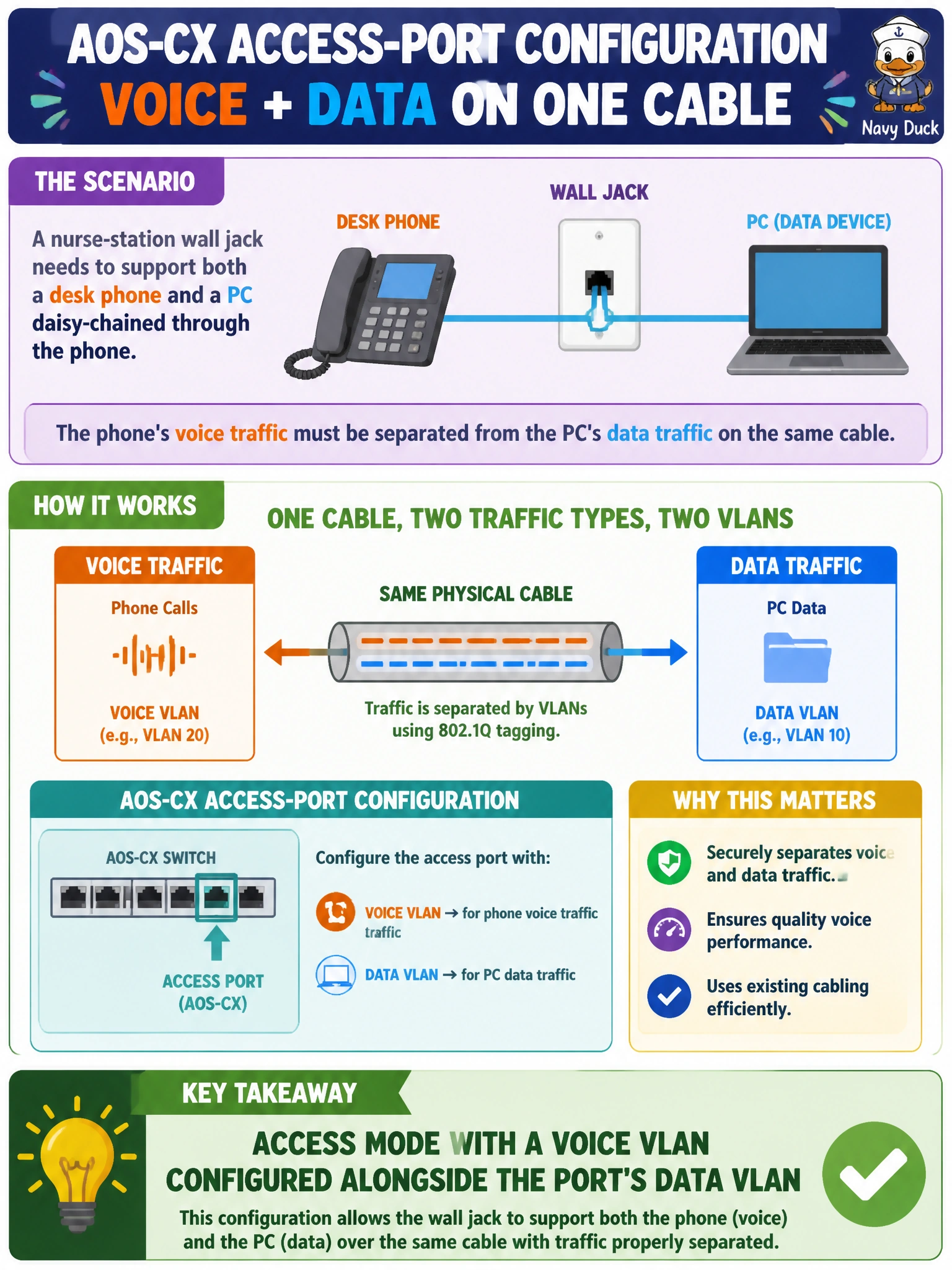
A nurse-station wall jack needs to support both a desk phone and a PC daisy-chained through the phone, with the phone's voice traffic separated from the PC's data traffic on the same cable. What AOS-CX access-port configuration supports this?
Select an answer to reveal the explanation.
Short Explanation
One cable, two kinds of traffic that still need to stay apart — that's the classic phone-plus-PC problem, and a voice VLAN on an access port solves it directly. The port keeps its normal untagged data VLAN for the PC while tagging the phone's voice traffic into its own VLAN, all over the same physical link.
Full Explanation
An access port configured with a voice VLAN alongside its regular data VLAN lets a single physical jack serve both an IP phone and a daisy-chained PC: the phone tags its voice traffic into the voice VLAN while the PC's traffic stays untagged in the port's normal access VLAN, keeping the two logically separate over one cable. Trunk mode allowing all VLANs is both unnecessary and risky — it exposes every VLAN on the network to whatever plugs into that jack, when the actual requirement is separating exactly two known traffic types, not opening the port to everything. Wiring two separate access ports to a single jack is not physically how a phone-and-PC daisy chain works; the PC connects through the phone's built-in switch port using one cable and one jack, so there is no second physical port to configure at the wall. Relying on the PC and phone to self-segregate traffic without any VLAN configuration assumes end devices enforce their own network separation, which is not how Ethernet or VLANs function — segregation has to be configured on the switch port itself. Caveat: the specific mechanism for how a phone learns its voice VLAN (such as via a discovery protocol) is a detail worth confirming per deployment, but the core access-port-plus-voice-VLAN model is what supports this use case. Operational check: verify the phone registers with an IP in the voice VLAN's subnet while the PC behind it receives an IP from the data VLAN's subnet.