
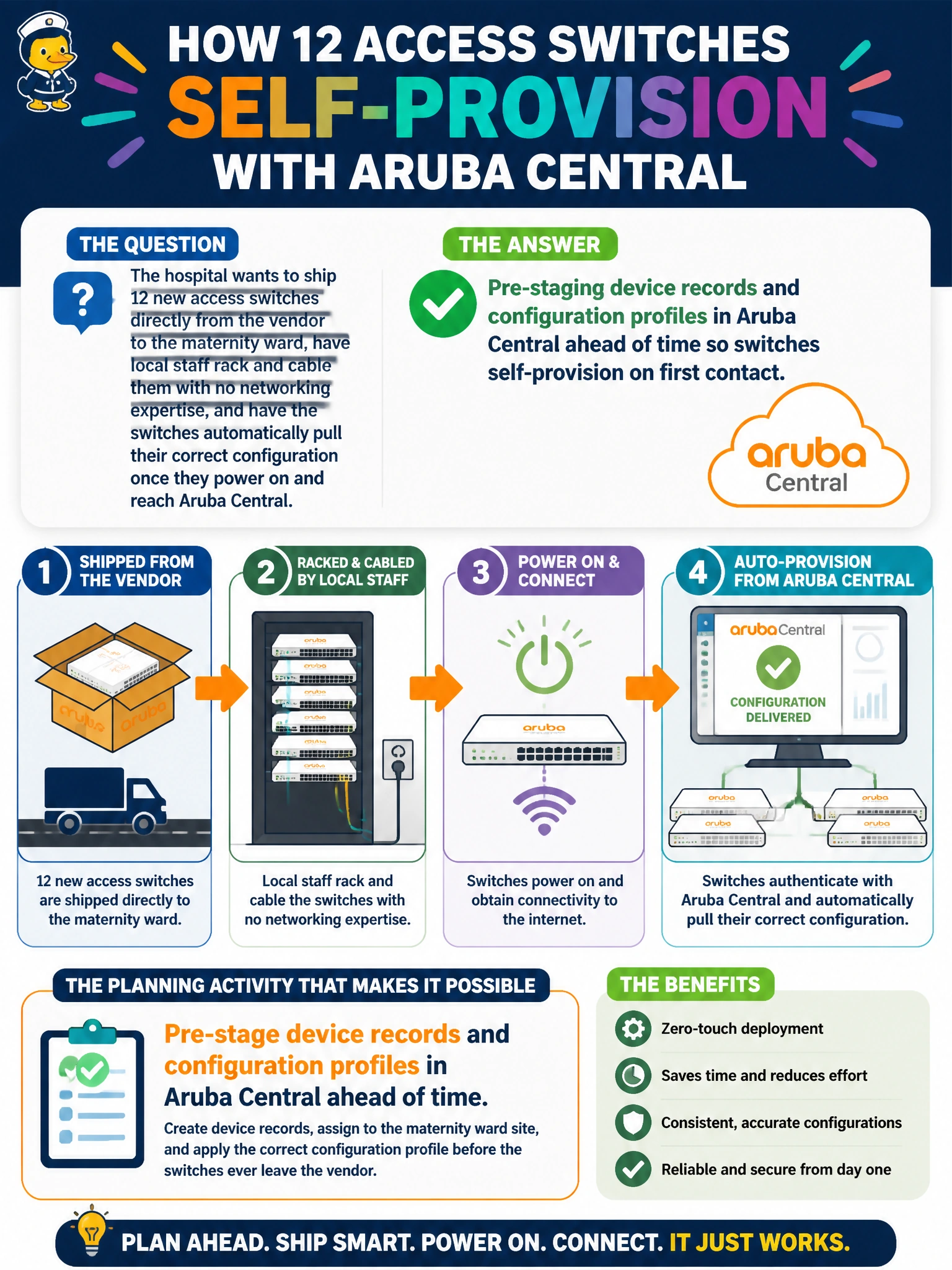
The hospital wants to ship 12 new access switches directly from the vendor to the maternity ward, have local staff rack and cable them with no networking expertise, and have the switches automatically pull their correct configuration once they power on and reach Aruba Central. Which planning activity makes this possible?
Select an answer to reveal the explanation.
Short Explanation
The trick to "ship it and let non-technical staff plug it in" is doing all the real work beforehand. Pre-stage the device in Central — its serial number, its group, its intended config — so the moment that switch calls home, Central already knows exactly what it's supposed to become.
Full Explanation
Enabling non-technical staff to simply rack and cable a switch requires that all the configuration decisions be made in advance and associated with that specific device in Aruba Central, typically by pre-staging the device's serial number or MAC address into the correct group with the intended configuration profile, so that when the switch boots and calls home, Central recognizes it and pushes the right settings automatically. This is the entire value of zero-touch provisioning: the planning work happens at a desk before shipment, not on-site by people without networking skills. Factory pre-configuring final IP addresses on the switch itself is fragile and defeats template-based provisioning, since any change to the plan after shipment requires physically touching the device again. Requiring local staff to console in and configure switches manually is the opposite of the stated goal and assumes exactly the expertise the scenario says is unavailable. Shipping switches with only factory defaults and no advance planning leaves nothing for Central to match the device against, so it would sit unconfigured or misconfigured on the ward's network. A concrete pre-implementation check is confirming the device's serial number is already visible and assigned to the correct group inside Central before the box ever leaves the shipping dock.