
A low-level design's trunk port table lists the ward access switch uplink as carrying only the staff-data VLAN and the management VLAN, deliberately excluding the biomedical-device VLAN. What does this detail imply for a nurse-call system connected to that ward's access switch?
Select an answer to reveal the explanation.
Short Explanation
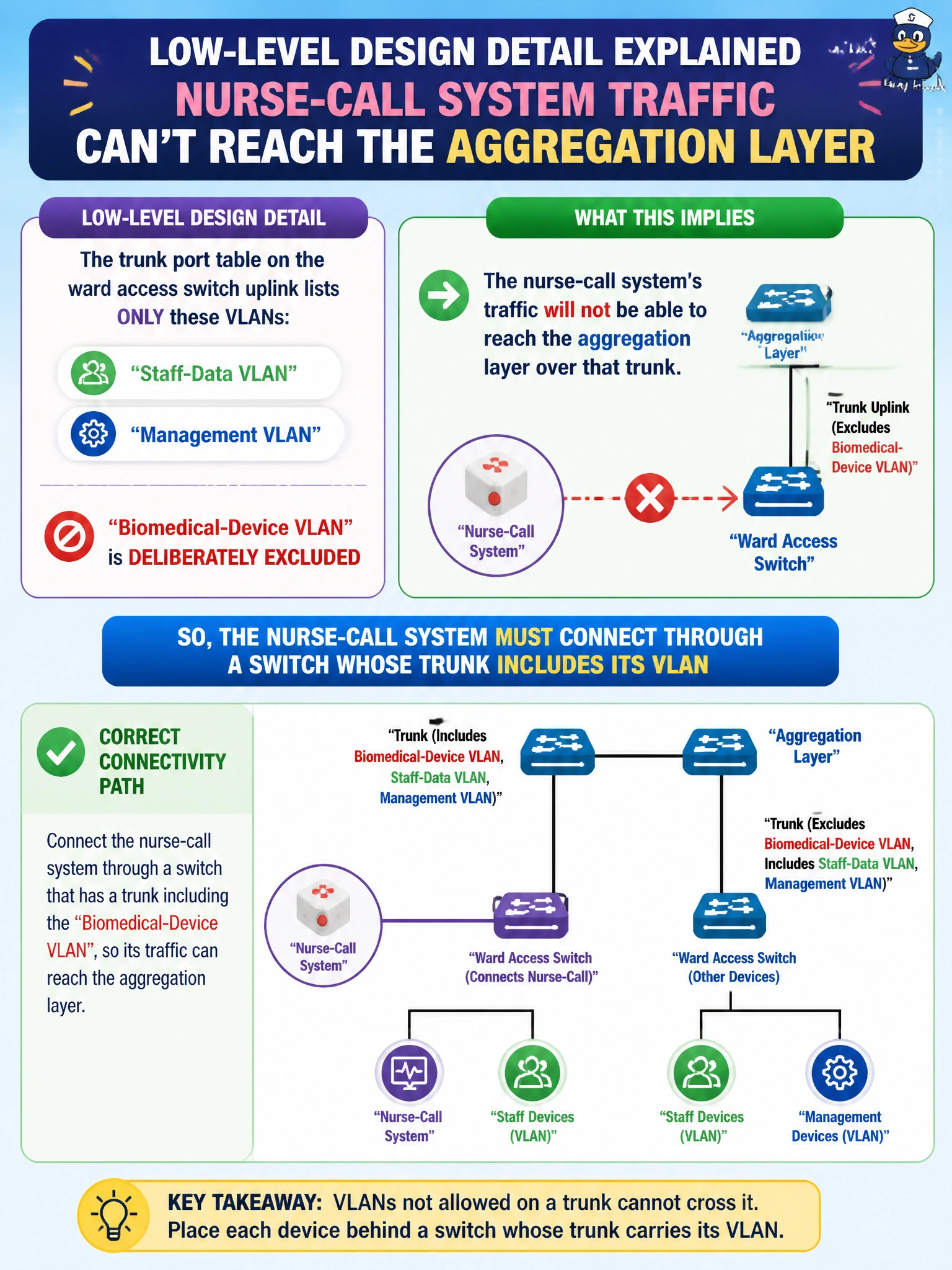
A trunk only carries the VLANs it's told to allow — leave one off the list and it's like locking a door in a hallway that VLAN's traffic needed to walk through. If the biomedical VLAN isn't on that uplink's allowed list, a nurse-call system on it is stuck talking to itself locally with nowhere to go. Reading that gap in the trunk table is exactly how you catch a design mistake before it becomes a dead nurse-call panel on install day.
Full Explanation
A trunk port's allowed-VLAN list is a hard boundary: only tagged traffic for VLANs explicitly permitted on that trunk crosses it, and everything else is dropped at that link regardless of what's configured elsewhere on the switch. If the biomedical-device VLAN is deliberately excluded from a ward access switch's uplink trunk, any device assigned to that VLAN on that switch — including a nurse-call system — has no path for its traffic to reach the aggregation layer, the core, or any centralized nurse-call server sitting elsewhere on the campus. The device would appear locally connected but effectively isolated. Assuming the system defaults to the management VLAN misunderstands VLAN assignment; a device's VLAN comes from its switchport configuration (access VLAN or a tagged assignment), not from whichever VLANs happen to ride the uplink. Claiming no VLAN assignment is needed ignores that every switchport, including one for a nurse-call device, belongs to some VLAN by design. Dismissing the exclusion as having no effect contradicts the fundamental behavior of 802.1Q trunking, where an unlisted VLAN simply doesn't pass. Reading this kind of detail correctly during the planning stage — before any cabling happens — lets the technician flag the inconsistency to the designer and get the trunk table corrected, or route the nurse-call system to an access switch whose uplink trunk does carry that VLAN, rather than discovering a silent outage after go-live.