
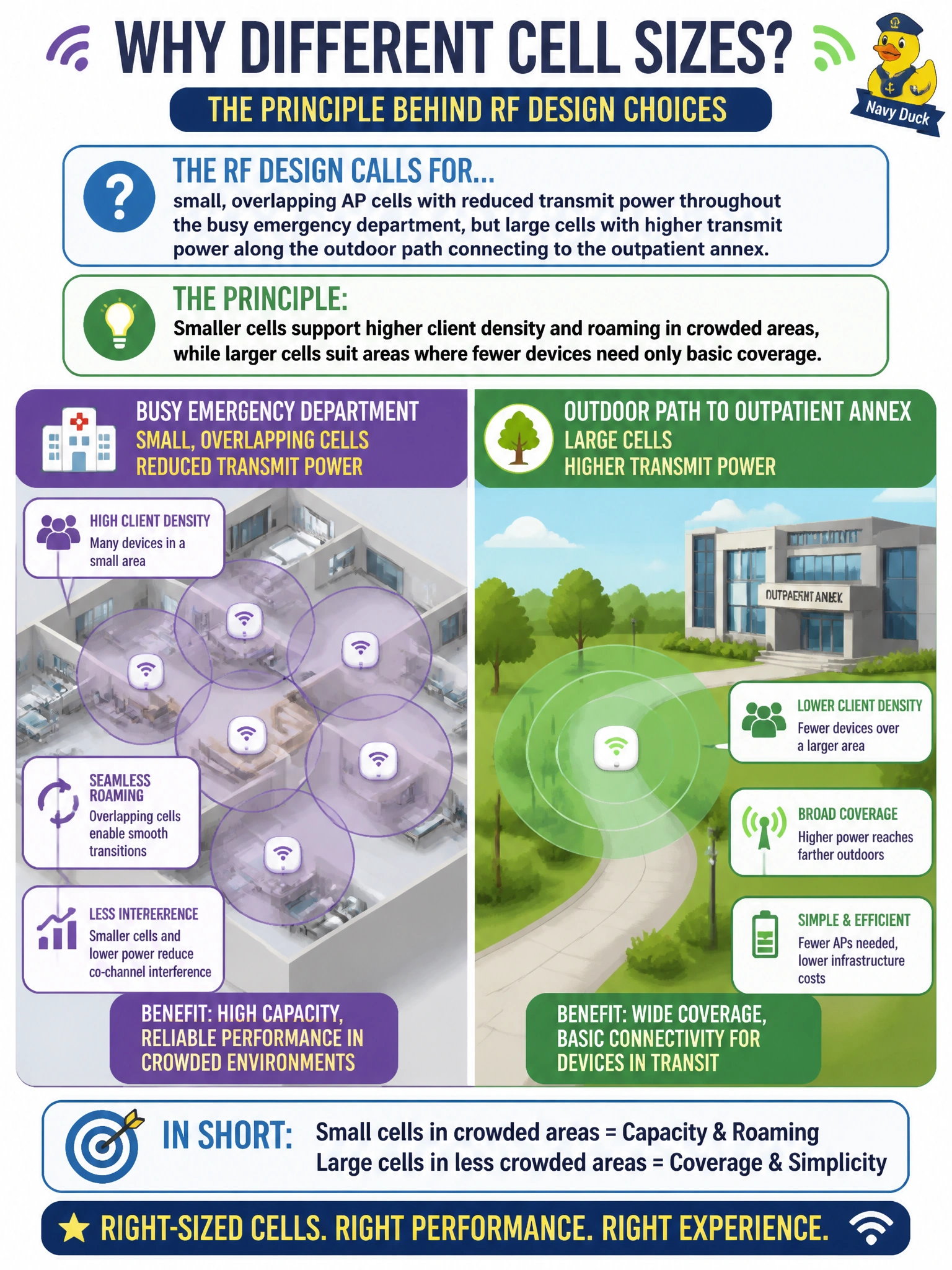
The RF design calls for small, overlapping AP cells with reduced transmit power throughout the busy emergency department, but large cells with higher transmit power along the outdoor path connecting to the outpatient annex. What principle explains this difference in cell sizing?
Select an answer to reveal the explanation.
Short Explanation
A packed emergency department is a lot like a busy subway platform — you want small cells so each one only has to handle a manageable crowd, plus smooth handoffs as people move around. A quiet outdoor path to the annex is the opposite problem: reach the whole stretch efficiently for a trickle of walkers. Cell size follows the crowd, not a fixed rule.
Full Explanation
AP cell sizing is a direct response to expected client density and mobility. In a busy emergency department, many devices — staff badges, monitors, mobile carts, phones — are packed into a small footprint and moving between rooms constantly, so small, overlapping cells at reduced power keep each AP's client load manageable and give roaming clients a nearby cell to hand off to quickly, minimizing dropped connections. Along a quieter outdoor path connecting to the annex, device density is low and mobility is simple point-to-point walking, so a designer can use larger cells at higher power to cover the distance efficiently without needing many APs. The claim that larger cells always deliver faster data rates is incorrect; data rate depends on signal quality (SNR) at the client, and an over-large cell can actually degrade rates at its edges due to weaker signal, not improve them. Saying cell size doesn't affect client capacity ignores a basic RF principle — every AP has a finite amount of airtime to share among its associated clients, so packing more clients into one large cell reduces each client's share, which is the whole reason dense areas shrink cell size instead of leaving it large. The claim that outdoor areas always need smaller cells than indoor clinical areas gets the scenario backwards, since it's client density and mobility patterns driving the decision, not the indoor/outdoor distinction itself. When reading a design, the technician should map cell size choices back to the density and mobility of each specific area rather than assuming one blanket setting fits the whole campus.