
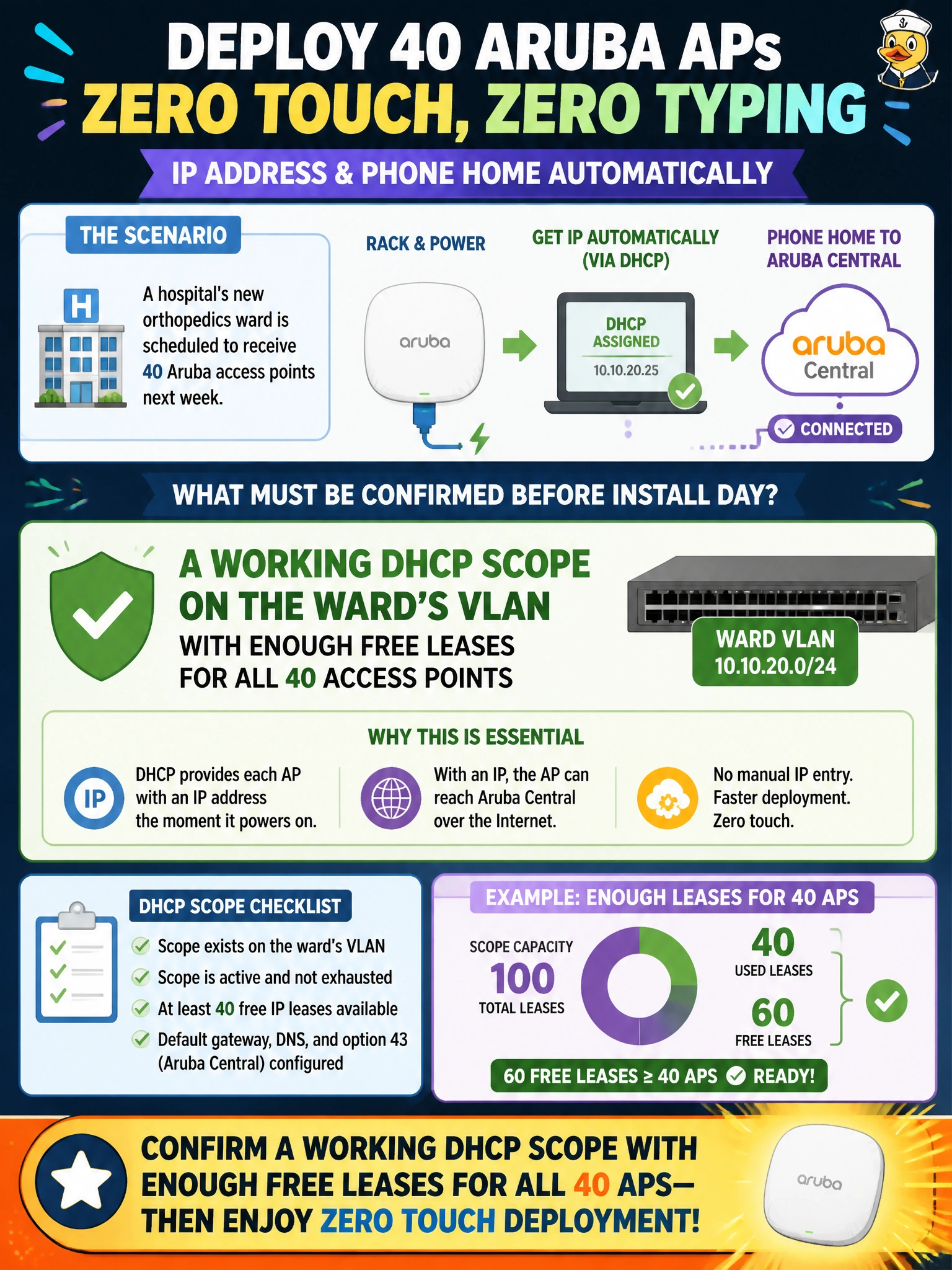
A hospital's new orthopedics ward is scheduled to receive 40 Aruba access points next week, and the deployment technician wants each AP to pull an address and phone home to Aruba Central the moment it is racked and powered, with zero manual IP entry. Which prerequisite absolutely must be confirmed on the ward's network before install day?
Select an answer to reveal the explanation.
Short Explanation
Think about what "plug in and it just works" actually requires: the AP needs an address handed to it automatically, the moment it boots. That means a live, reachable DHCP scope on that VLAN with enough free leases for every AP you're racking. Skip that check and install day turns into 40 techs typing addresses by hand.
Full Explanation
Zero-touch provisioning depends on the AP being able to request and receive an IP address the instant it powers on, so the pre-implementation checklist has to confirm a live DHCP scope is reachable on the VLAN the APs will land on, with a lease pool sized for the full deployment plus headroom for reboots and future growth. A scope that is technically configured but exhausted, or scoped to the wrong VLAN, produces the same symptom as no DHCP at all: an AP that never reaches Central. Hand-typing static addresses defeats the entire point of zero-touch onboarding and does not scale to 40 devices in a ward rollout. A local RADIUS server with pre-loaded MAC addresses addresses authentication of clients or device auth, not the basic act of getting an IP address at boot, so it solves a different problem entirely. A dedicated per-AP VLAN with one host per subnet is unnecessary complexity that Aruba deployments do not require and would multiply the number of scopes to manage for no benefit. Before install day, the technician should verify the scope's current utilization and confirm a test device on that VLAN actually receives a lease.