
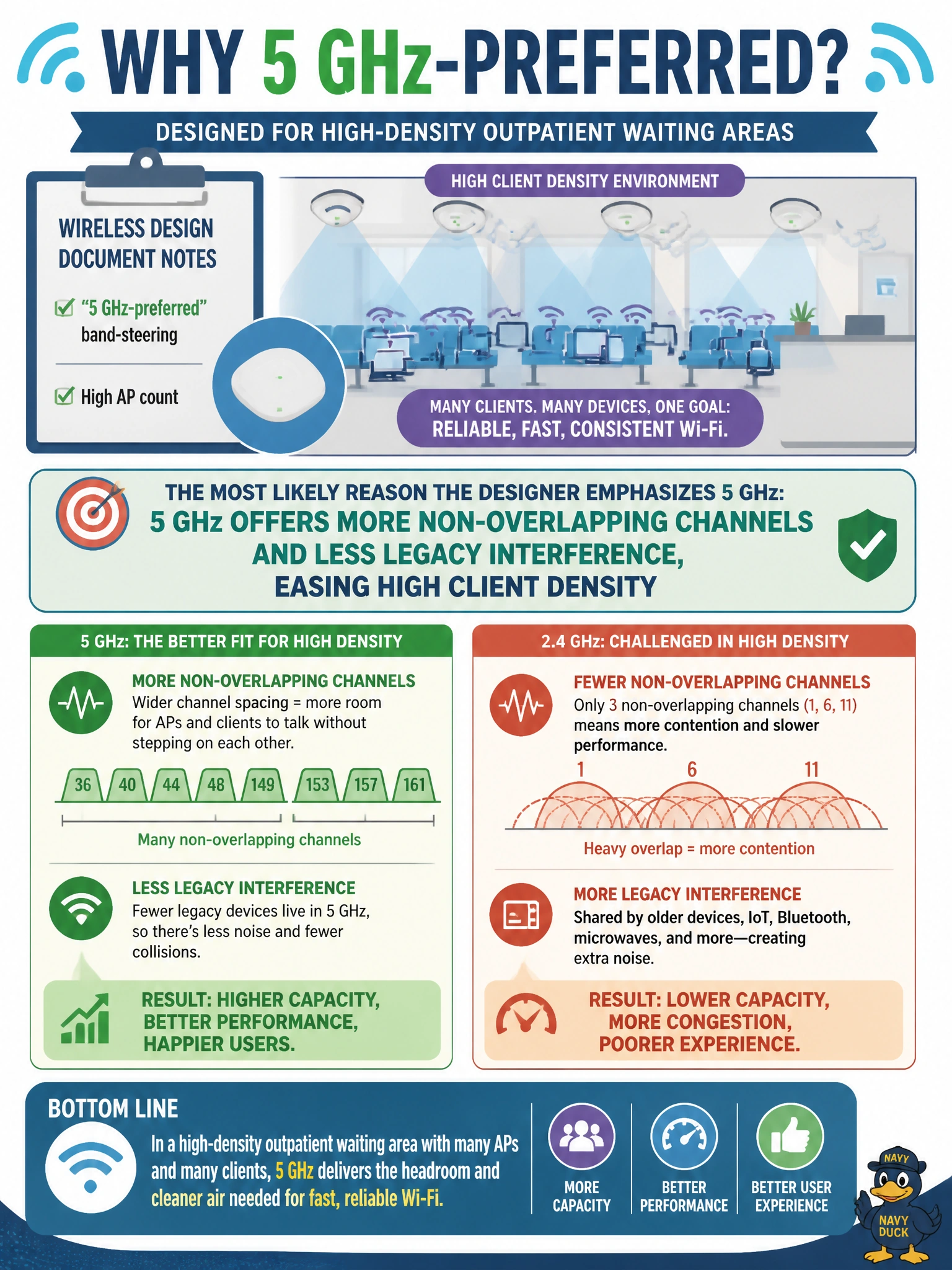
The wireless design document for a high-density outpatient waiting area notes a "5 GHz-preferred" band-steering setting alongside a high AP count. What is the most likely reason the designer emphasizes 5 GHz here?
Select an answer to reveal the explanation.
Short Explanation
A crowded waiting room full of phones is basically rush hour, and 5 GHz is the band with way more open lanes and way less legacy traffic clogging things up. Steering capable clients toward it frees up the 2.4 GHz band for the handful of older devices that still need it. That's the whole reason the design leans on 5 GHz here — more room to spread everyone out.
Full Explanation
Band steering toward 5 GHz in a high-density design takes advantage of two real characteristics of that band: it offers substantially more non-overlapping channels than 2.4 GHz, letting a designer place many nearby APs on distinct channels instead of forcing reuse and contention, and it's less crowded with legacy devices and non-Wi-Fi interference sources that commonly saturate 2.4 GHz. In a waiting area with a high AP count and many concurrent clients, both of those properties directly ease congestion and improve capacity. The range claim is backwards — 5 GHz signals generally attenuate faster than 2.4 GHz over the same distance and through obstacles, so range is not the reason to prefer it; capacity and channel availability are. Guest network isolation is achieved through VLAN and SSID policy, not through which radio band a client associates on, so tying 5 GHz preference to guest isolation misattributes the mechanism. The claim that 2.4 GHz can't support more than one AP per floor is simply false; 2.4 GHz has fewer non-overlapping channels (typically three usable in most regions), which limits density but doesn't cap it at a single AP. A technician reviewing this design should confirm the SSID's band-steering or client-match settings actually reflect this stated preference once configuration begins, since a design note alone doesn't guarantee the behavior is implemented correctly.