
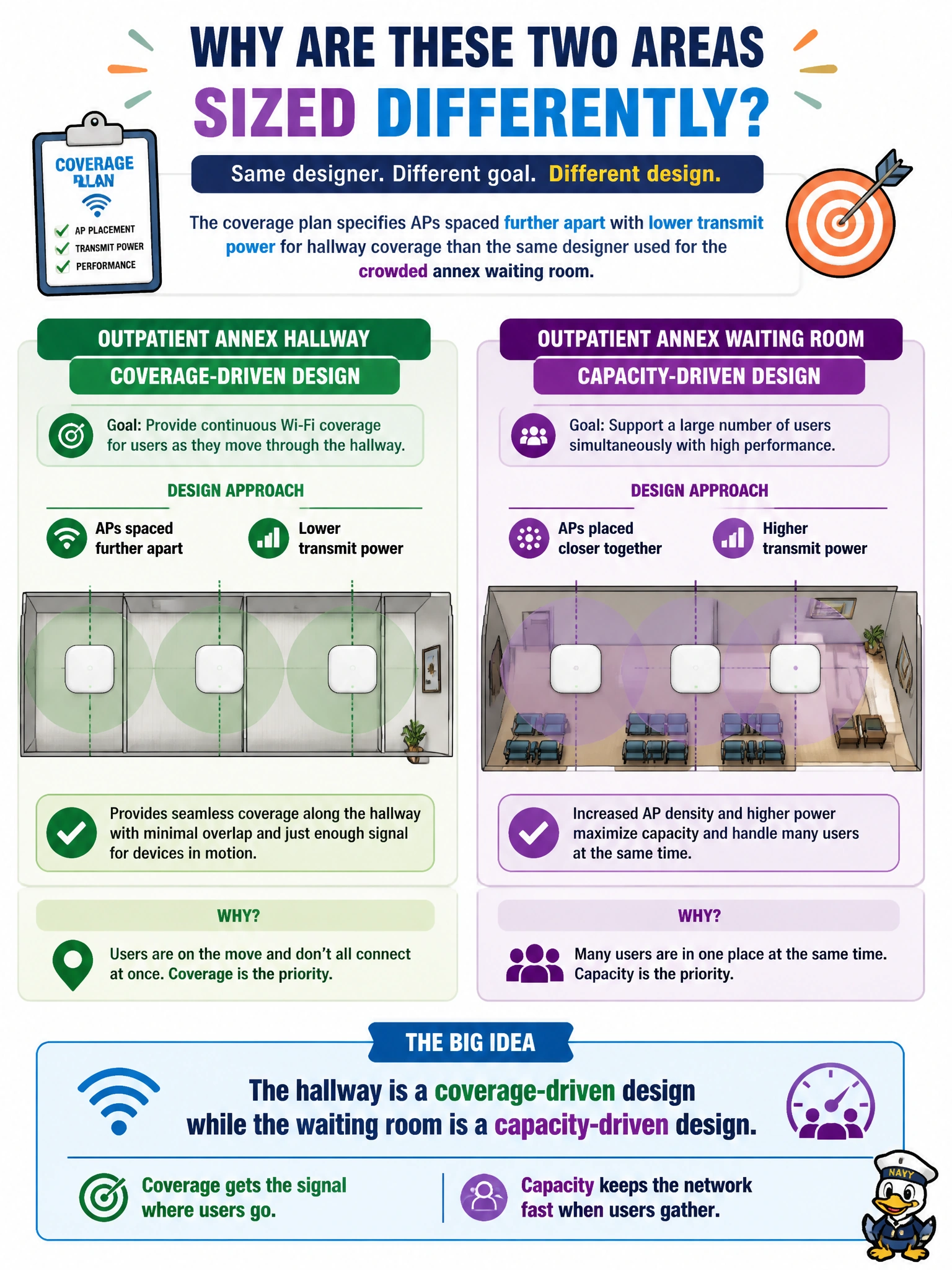
In the outpatient annex, the coverage plan specifies APs spaced further apart with lower transmit power for hallway coverage than the same designer used for the crowded annex waiting room. Why would a designer size these two areas differently?
Select an answer to reveal the explanation.
Short Explanation
There are really two questions an RF designer asks: "can a signal reach everyone here?" and "can this cell handle everyone who shows up?" A quiet hallway with a handful of walkers is a coverage question — spread APs out. A packed waiting room full of phones is a capacity question — pack cells tighter. Same designer, two different problems, two different answers.
Full Explanation
RF designs are shaped by two distinct goals that often pull in opposite directions: coverage design maximizes the area a single AP can serve adequately, using wider spacing and higher power where client density is low, while capacity design shrinks the cell size and often lowers power to support many simultaneous clients in a small footprint without over-subscribing a single radio. A hallway typically has light, transient foot traffic, so the priority is simply reaching every point along its length efficiently — a coverage problem. A crowded waiting room, by contrast, packs many concurrent devices into a small space, so the priority shifts to giving each client enough airtime and throughput, which calls for smaller, more numerous cells even though that means tighter AP spacing. The claim that hallways need higher capacity than waiting rooms inverts the actual client density between the two spaces. Restricting hallways to 2.4 GHz only isn't implied by anything here — band choice is a separate design variable from cell sizing, and nothing in the scenario ties coverage-driven design to a specific band. Capping the waiting room at a single AP would actually undermine the capacity goal, since more clients generally call for more cells, not fewer. When reviewing a design like this, a technician should map RF parameters back to the intended goal for each space — coverage or capacity — since applying one area's settings to the other area's problem produces a poor deployment.