
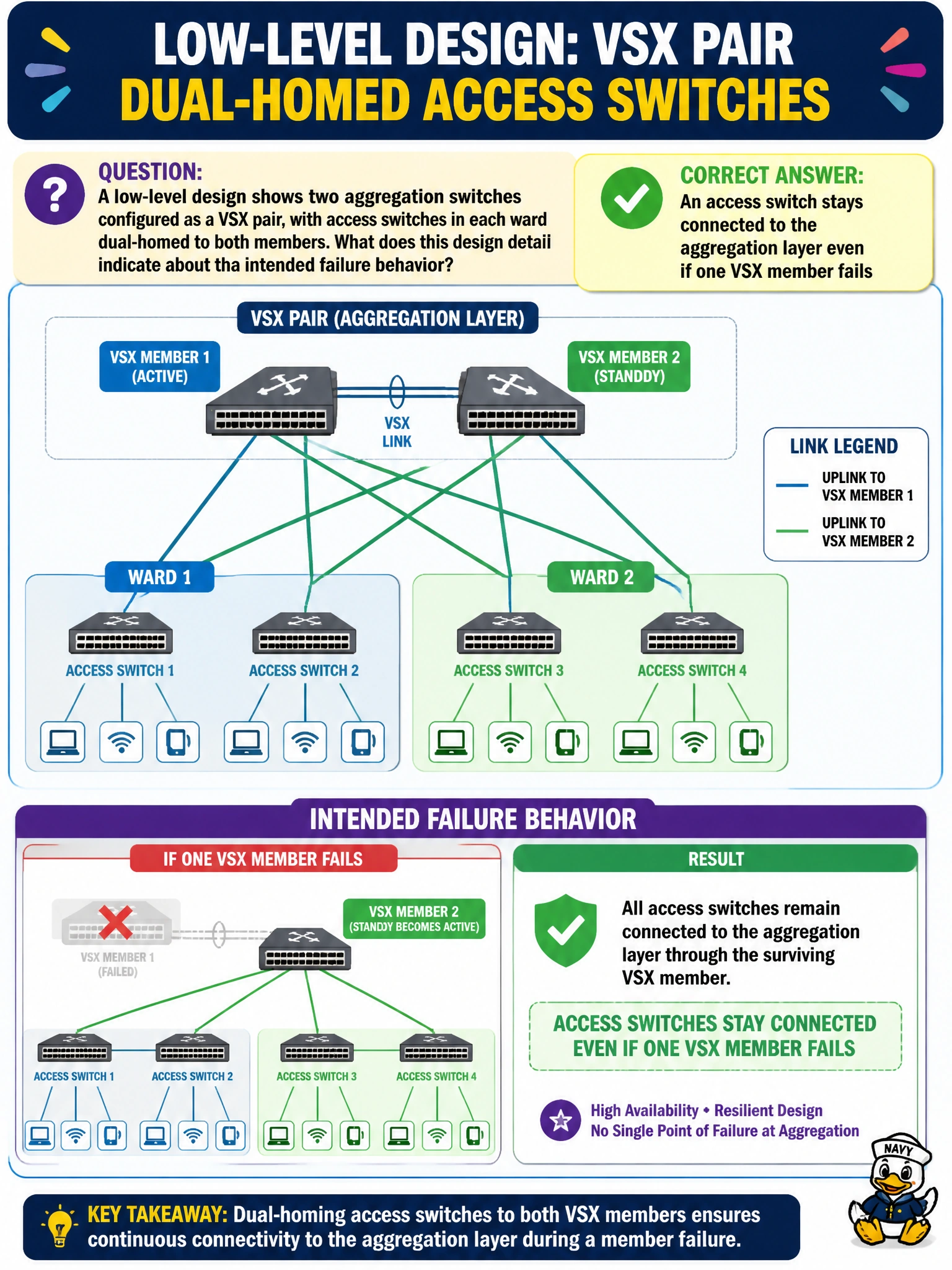
A low-level design shows two aggregation switches configured as a VSX pair, with access switches in each ward dual-homed to both members. What does this design detail indicate about the intended failure behavior?
Select an answer to reveal the explanation.
Short Explanation
A VSX pair is designed so two physical switches act like one logical partner from the access switch's point of view. Dual-homing means each ward switch has a foot in both doors, so losing one door doesn't lock anyone out. The intent behind that diagram is survivability, not a coin-flip on which switch happens to stay up.
Full Explanation
VSX (Virtual Switching Extension) lets two physical AOS-CX switches present themselves as a single logical aggregation point, and when access switches are dual-homed — connected to both VSX members simultaneously — the design intent is that a single switch failure doesn't take down connectivity for the wards relying on it. Traffic continues flowing through the surviving VSX member and its still-active links, which is exactly the resiliency the design is meant to deliver. The idea that traffic stops entirely if either member fails contradicts the whole point of a redundant pair; that outcome would describe a single point of failure, which VSX with dual-homing is specifically built to avoid. Claiming access switches need manual reconfiguration after a failure misreads the design intent as well — the value of this topology is that failover happens without operator intervention, at least at the link layer. Limiting VSX to wireless controller redundancy is also incorrect; VSX is a wired switching feature for pairing aggregation or core switches, unrelated to how wireless controllers achieve redundancy. When reading this kind of design, a technician should confirm that each access switch's two uplinks genuinely terminate on separate VSX members rather than two ports on the same physical device, since that single detail is what actually delivers the resiliency the diagram implies.