
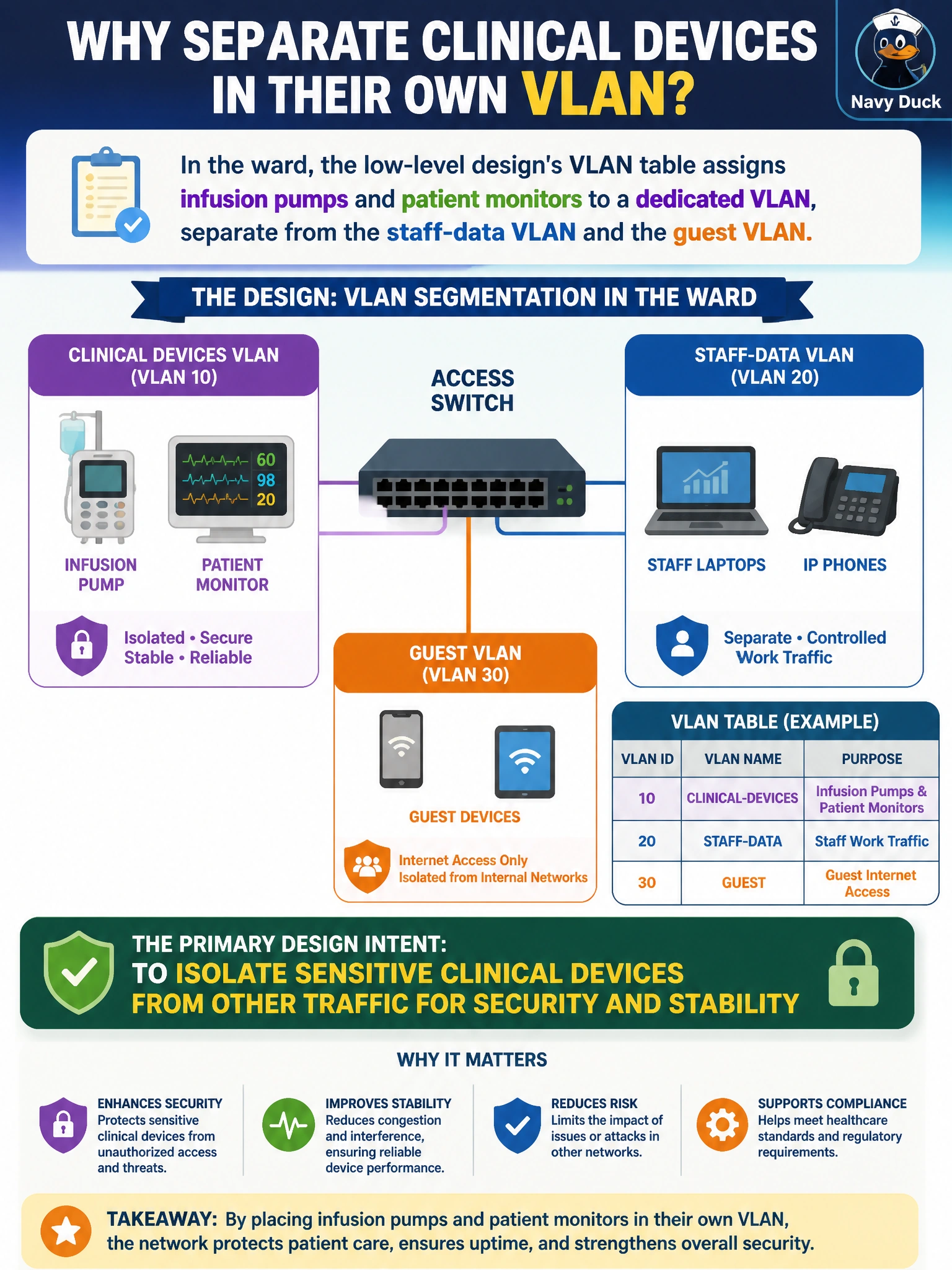
The low-level design's VLAN table assigns infusion pumps and patient monitors in a ward to a dedicated VLAN, separate from the staff-data VLAN and the guest VLAN. What is the primary design intent behind this separation?
Select an answer to reveal the explanation.
Short Explanation
Infusion pumps and monitors aren't just another device on the network — they're life-safety equipment, and design documents treat them that way. Putting them on their own VLAN is like giving them a separate hallway so a guest laptop browsing the internet next door never bumps into them. That separation is about security and stability, not convenience.
Full Explanation
Segmenting biomedical devices onto a dedicated VLAN is a foundational security and reliability practice: it contains broadcast traffic, limits the blast radius of a compromised or misbehaving device on another VLAN, and lets the network team apply tighter access controls and monitoring specifically to clinical equipment. This matters most in a hospital, where a pump or monitor malfunctioning due to network congestion or exposure to a guest-network threat carries direct patient-safety consequences. DHCP lease timing is a per-scope configuration detail, not the reason for VLAN separation — a technician could shorten or lengthen leases on any VLAN regardless of segmentation. Bypassing the firewall is the opposite of good design intent; a dedicated VLAN typically gets more firewall scrutiny between it and other segments, not less, since the goal is controlled access, not an open bypass. Reducing overall IP address consumption is a minor and incidental side effect at best — segmentation typically adds a subnet rather than removing addressing overhead. When reading a design like this, a technician should note which VLAN the biomedical devices land on and check that the corresponding access switch ports and any inter-VLAN firewall rules are documented consistently with that intent, since inconsistency here is a common implementation error worth catching before rollout.