
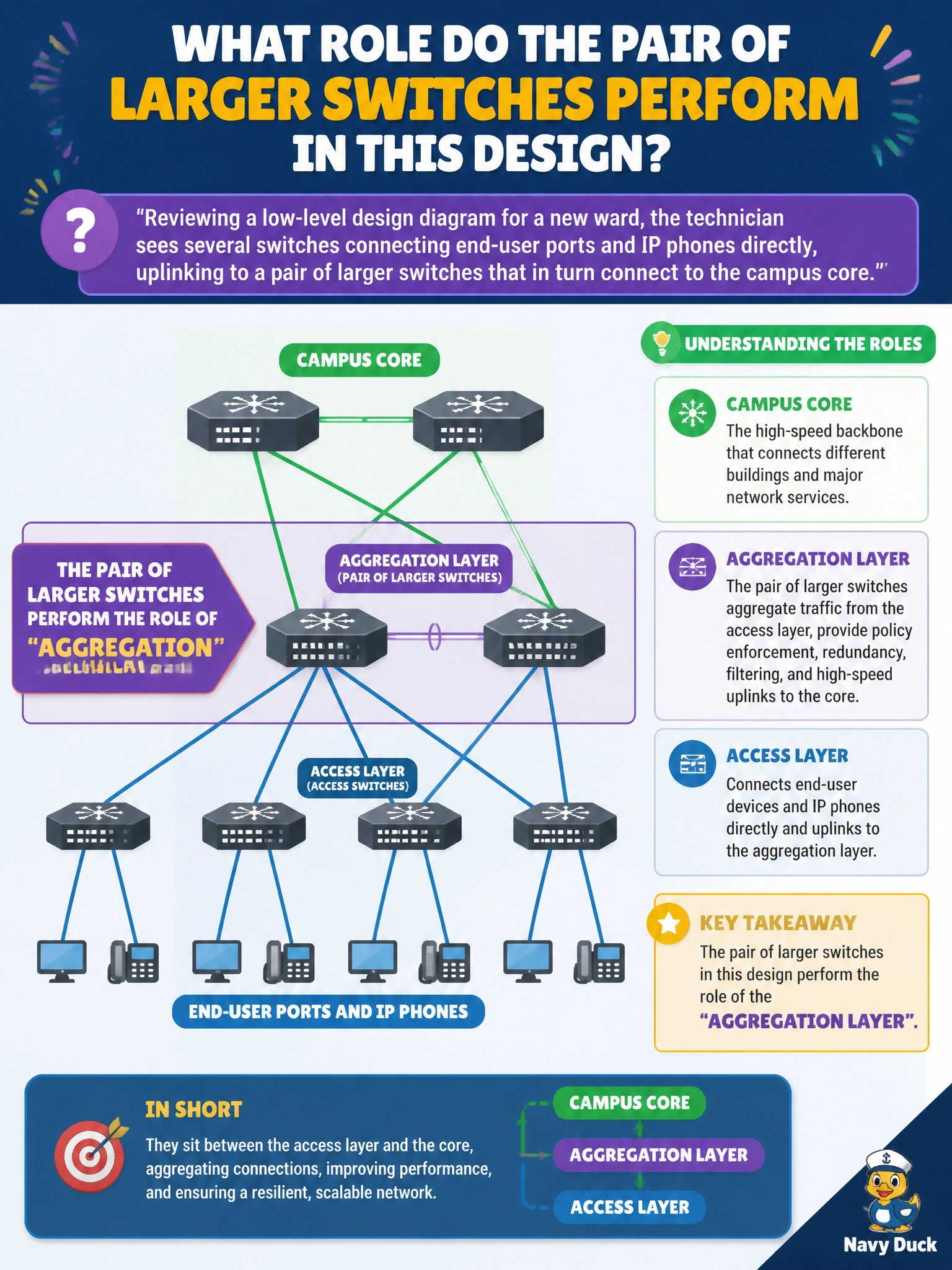
Reviewing a low-level design diagram for a new ward, the technician sees several switches connecting end-user ports and IP phones directly, uplinking to a pair of larger switches that in turn connect to the campus core. What role do the pair of larger switches perform in this design?
Select an answer to reveal the explanation.
Short Explanation
Think of the campus like a hospital's own hallway system: patient rooms feed into ward corridors, and ward corridors feed into the main hospital hallway. The switches plugged straight into phones and PCs are the ward corridors — that's the access layer — and the pair collecting all of them before handing off to the core is the aggregation layer. It sits in the middle, gathering traffic before it reaches the campus backbone.
Full Explanation
A three-tier campus design separates access, aggregation, and core roles by what each layer connects to. The access layer is defined by direct connections to end devices — here, the switches terminating IP phones and user ports fill that role. The aggregation layer sits above access, collecting uplinks from multiple access switches and providing a consolidation point before traffic reaches the core; that description matches the pair of larger switches in this diagram exactly, since they receive uplinks from several access switches and forward toward the core. The core layer is the wrong answer because core switches interconnect aggregation blocks and other core devices at high speed, and typically don't terminate access-switch uplinks directly in a design of this size; the diagram already shows a separate core beyond this pair. WAN edge is unrelated to internal campus tiering altogether — it describes the boundary connecting the campus to external circuits like an ISP or a point-to-point link to another site, not an internal aggregation point. Recognizing this pattern matters because each tier typically carries different responsibilities in a design, such as where VLAN trunking, routing boundaries, or redundancy (like a VSX pair) are expected to appear. A technician reading a diagram like this should check the aggregation switches for redundant links to both the access layer below and the core above, since that pair is the natural place for that dual-homing to be documented.