
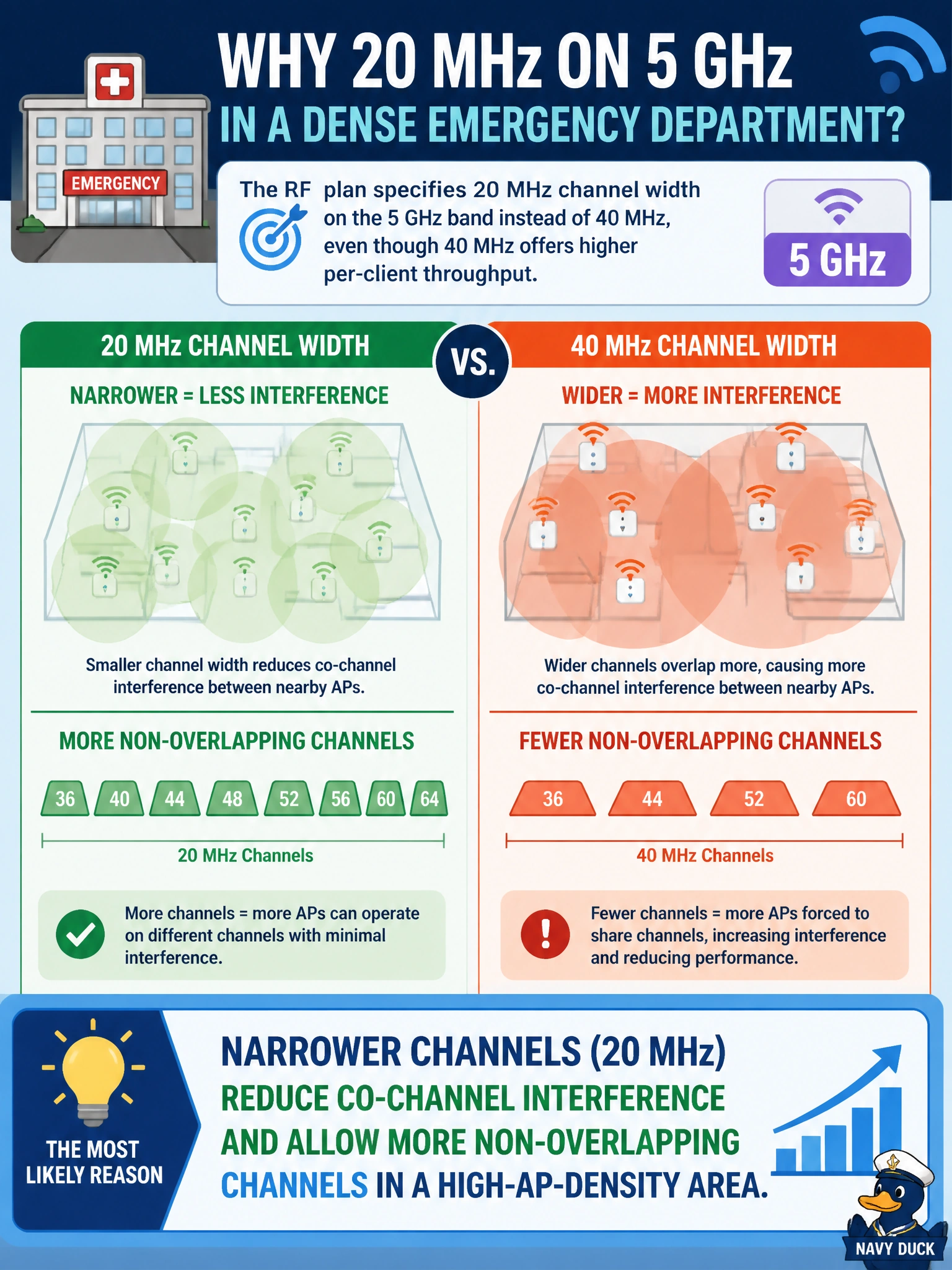
The RF plan for a densely populated emergency department specifies 20 MHz channel width on the 5 GHz band instead of 40 MHz, even though 40 MHz would offer higher per-client throughput. What is the most likely reason the designer chose this?
Select an answer to reveal the explanation.
Short Explanation
Picture the 5 GHz band as a highway with only so many lanes — bond two lanes into a wider one and you move faster, but you have fewer lanes left for other cars nearby. In a packed emergency department with lots of APs close together, more lanes (channels) beats wider ones. That's why the designer traded top speed for room to breathe.
Full Explanation
Channel width and channel count trade off against each other: a wider channel like 40 MHz combines two 20 MHz channels to raise a single client's throughput ceiling, but it cuts the number of distinct, non-overlapping channels available across the band. In a high-density AP deployment like an emergency department, that reduction forces nearby APs to reuse the same channels more often, increasing co-channel interference and hurting overall capacity even though any one link could theoretically go faster. Choosing 20 MHz instead preserves more non-overlapping channels, letting the designer keep adjacent APs on different channels and reduce contention — the right trade for a capacity-constrained, high-density space. The 2.4 GHz legacy-client explanation doesn't hold because this design decision is about the 5 GHz band specifically, and legacy 2.4 GHz clients don't dictate 5 GHz channel width. Transmit power and channel width are independent RF parameters; narrowing a channel doesn't raise the power ceiling the radio can transmit at. And ruling out 40 MHz support entirely is factually wrong — Aruba APs support wider channels, they're just often a poor fit for dense environments. A technician validating this in the field would check the channel plan against the AP density map and confirm minimal channel reuse between adjacent APs before deployment.