
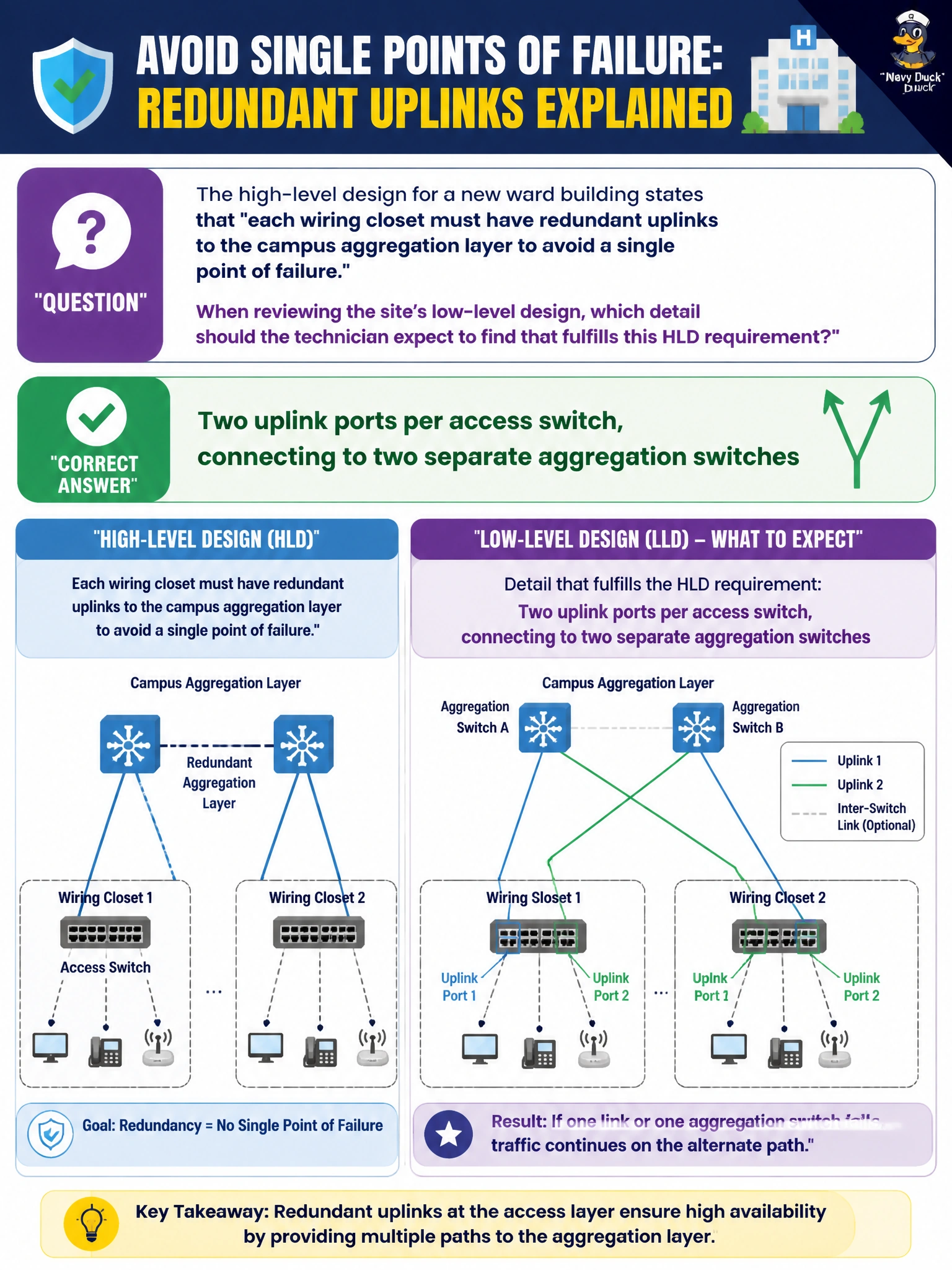
The high-level design for a new ward building states that "each wiring closet must have redundant uplinks to the campus aggregation layer to avoid a single point of failure." When reviewing the site's low-level design, which detail should the technician expect to find that fulfills this HLD requirement?
Select an answer to reveal the explanation.
Short Explanation
An HLD statement like "no single point of failure" is a promise, and the LLD is where that promise gets cashed in as actual ports and cables. If one access switch has only one path up, that promise is broken, no matter how good the paperwork sounds. Two uplinks to two different aggregation switches is what redundancy actually looks like on a diagram.
Full Explanation
Reading a design means connecting intent to implementation: an HLD requirement for redundancy has to show up in the LLD as a concrete, verifiable detail, not just restated language. Two uplink ports per access switch, each terminating on a separate aggregation switch, is exactly that — it removes the single cable or single device that could take the closet offline. A single 10G uplink fails the requirement outright, regardless of its speed, because bandwidth is not the same thing as redundancy; one link means one failure domain. A note deferring redundancy to a later phase is a documented gap, not a fulfillment of the HLD, and a technician who spots this should flag it rather than assume it satisfies the design intent. Restricting the trunk to only the management VLAN addresses which traffic crosses the link, not how many physical paths exist, so it doesn't speak to redundancy at all. In practice, a technician verifying this on-site would trace both uplink cables from the access switch and confirm they land on two distinct aggregation-layer chassis, not two ports on the same device — a common shortcut that looks redundant on a diagram but isn't in reality. This kind of gap-check between HLD promises and LLD detail is a core part of reading someone else's design correctly.