
A program manager builds an automation that labels stale onboarding issues, posts guidance comments, and must avoid deleting code or exposing private customer data across five repositories. Which tool setup should the manager use to select and configure tools within automations?
Select an answer to reveal the explanation.
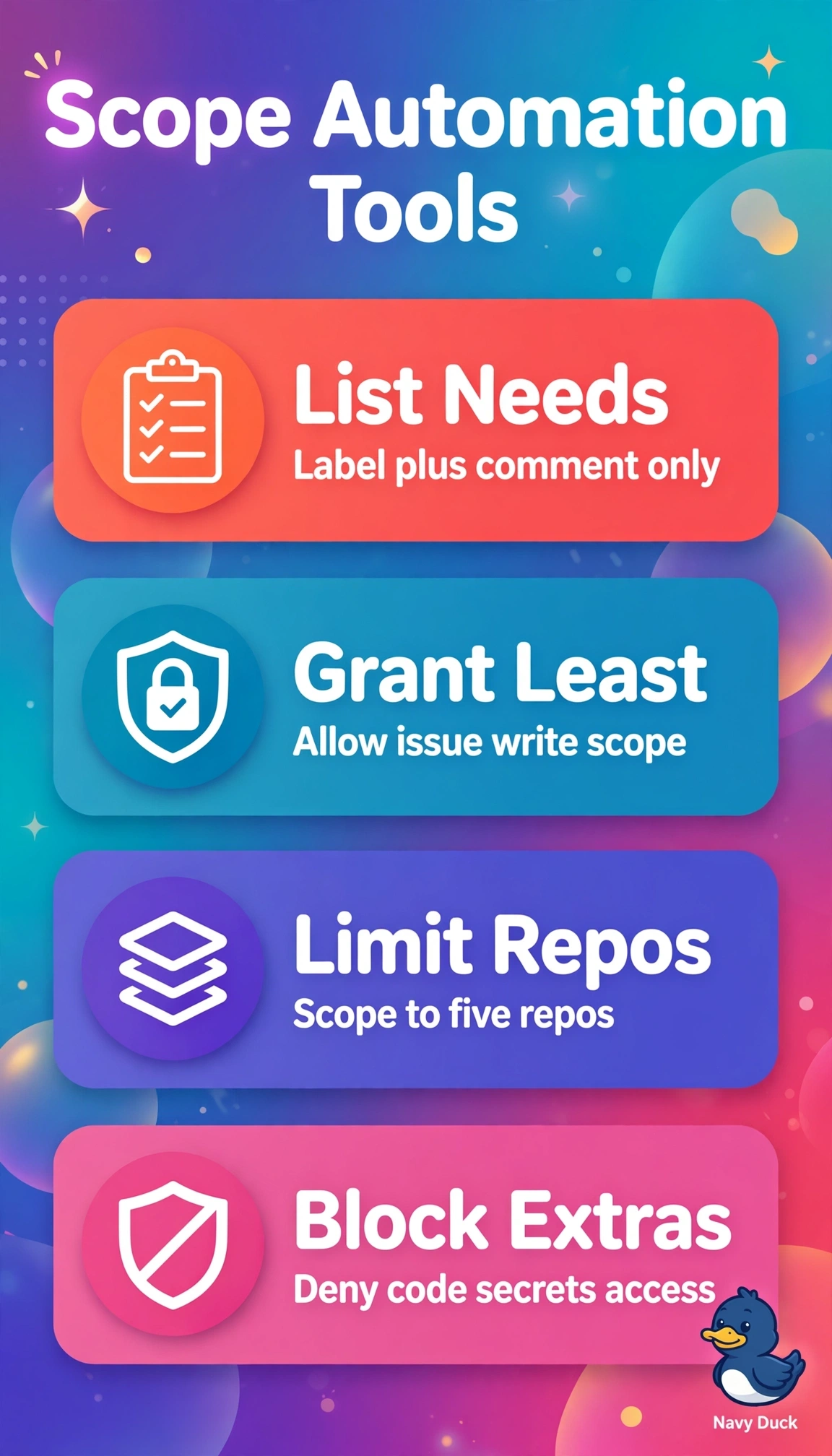
Short Explanation
You give the helper just enough keys to do its job. That least-privilege kit is your seatbelt against leaks and accidents.
Full Explanation
The correct setup follows least-privilege tool selection by granting only the capabilities required for the stated tasks across exactly the required scope, pairing issue read-write including labeling with comment posting and restricting access to the five onboarding repositories so stale issues can be labeled, guidance can be posted, and code deletion or customer data exposure outside scope is prevented. The triage-focused setup fails on functional coverage because duplicate detection and general triage cannot apply persistent stale labels, so even with correct scoping and commenting it leaves the primary labeling task unfulfilled despite being valuable for backlog hygiene. The centralized hub setup fails on scope coverage because limiting labeling and commenting to a single template or hub repository streamlines governance but leaves the other four repositories unautomated, violating the explicit five-repository requirement. The organization-wide search setup fails on security containment because broad search across all repositories to enrich context breaks scoped access and risks surfacing private customer data, violating the explicit non-exposure constraint even though broad context is useful for support. As an exam caveat, distinguish useful-in-general from correct-for-this-scenario by mapping every verb and scope phrase in the stem to a tool permission and rejecting any setup that adds risky permissions or drops a required action. As a practical check, dry-run the automation with audit logging on a test set across the five repositories to confirm stale labels apply, comments post, and no code modifications or cross-repository data reads occur.