
A program manager automates weekly status digests from 200 linked issues, needs concise risks and owners, must limit cost and keep tone consistent for executives across a 12-week program. Which setup should the manager use to configure prompts and models for an automation?
Select an answer to reveal the explanation.
Short Explanation
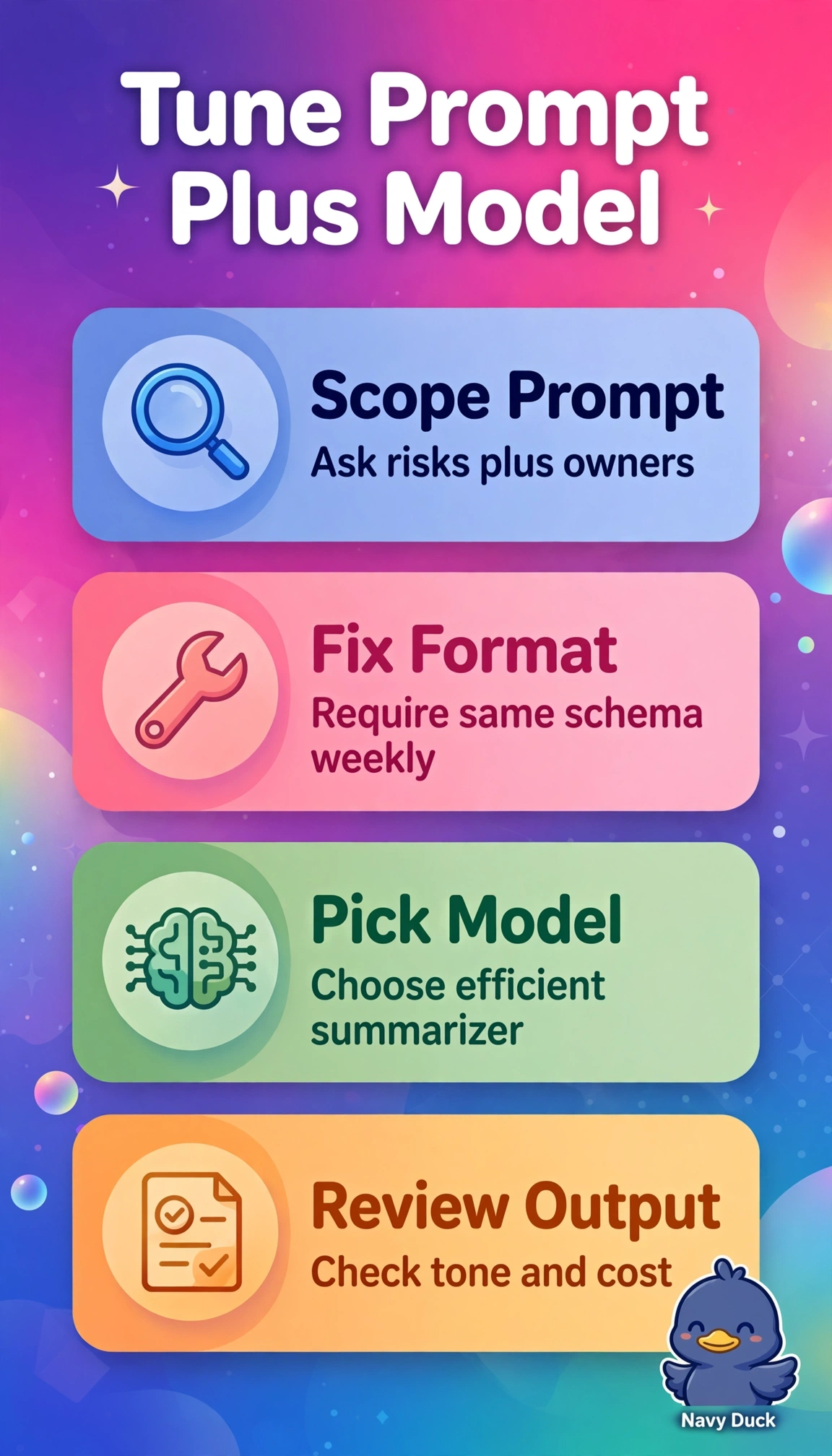
You get steady executive updates by pairing tight directions with the right engine. That combo is your recipe for cheap, consistent digests.
Full Explanation
The correct setup succeeds because weekly digests from 200 linked issues require large-context aggregation filtered to risks and owners, a focused summarization prompt with an explicit output schema enforces brevity and extractable fields, an executive tone instruction maintains consistency over 12 weeks, and a cost-efficient summarization-tuned model controls spend across repeated runs without sacrificing quality for this well-scoped task. The premium reasoning model alternative fails on cost efficiency because overprovisioning the most capable model for routine summarization greatly increases token and latency cost across 12 weekly runs while adding little value for concise extraction. The verbose technical changelog alternative fails on audience fit because tuning for detailed engineering output preserves cost and structure but produces lengthy jargon-heavy digests that violate concise executive-ready tone and obscure risks and owners. The free-form narrative alternative fails on schema control because fluent paragraphs without structured fields make risks and owners inconsistent and hard to parse, audit, and compare week over week despite good tone and cost. Exam caveat: distinguish model capability from task fit and prioritize stated constraints like cost, audience, and output structure over general power when selecting prompts and models. Practical check: pilot the prompt on two weeks of linked issues, verify risks, owners, tone, length, and cost per run, and lock the schema and model version for the program duration.