
A logistics company pilots an agent that drafts customs forms: baseline handling is 12 minutes with 8% errors, the pilot shows 4 minutes with 2% errors across 400 shipments, plus setup and review costs. Which impact assessment best quantifies business value for a go or no-go decision on this automation?
Select an answer to reveal the explanation.
Short Explanation
Excitement fades, but minutes and mistakes hit the ledger every week. Your baseline comparison turns pilot numbers into dollars and risk avoided, which is what leaders fund.
Full Explanation
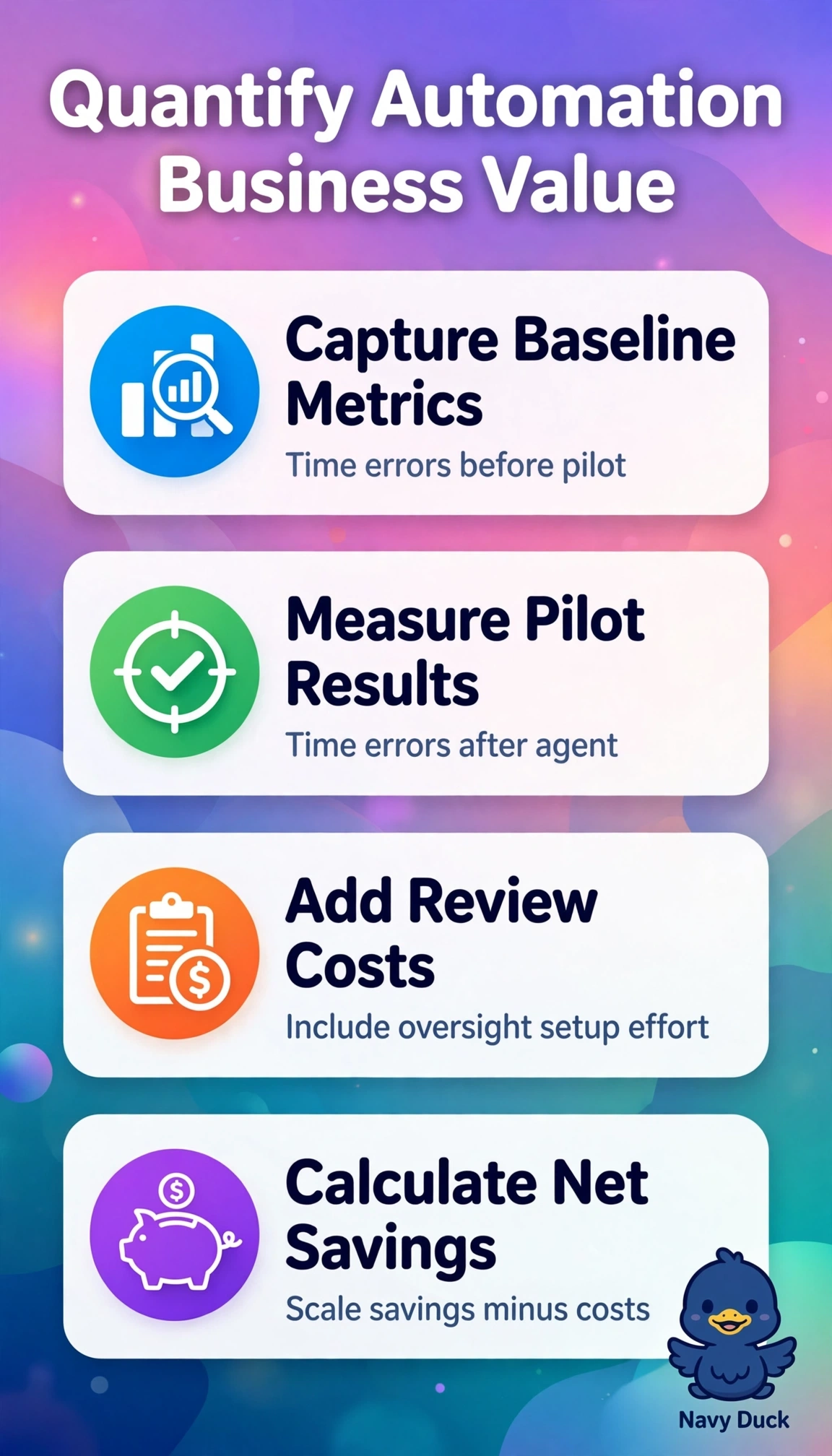
The go or no-go decision requires incremental net business value, which means anchoring pilot results to the stated baseline and converting operational deltas into money and risk. The correct approach does this by contrasting 4 minutes versus 12 minutes, 2% versus 8% errors, and added human review effort across 400 shipments, then subtracting setup and review costs to yield net savings plus quantified risk reduction for customs delays, penalties, and rework. One plausible but incomplete analysis calculates gross time saved from the throughput gain while omitting setup and ongoing review costs, which violates the net-savings principle and inflates ROI by treating freed minutes as free. Another sound efficiency analysis captures cycle time and review cost against baseline to show net savings yet assigns no value to the error-rate improvement, which misses the core quality-cost concept that fewer defects reduce downstream cost, delay, and regulatory exposure. A third common forecasting analysis extrapolates pilot speed and quality to annual capacity without anchoring to baseline performance, which fails the incrementality concept because absolute pilot metrics alone cannot prove what the automation changed. Exam caveat: beware attractive calculations that satisfy most of the stem but drop costs, quality, or baseline comparison, as scale-up questions test net incremental value, not pilot activity alone. Practical check: validate with finance by pricing review minutes at fully loaded labor, amortizing one-time setup over expected volume, and applying an error-cost rate to the six-point reduction before approving scale-up.