
A technical project manager wants an agent to turn new customer feedback discussions in GitHub into prioritized backlog items each sprint. Engineers complain the current request is too vague to build reliably. Which decomposition of the use case into processes and tasks will make the agentic workflow buildable?
Select an answer to reveal the explanation.
Short Explanation
You turn a foggy mountain into climbable switchbacks with clear handoffs. Small sequenced steps with defined inputs let agents act reliably. Vague mega-tasks just invite wandering.
Full Explanation
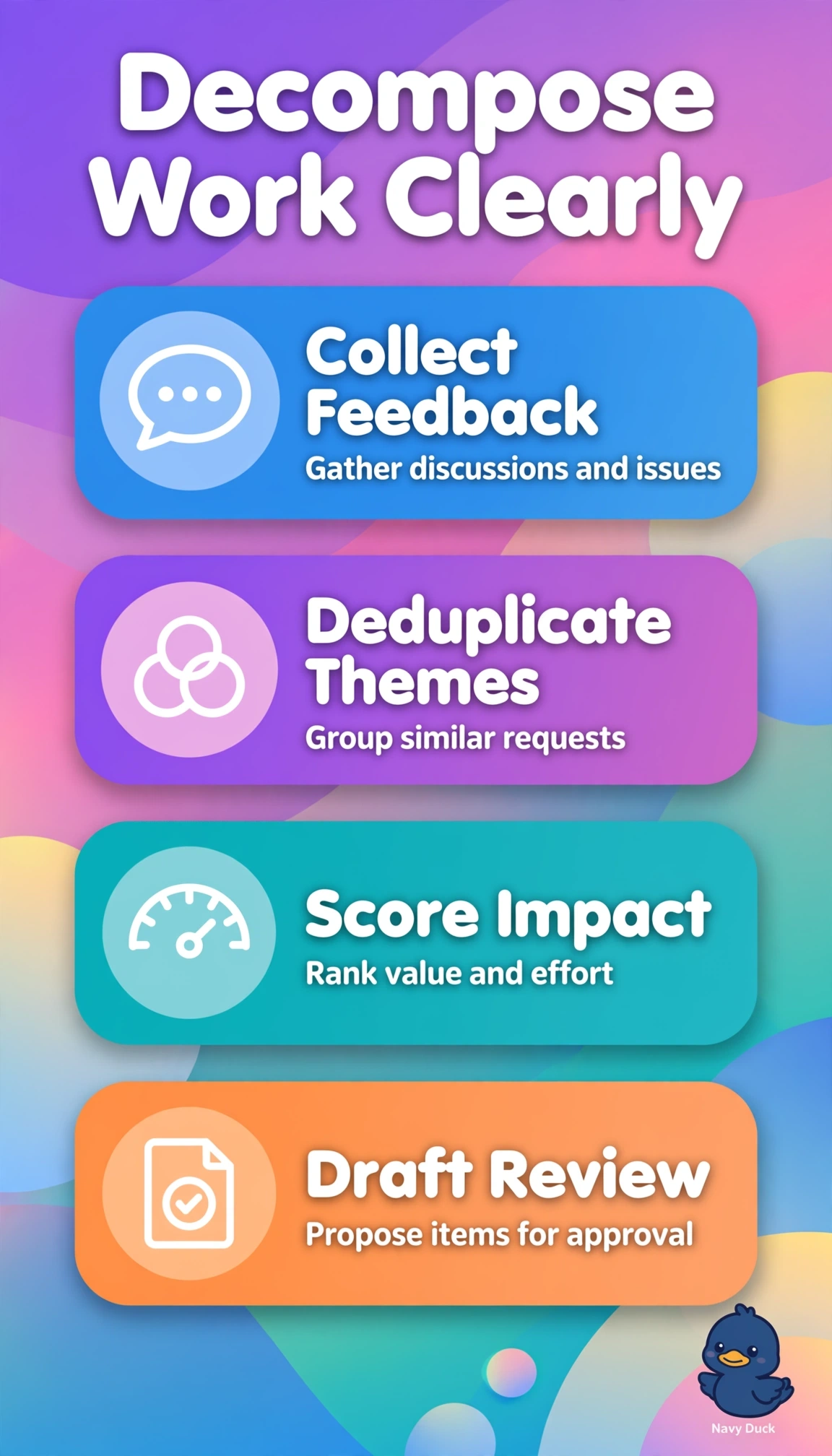
The correct decomposition works because it converts a vague goal into verifiable, automatable processes with clear inputs and outputs: ingesting new GitHub discussions each sprint establishes source and cadence, deduplicating themes reduces noise into testable clusters, scoring impact provides an explicit prioritization rule engineers can implement and evaluate, and drafting backlog items for review creates a bounded human-in-the-loop deliverable rather than autonomous planning. The variant that drafts items without scoring impact fails on prioritization logic, since it produces a backlog in name only and leaves ranking implicit, which reintroduces the vagueness engineers flagged and makes evaluation unreliable. The variant that replaces drafting with documentation updates fails on task completion, because summaries and docs are useful artifacts but do not satisfy the required transformation into actionable, prioritized backlog items ready for sprint planning. The variant that performs the full pipeline only once at kickoff fails on recurrence and freshness, since customer feedback is continuous and a one-time batch quickly becomes stale and violates the each-sprint requirement. As an exam caveat, do not select a choice merely because it mentions plausible agent steps like clustering or scoring; every stated constraint of source, cadence, prioritization, and reviewable output must be satisfied together. As a practical check, require each process to name its trigger, input schema, success metric, and owner, then trace one GitHub discussion through deduplication, score, and draft item before building the sprint automation.