
A support operations manager uses an agentic workflow to summarize 500 tickets weekly, flagging churn risk and required follow-ups. Two summaries misquoted refund amounts and missed SLA breaches. Which review practice best validates agentic workflow outputs before stakeholders act?
Select an answer to reveal the explanation.
Short Explanation
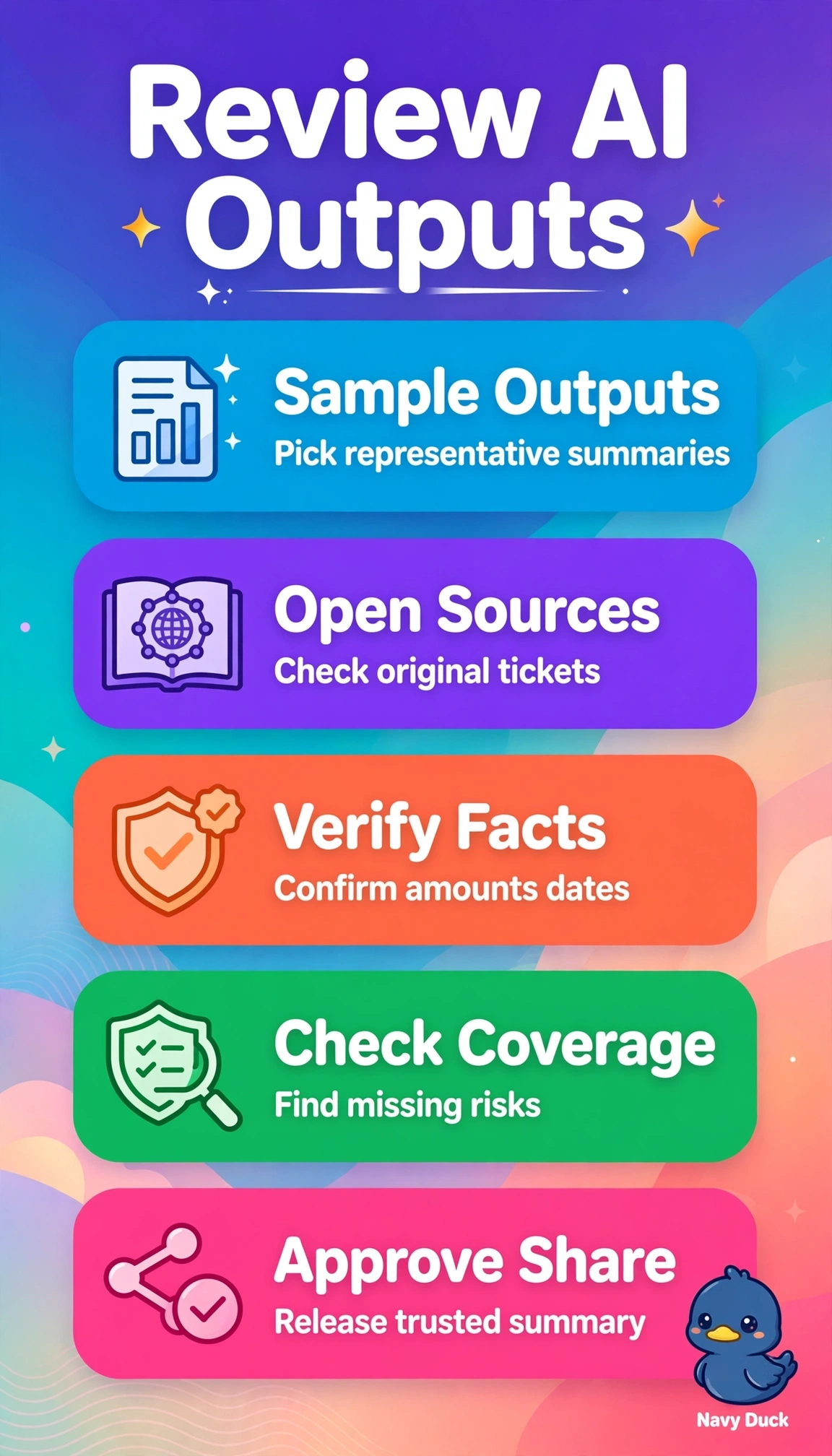
Smooth writing can still hide wrong numbers. Your source sampling is like spot-checking receipts so only accurate summaries reach stakeholders.
Full Explanation
The correct practice is right because with 500 tickets weekly and observed errors in quoted refund amounts and undetected SLA breaches, stakeholders cannot act until a sample is traced back to source tickets for factual accuracy, full coverage of required follow-ups and churn signals, and explicit grounding of each claim, all completed before distribution to prevent faulty decisions on refunds and escalations. Auditing weekly summaries for consistent churn-risk scoring and follow-up assignment is a legitimate prioritization routine but fails by concept of grounding because internal consistency can look clean while still misquoting amounts or omitting breaches that only source comparison would reveal. Verifying sampled refund totals against billing records is a sound financial control but fails by concept of completeness because correct money figures do not prove that SLA breaches, churn risk, or required follow-ups were fully captured for stakeholder action. Checking summaries against service logs to confirm SLA capture is a sound reliability check but fails by concept of accuracy because confirming breach coverage does not validate refund figures or churn interpretation. An exam caveat is to distinguish partial validations that improve one quality dimension from the best validation that jointly satisfies accuracy, completeness, and grounding against the original source before use. A practical check is to maintain a small weekly audit sheet that records ticket ID, claimed refund versus source value, claimed SLA status versus source timeline, and follow-up match, then hold distribution until discrepancies are corrected and patterns trigger workflow tuning.