
A business analyst asks Copilot to compare vendor proposals stored in an issue thread, but gets long paragraphs that are hard to compare. The team needs a tight side-by-side view. Which prompting technique best specifies the structure of the response for reliable comparison?
Select an answer to reveal the explanation.
Short Explanation
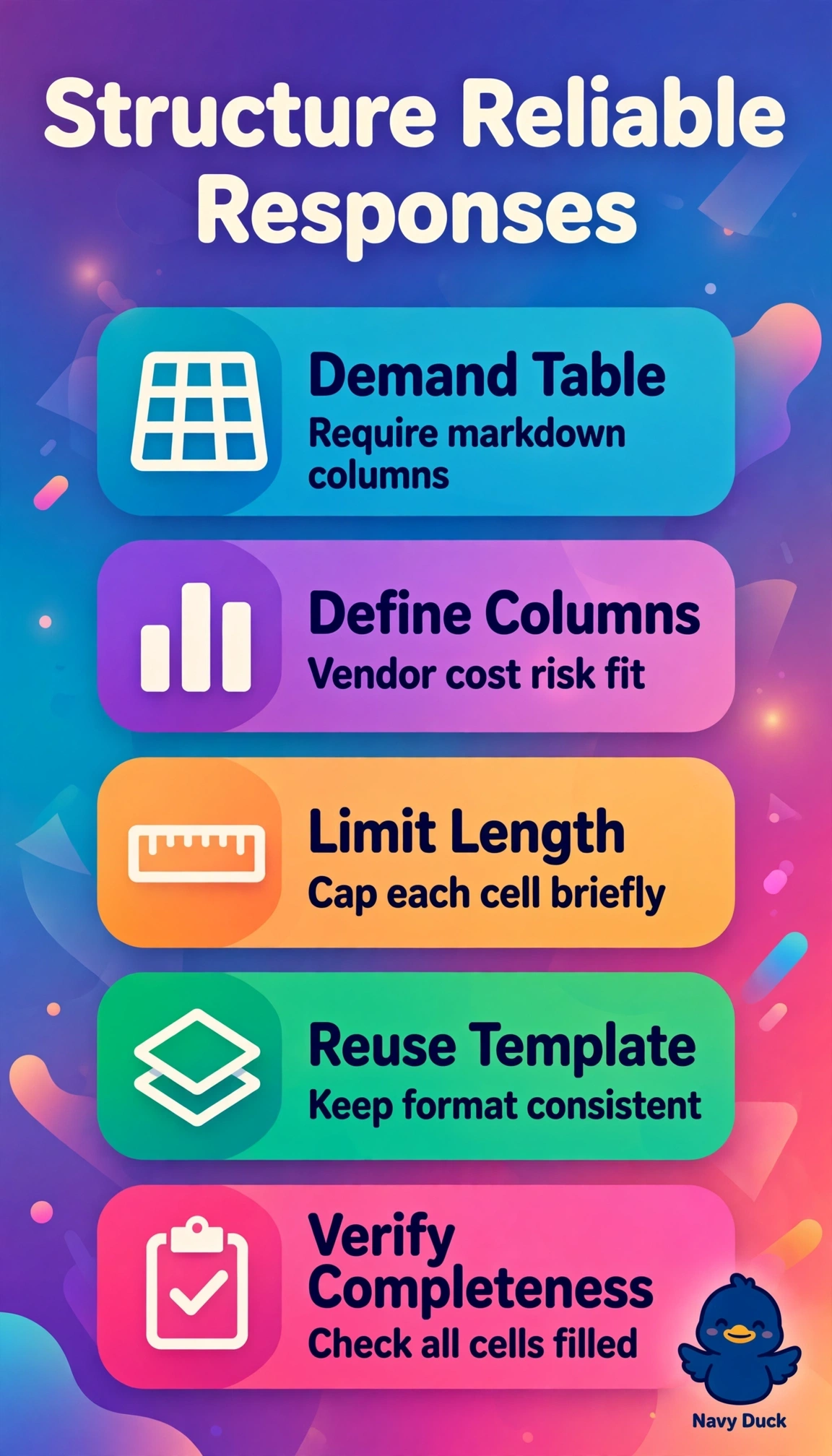
You get cleaner answers when you hand over the container first. Columns and limits force fair comparisons, and formatting makes decisions easy.
Full Explanation
The tight side-by-side requirement is best met by explicitly naming both schema and brevity, which is why requesting a markdown table with defined columns and a per-cell maximum directly solves the stated pain of long paragraphs by forcing aligned attributes and truncated summaries that can be scanned across vendors for reliable comparison from the issue thread context. A concise bulleted approach with a strict limit helps with brevity but fails on comparability because bullets stack vertically without enforced columns, so criteria drift between vendors and the reader must still hunt for price, timeline, or risks. A markdown table with defined columns but unlimited cell text restores alignment yet fails on tightness because verbose cells recreate the original wall-of-text problem inside a grid, undermining scannability and increasing variance between runs. A side-by-side pros-and-cons paragraph with an overall length limit improves brevity but fails on structure because freeform prose does not guarantee the same fields in the same order, making systematic comparison unreliable even when short. As an exam caveat, distinguish specifying output structure from merely asking for summarization or shortening, since only explicit format plus constraints ensures consistency, and as a practical check, verify the prompt names the exact columns and a character or word cap per cell and test with two vendors to confirm the model produces aligned, succinct rows before applying it to the full thread.