
A program manager must modernize 40 legacy onboarding docs: the agent must propose a new structure, get stakeholder sign-off, then migrate content across repositories with team visibility. Accuracy matters, but constant prompts would stall delivery. Which agent execution mode should the manager select to balance control and momentum for this migration?
Select an answer to reveal the explanation.
Short Explanation
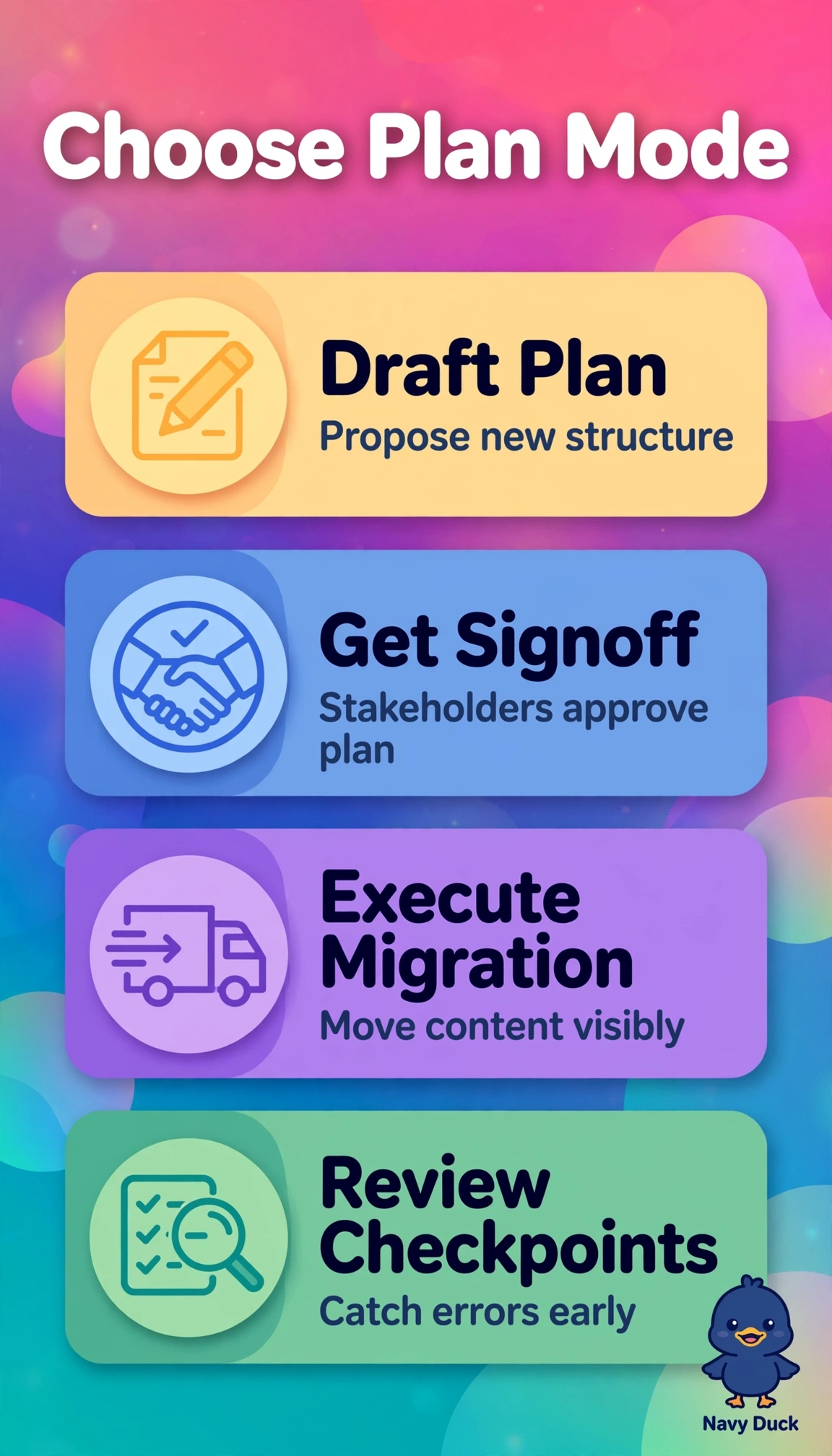
You need direction before motion. Locking the plan-mode blueprint first gives stakeholders control without micromanaging. Then execution can flow with clear guardrails.
Full Explanation
Plan mode followed by checkpointed execution is correct because it separates governance from throughput, letting stakeholders approve structure once before any content moves and then allowing steady migration with team visibility without per-document interruption, which directly balances accuracy and momentum for 40 documents across repositories. Fully autonomous migration with live dashboard updates is a legitimate high-velocity pattern that preserves speed and transparency, but it fails on upfront governance because it starts moving content without an approved structure, inviting large-scale rework if stakeholders disagree. Requiring human approval for every migrated document is a widely used high-assurance pattern that protects accuracy and keeps progress visible, but it fails on the autonomy trade-off because constant prompts create the exact stall the scenario warns against. Using plan mode for initial sign-off then running the entire migration autonomously without intermediate checkpoints is also common for maximizing speed after approval, but it fails on observability because the team loses visibility during the critical cross-repository phase. As an exam caveat, distinguish upfront approval from continuous approval, since prompts often test whether you add control at the risky planning boundary rather than at every low-risk step. As a practical check, confirm the plan artifact explicitly defines structure, repository mapping, and checkpoint cadence before authorizing execution.