
A business analyst receives an agent-generated migration plan that proposes database schema changes and revised timelines for a retail checkout system. Before sharing with engineering, accuracy and risk must be confirmed. Which review method should the analyst use to review agentic workflow outputs?
Select an answer to reveal the explanation.
Short Explanation
Polished text can still hide potholes. Cross-checking sources lets you catch errors before engineers build on them.
Full Explanation
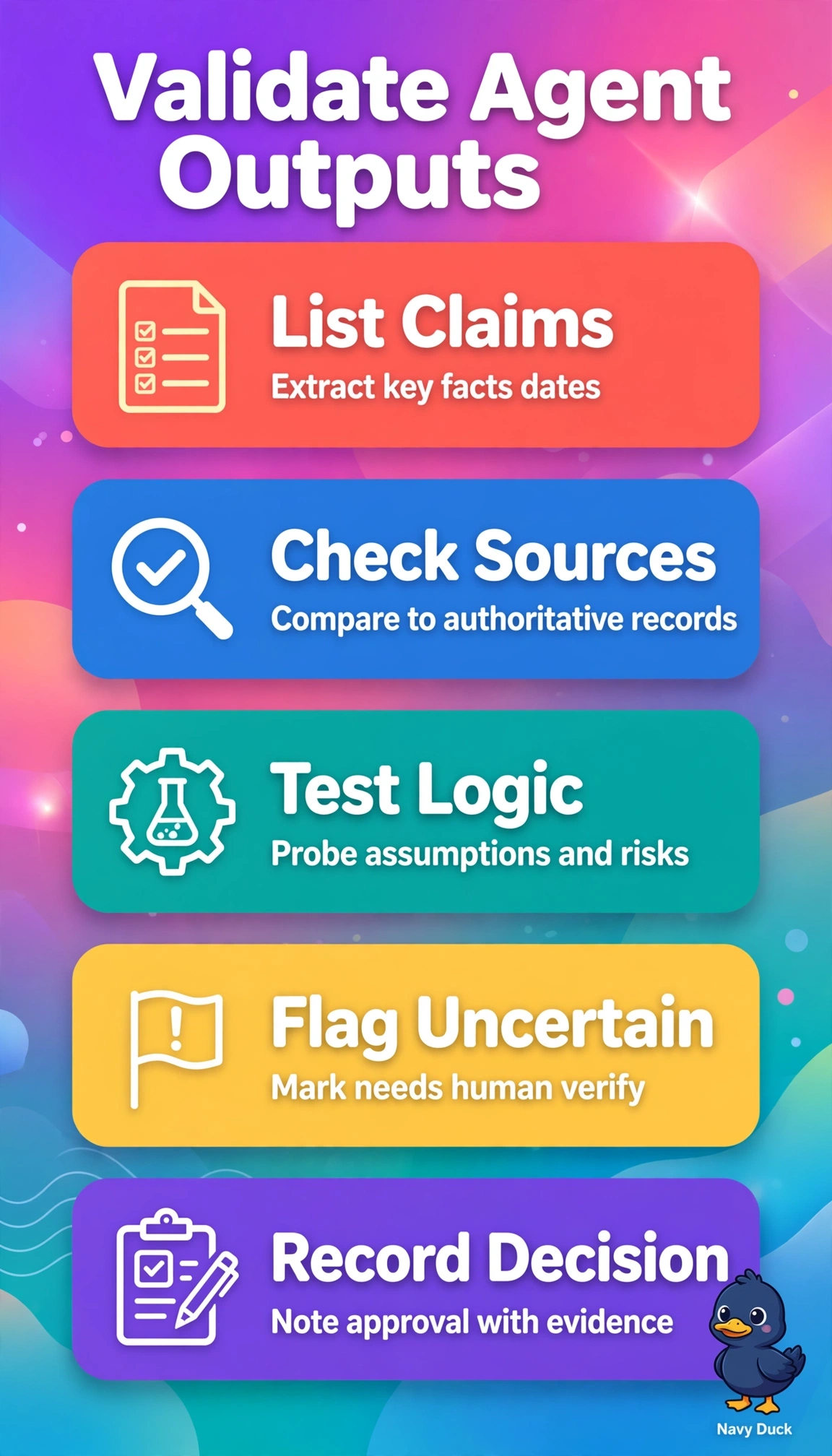
The correct response succeeds because a retail checkout migration requires both external grounding and explicit risk management, so validating schema changes and revised timelines against source records establishes factual accuracy while flagging uncertain items preserves human accountability before engineering action. The historical timeline validation alternative fails on completeness because schedule plausibility cannot substitute for schema correctness when database changes carry structural risk, and deferring that check to engineering violates the requirement to confirm accuracy beforehand. The confirm-and-share alternative fails on escalation because even thorough source comparison leaves residual ambiguity, and without flagged uncertainties engineering receives an apparently certain plan that hides risk rather than managing it. The internal reconciliation alternative fails on grounding because agentic outputs can be fluent and fully self-consistent while still hallucinating facts, so coherence alone never proves alignment with systems of record. As an exam caveat, distinguish thorough-sounding partial verification from full verification plus human review, since test makers deliberately make incomplete checks attractive by describing legitimate project history analysis, documentation review, or consistency testing. As a practical check, map each proposed table, field, dependency, and date to its source ticket or registry entry and forward only an annotated plan where every unmapped item is marked for human verification.