
A workplace manager wants an agent to auto-approve office supply reorders without finance review. Policy allows approval only when the order is under $200, from a preferred vendor, within the remaining team monthly budget, and with no duplicate order in the past 7 days. Which decision-making criteria specification gives the agent a safe autonomous boundary?
Select an answer to reveal the explanation.
Short Explanation
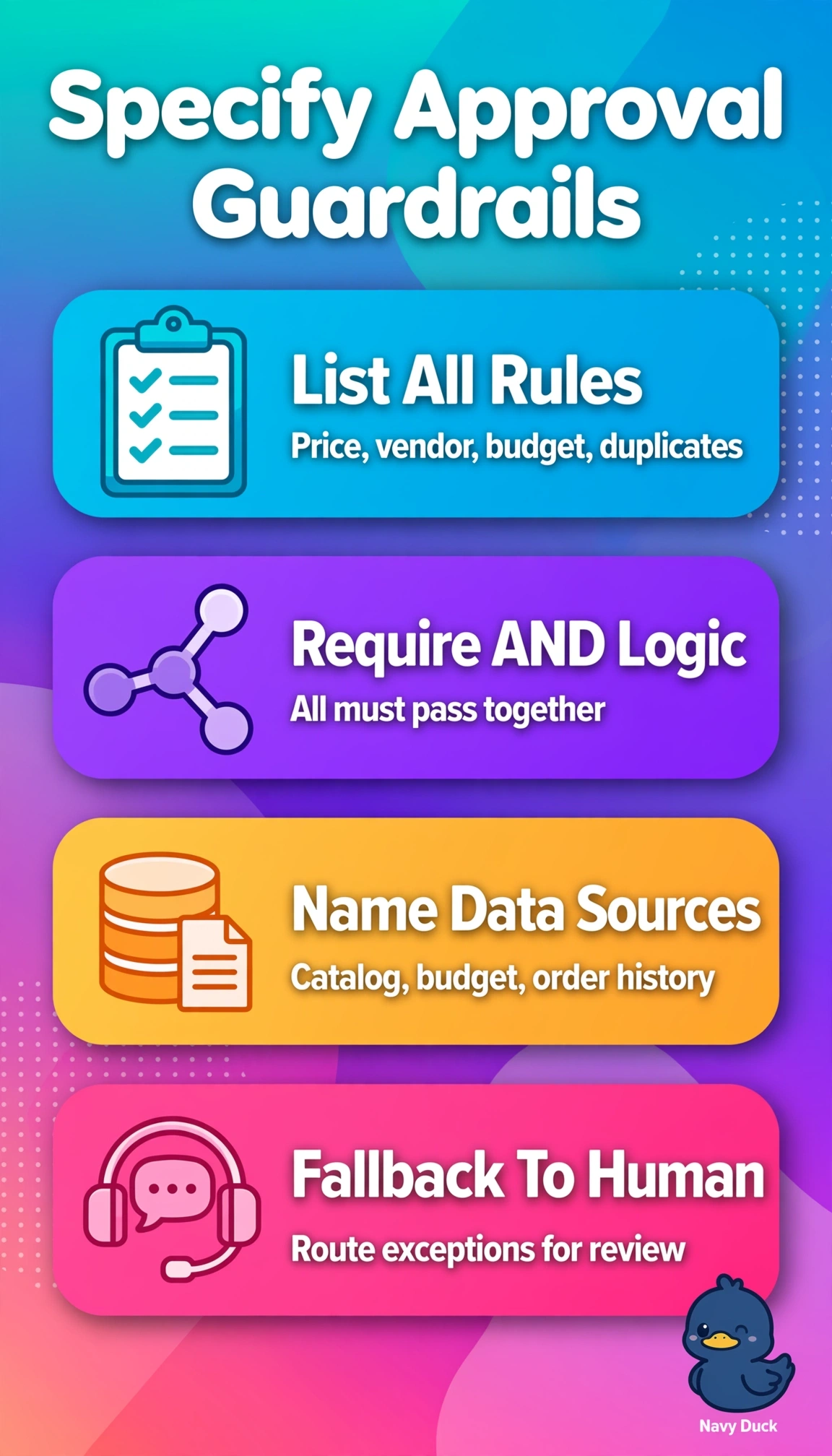
You're handing your agent a bouncer's list at the door, so it only waves an order through when price, vendor, budget, and timing all get a yes. You'll want those four rules joined by AND with clear sources and a handoff to a human when anything's fuzzy, and that checklist keeps spending safe.
Full Explanation
The safe boundary must conjunctively enforce under-$200 order total, preferred-vendor status, live remaining monthly budget, and 7-day duplicate absence, each tied to an explicit source with fallback to human review when any check fails or data is uncertain, which contains spend, contract, budget, and duplication risk without finance review. The weighting variant fails on hard versus soft constraints because treating preferred vendor as a score still permits autonomous approval of off-contract vendors when price and budget look favorable, violating the required match. The audit-logging variant fails on preventive versus detective control because post-approval traceability cannot block a repeat order within seven days, so duplication occurs before any human sees it. The per-item variant fails on unit of measurement because validating each line under $200 still allows a multi-item cart over $200 to auto-approve, breaching the total cap and threatening the monthly budget. An exam caveat is that mature-sounding safeguards like scoring, logging, or live checks never compensate for a missing required condition, so read for AND enforcement rather than presence of helpful tooling. A practical check is to map each rule to its authoritative total calculation, vendor master, real-time ledger, and seven-day history, then test edge cases at $200, non-preferred vendor, zero balance, day-six reorder, and source outage to verify fallback.