
A program manager is building an agentic workflow to turn meeting notes into onboarding tasks for a 40-person support team. It must follow company tone, create tasks in priority order, and ask for missing owners. Results are inconsistent and skip steps. Which approach best creates agentic workflow instructions that stabilize behavior?
Select an answer to reveal the explanation.
Short Explanation
Vague directions get wandering work. You're giving the agent a clear playbook with instructions for role, steps, and edge cases, much like a recipe that lists order and substitutions.
Full Explanation
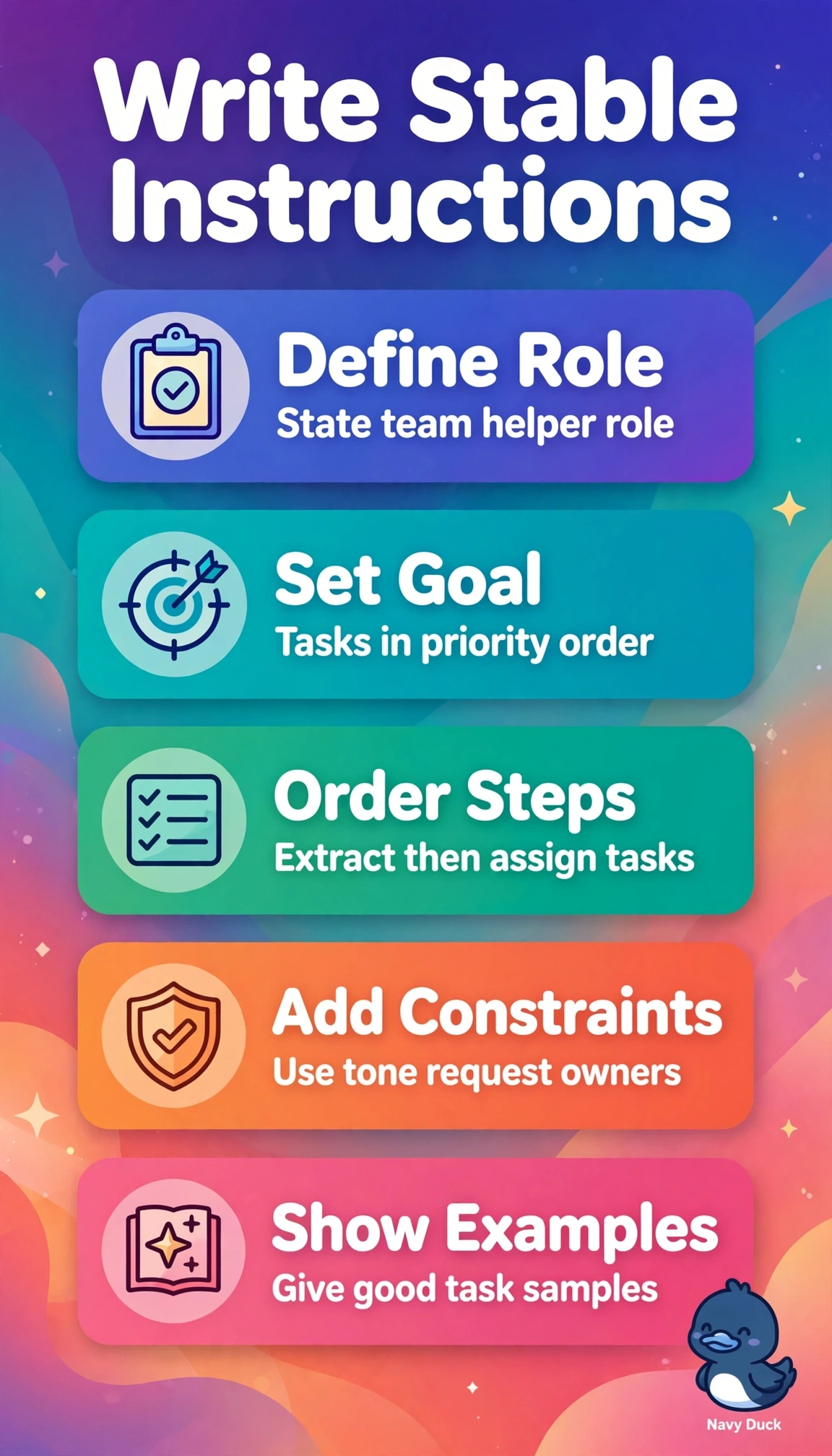
The correct approach succeeds because inconsistent, step-skipping behavior comes from underspecified agency, and a shared file combining role, goal, ordered steps, constraints, and examples controls all three requirements together: role plus examples grounds company tone, ordered steps enforce priority sequencing rather than inferred order, and an explicit ask-for-owner constraint creates a reliable human-in-the-loop gate that prevents silent completion. Defining tone and priority logic while auto-assigning missing owners is efficient and common for momentum, but it fails the delegation concept by replacing required clarification with assumption, risking wrong accountability across a 40-person team. Using reusable templates with role and examples grouped by team function is a legitimate standardization pattern, but it fails the sequencing concept because functional grouping improves findability without guaranteeing priority order or stepwise completeness. Building an ordered checklist with blocking validation for owners is strong for completeness and governance, but it fails the stylistic grounding concept because without role, tone rules, and examples the tasks can be correctly sequenced yet inconsistent in voice. For exam purposes, favor explicit structure over inferred intelligence and treat any answer that lets the model guess order, tone, or ownership as suspect even when it sounds faster. As a practical check, pilot on messy notes with tied priorities and one missing owner and verify the run preserves priority order, mirrors approved tone, pauses for the owner, and logs decisions before scaling.