
You are a product manager comparing Q4 support tickets. You need fast summaries of 2,000 short tickets today, then next week deep root-cause reasoning across linked tickets, specs, and incident threads. Copilot offers several models with different speed and reasoning trade-offs. Which model selection strategy should you apply for this business task?
Select an answer to reveal the explanation.
Short Explanation
Matching muscle to the job saves you hours. Fit matters like using a scooter for errands and a truck for moving day. Go quick for volume, deep for tangled analysis.
Full Explanation
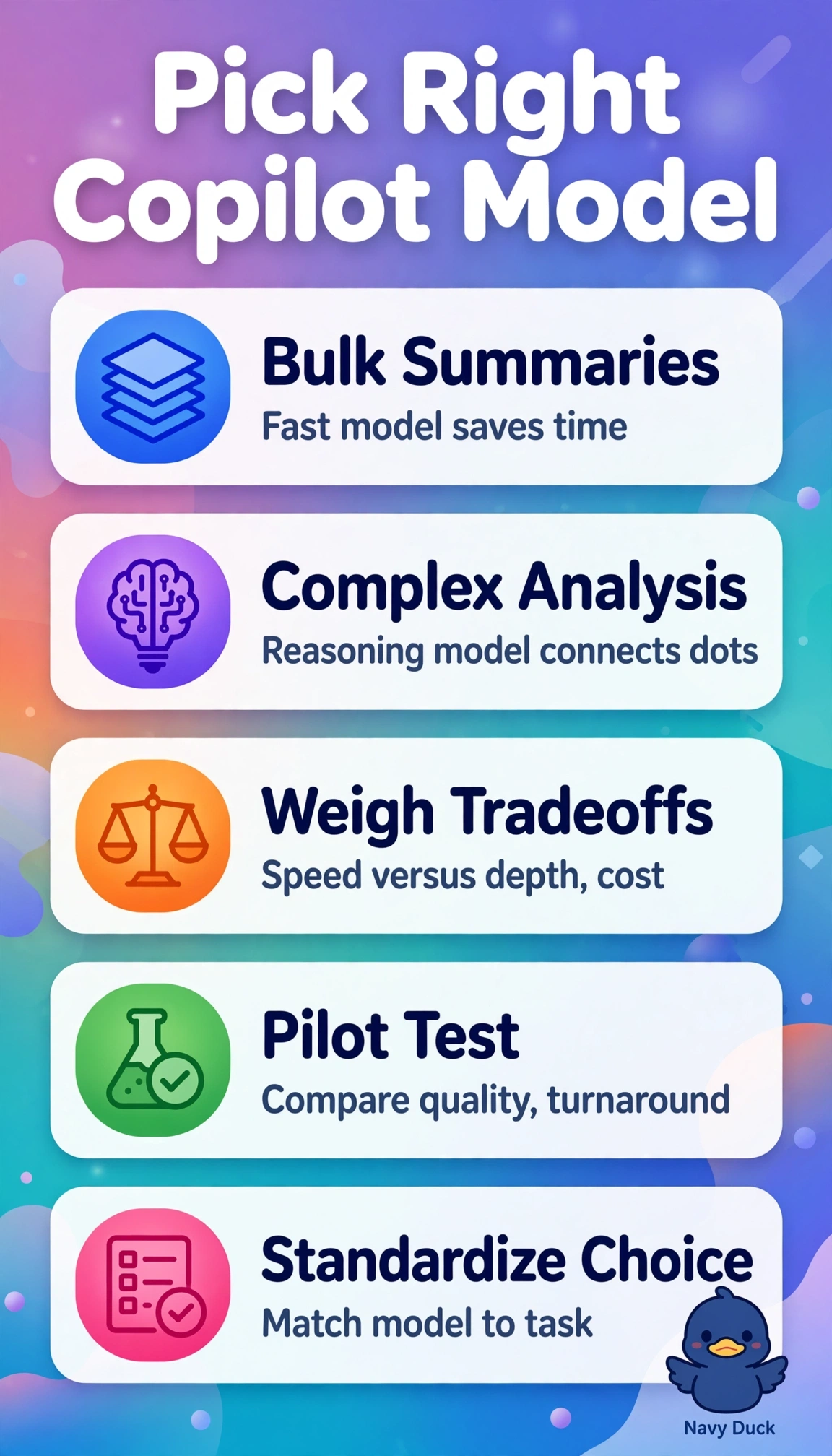
The correct strategy aligns model strengths to phased demands, using an efficient low-latency model to handle high-volume, low-complexity summarization under a same-day deadline where throughput and cost control matter, then switching to a high-reasoning model that can sustain multi-hop inference across heterogeneous linked sources for root-cause work where accuracy outweighs speed. Using a fast efficient model for both phases preserves throughput and cost for the 2,000 tickets but fails by concept of reasoning depth, since shallow models truncate chains of evidence and miss causal links across specs and incident threads. Using a stronger reasoning model for both phases preserves analytical quality but fails by concept of latency and operational fit, since deliberate step-by-step inference increases time and cost per call and cannot meet the today requirement for bulk output. Using efficient summarization plus reasoning confined to single tickets improves both speed and depth in isolation but fails by concept of context scope, since restricting inputs to isolated tickets discards the explicitly required linked tickets, specs, and threads needed for true cross-document causality. An exam caveat is to distinguish volume urgency from cognitive complexity rather than assuming one model must cover both, as prompts that state today versus next week and short versus linked signal an intentional split. A practical check is to pilot time-to-complete and quality on samples, verifying that the fast model meets summary throughput and the reasoning model correctly cites sources across documents before committing Q4 workflow.