
A business analyst relies on an agent to draft vendor comparison briefs, but outputs often omit pricing risks and overstate feature parity, requiring consistent quality without adding manual review of every draft. Which configuration of self-critique loops best improves accuracy automatically?
Select an answer to reveal the explanation.
Short Explanation
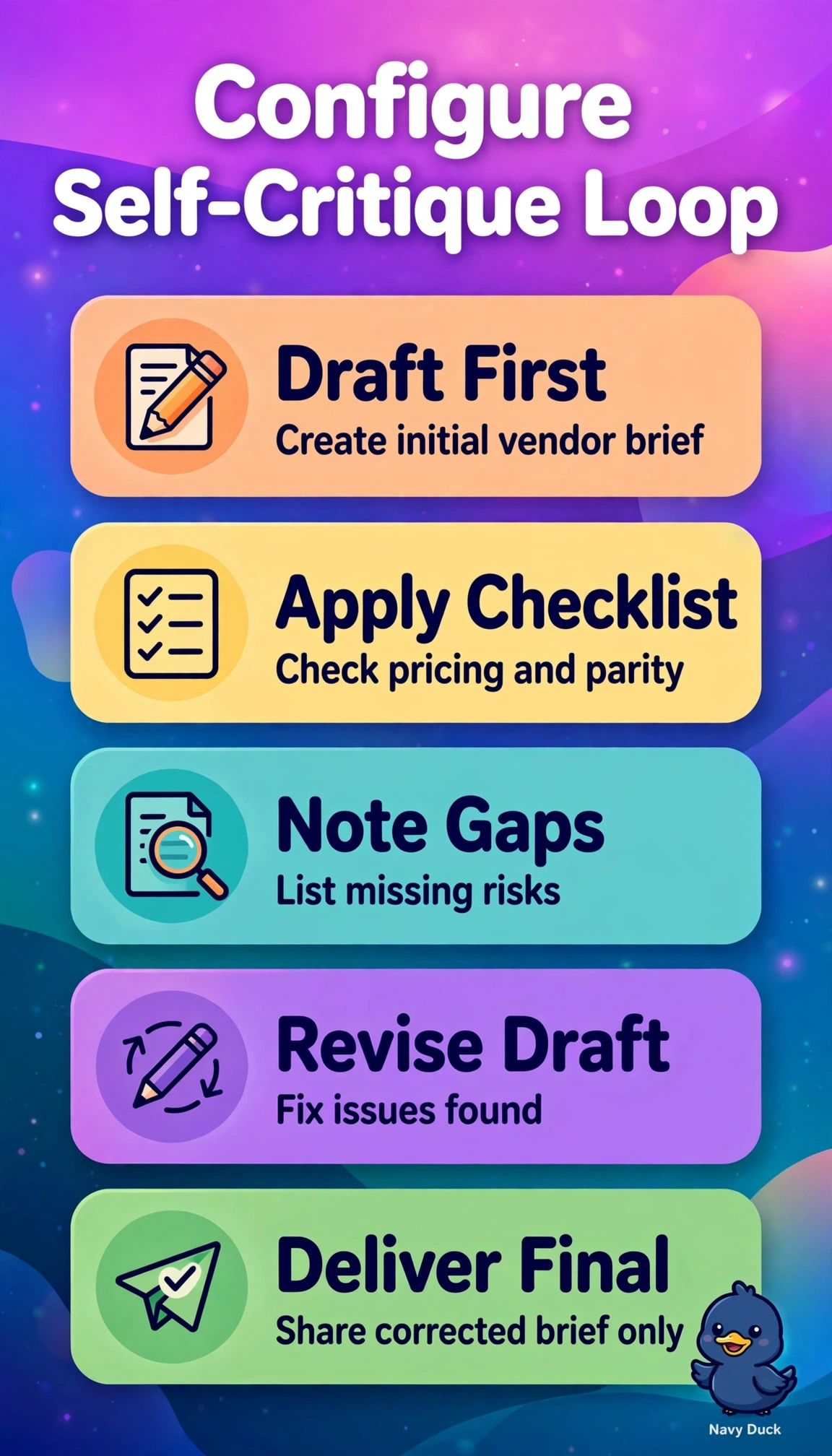
Great agents double-check their own homework before handing it in. A built-in review pass against your checklist bakes quality in, with self-critique acting as a second set of eyes.
Full Explanation
The correct configuration works because it implements a closed self-critique loop tied to the specific failure modes, prompting the agent to evaluate its own draft against an explicit risk checklist for pricing risks and feature parity and then revise identified gaps before delivery, which improves factual completeness automatically without requiring human review of every draft. A retrieval-based approach that fetches current vendor sources and adds citations strengthens grounding and traceability, but by concept it leaves the original overstated parity claims unexamined and unrevised, so added evidence does not equal correction. A clarity-focused revision loop that checks internal consistency and rewrites vague language improves readability and coherence, but by concept it optimizes expression rather than verifying substantive accuracy against external risks and differentiation criteria. A parallel-sampling approach that generates multiple drafts and automatically selects the highest-scoring version is a legitimate technique for robustness, but by concept selection without targeted critique and revision can still propagate the same systematic omissions across candidates. An exam caveat is to distinguish techniques that add information or polish delivery from those that explicitly verify and then rewrite the draft against task-specific quality criteria. As a practical check, require logging of the checklist findings with before-and-after diffs showing pricing risks added and parity statements corrected, confirming automatic improvement rather than mere reformatting or source attachment.