
A healthcare startup runs Copilot agents and Actions workflows that deploy staging builds and query a claims database. The team must prevent credential leaks in logs, chat transcripts, and forks while allowing automated access. Which secrets management consideration should the team apply when agents and workflows run?
Select an answer to reveal the explanation.
Short Explanation
You're automating with sensitive keys, so lock them down properly. Encrypted secrets with least privilege keep agents working without exposing credentials.
Full Explanation
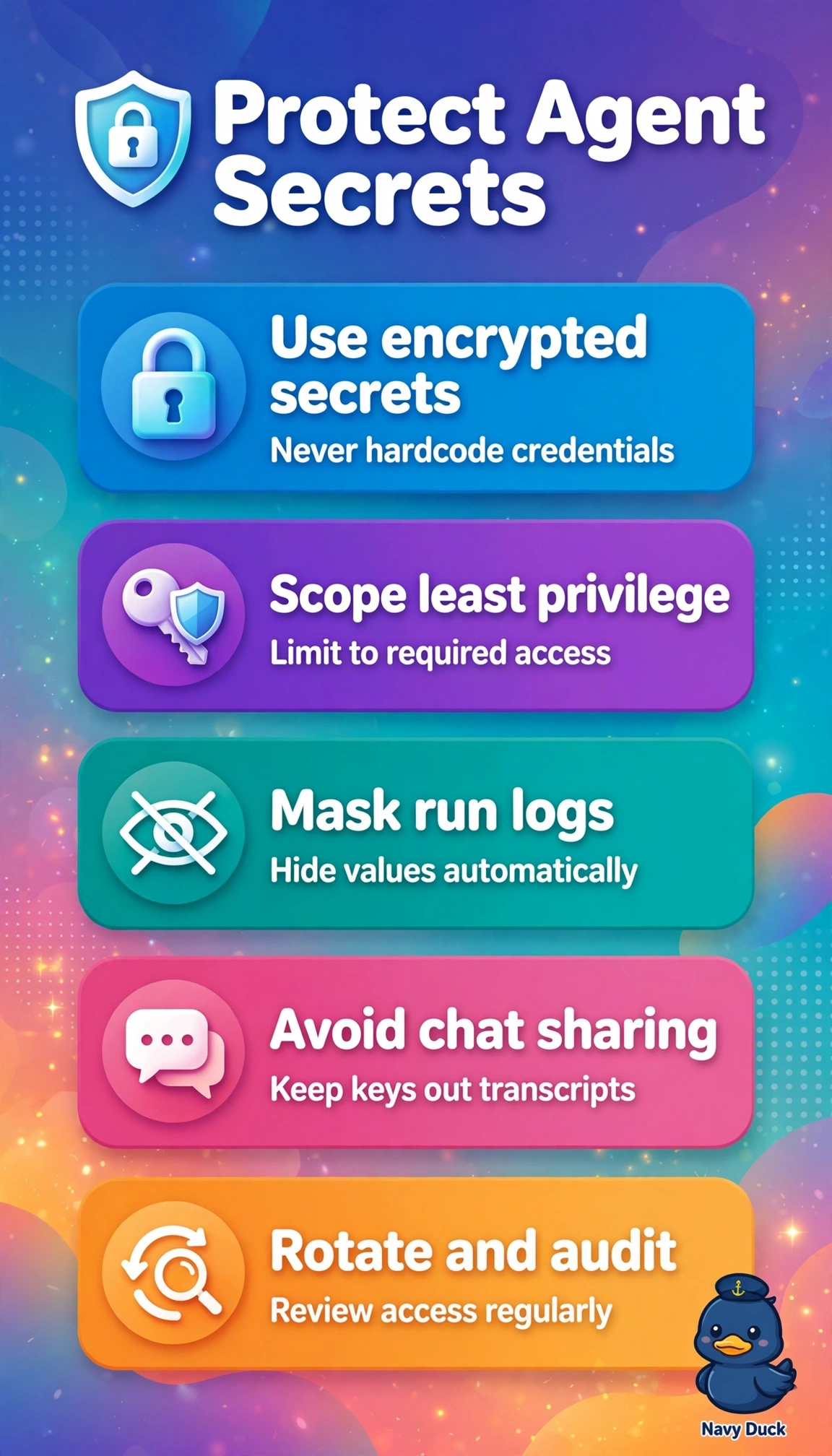
The correct consideration combines encrypted Actions secrets, least-privilege scopes, and masked logs because staging deployments and claims database queries need unattended access without exposing long-lived credentials in workflow logs, Copilot chat transcripts, or forked runs, and Actions secrets provide encryption at rest, granular repository or environment scoping, automatic redaction, and no default exposure to forks. Enabling organization secrets on fork pull requests to automate external builds is a legitimate pattern for public open-source CI, but in this healthcare context it violates the fork-containment fact by executing untrusted fork code with direct access to sensitive claims credentials. Using encrypted Actions secrets only to automate database queries in workflows is standard for CI automation and satisfies least privilege, yet it misses the stated log and transcript safeguard by omitting masking and agent-output handling, leaving resolved values at risk of persisting in Copilot transcripts. Requiring manual reviewer approval for each secret use is a sound protection-rule practice for production access, but it contradicts the explicit need to allow automated access for staging builds, creating friction and workarounds. Exam caveat: distinguish secret scope and availability from encryption alone, as encrypted storage does not automatically mean safe for forks or visible logs. Practical check: confirm secrets are scoped to the staging environment, fork pull requests cannot access them, log masking and transcript redaction are verified in a test run, and workflows use minimal scopes with rotation.