
A program manager runs a weekly reporting workflow where an agent must summarize closed issues, apply the team's tone skill, and post to a dashboard. The skill must trigger reliably with correct inputs. Which integration best calls skills from agents and workflows?
Select an answer to reveal the explanation.
Short Explanation
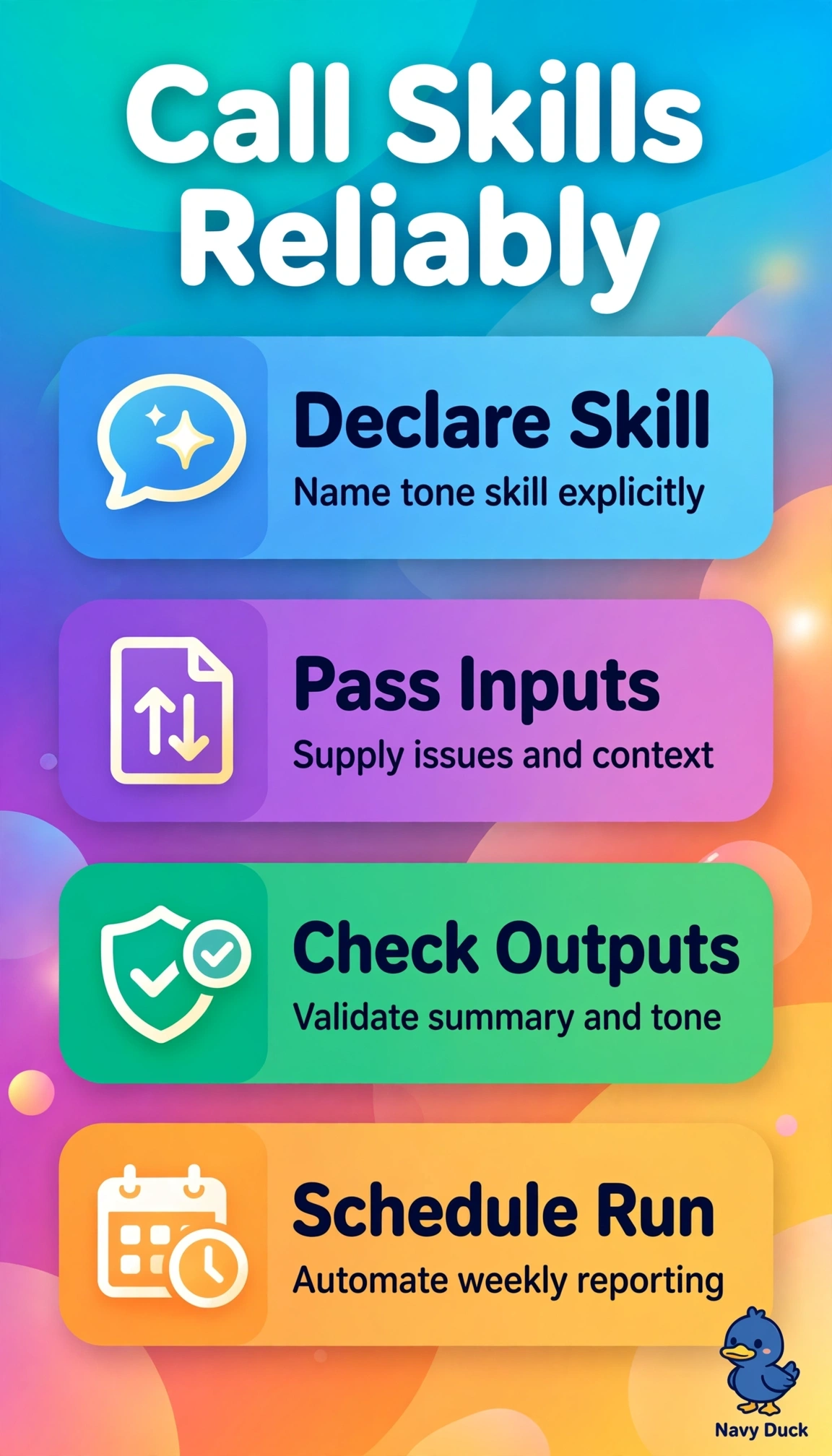
Hope isn't a strategy for automation. You'll get reliable reports by wiring the explicit skill call with clean inputs right into your workflow step.
Full Explanation
The correct integration declares the tone skill as a deterministic workflow node with explicit inputs such as closed-issue summaries and explicit outputs such as styled text for the dashboard, which guarantees reliable triggering, correct data passing, version control, and observability in a recurring operational process. Allowing autonomous invocation based on conversational context is a legitimate agentic pattern for open-ended assistance, but it fails determinism because the model may skip, duplicate, or mistime the skill when a weekly report demands guaranteed execution. Loading the skill into the system prompt is widely used for persistent persona or style, but it fails scoping and contract clarity because it applies tone globally without defined inputs and outputs and risks diluting instructions or leaking style to unrelated tasks. Exposing the skill as an on-demand tool with auto-inferred parameters reflects standard function-calling practice, but it fails input reliability because inferred arguments can omit required fields or misformat content for the dashboard. For exam purposes, distinguish orchestrated workflows requiring predictability from autonomous agents suited to flexible judgment, and always favor explicit orchestration when the stem emphasizes reliably and correct inputs. As a practical check, inspect the workflow run trace to confirm the tone step executed in sequence with validated inputs and produced dashboard-ready output before posting.