
A product manager inherits a backlog of 300 GitHub issues with missing owners, duplicate reports, and inconsistent labels across mobile and API teams. Releases are delayed by unclear priorities. Which issue management practice best restores clarity and ownership?
Select an answer to reveal the explanation.
Short Explanation
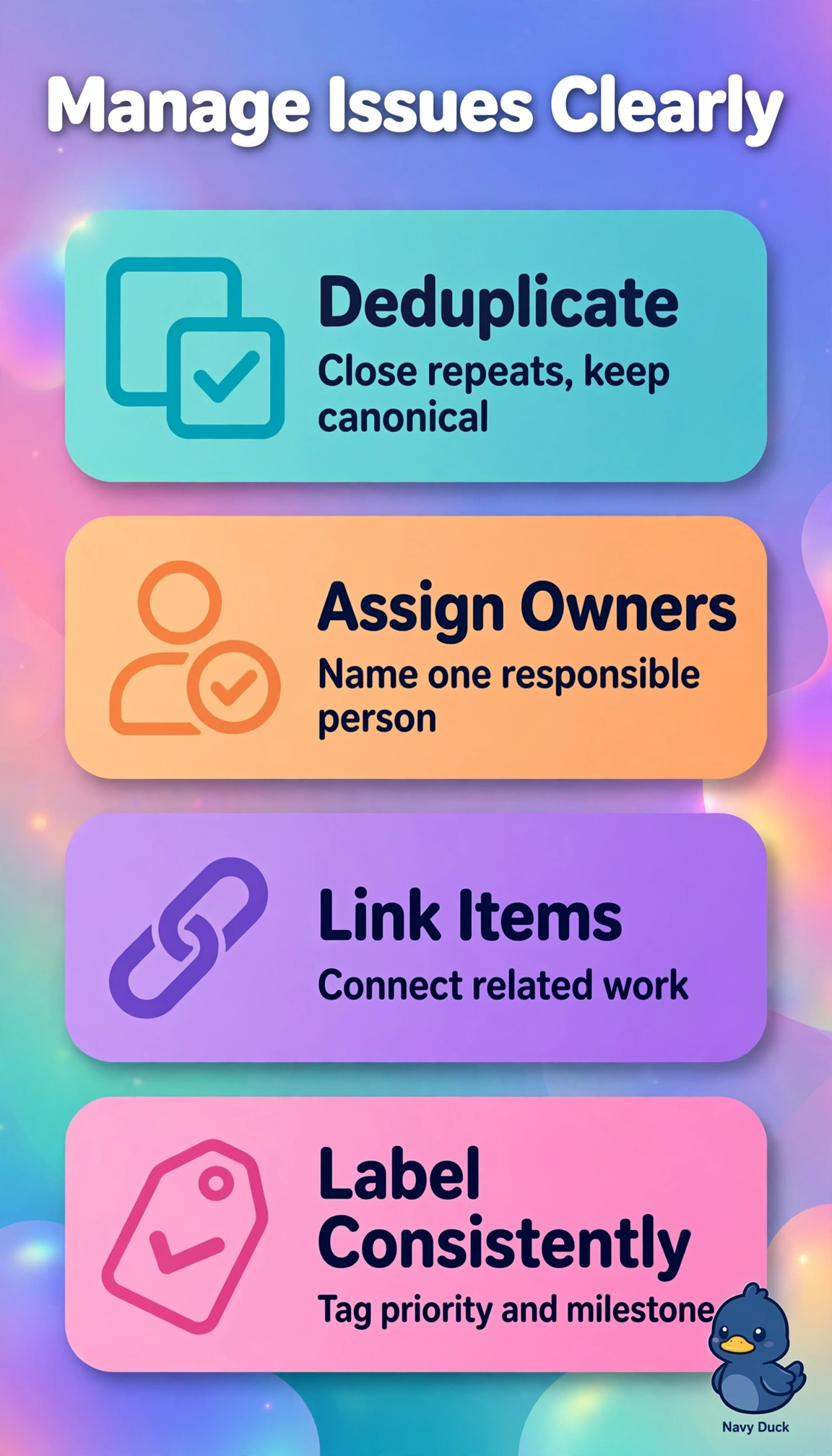
Chaos loves a messy backlog. You'll ship faster by applying structured hygiene that links duplicates, names owners, and labels work consistently.
Full Explanation
The correct practice succeeds because it addresses all four backlog failures together: deduplication removes noise from duplicate reports, explicit ownership closes the accountability gap, linking surfaces mobile-API dependencies, and consistent labels plus milestones create a shared prioritization and release view that directly unblocks delayed releases. The self-assignment alternative fails on accountability theory: voluntary claiming feels agile and is commonly used in open source, but with 300 orphaned items and two teams under release pressure it preserves diffusion of responsibility and leaves priorities unclear. The preserve-labels alternative fails on taxonomy governance: assigning owners and linking is valuable, yet retaining inconsistent labels across mobile and API perpetuates the exact search, filter, and triage problem that caused unclear priorities. The external-tracking alternative fails on system-of-record discipline: deduplication, ownership, and labels help, but moving milestones and priority out of GitHub fragments truth and guarantees drift between issues and documents. As an exam caveat, distinguish familiar agile habits from what the stem explicitly demands, since a normally sound technique becomes incorrect when it omits deduplication, ownership, consistent labeling, or milestones. As a practical check, audit the tracker after cleanup for zero unassigned critical issues, zero known duplicates, a documented label guide used by both teams, and every release-blocking item tied to the current milestone.