
A product manager must update 15 legacy docs in GitHub, some edits are low-risk formatting, but several sections change customer-facing API commitments requiring careful wording. She wants speed with control. Which agent work mode should she choose for this validation practice?
Select an answer to reveal the explanation.
Short Explanation
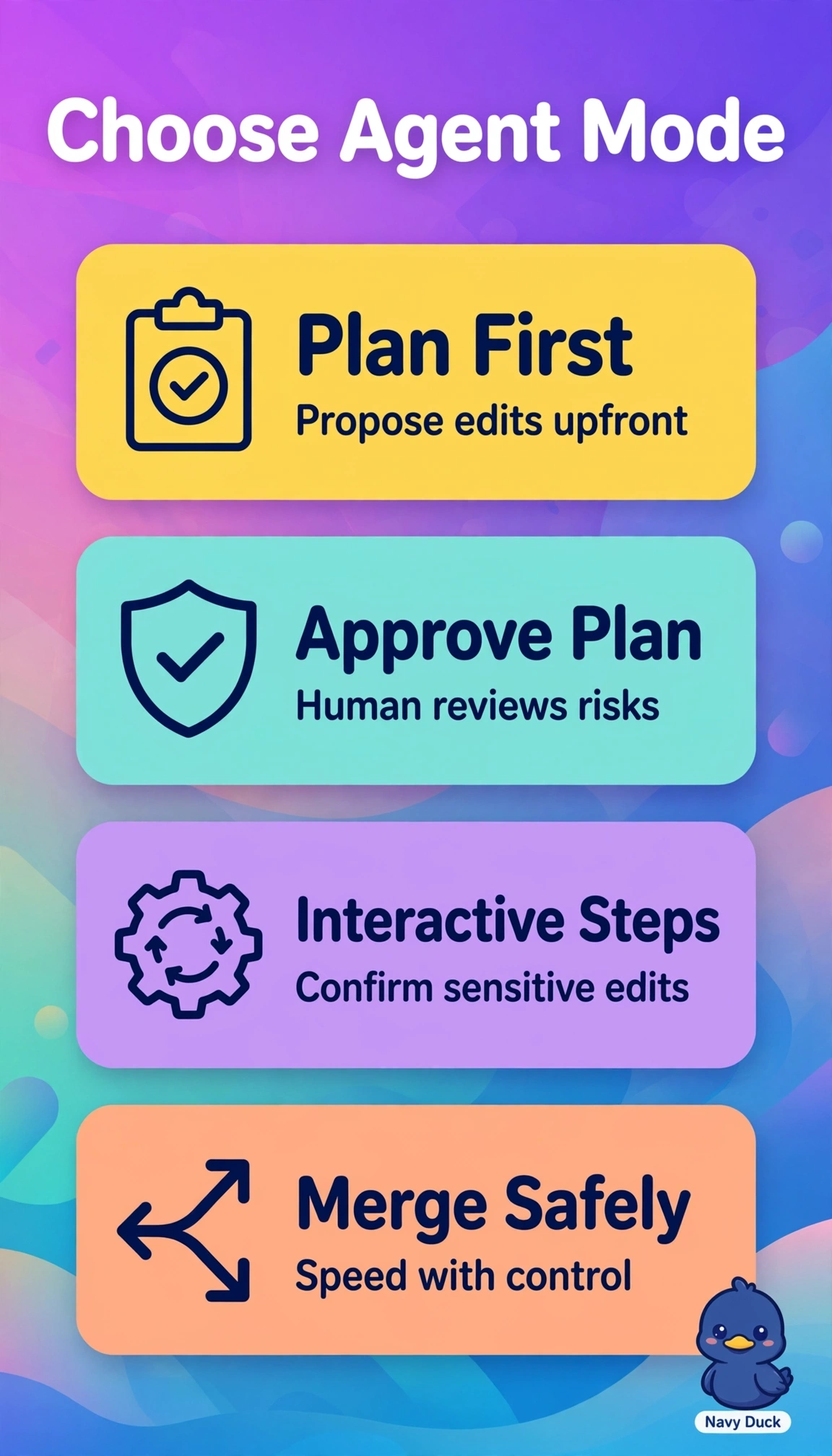
You get a blueprint before swinging hammers on risky walls. Plan mode gives you speed plus a safety pause for those API promises.
Full Explanation
The correct approach fits this mixed-risk multi-file task because plan mode first creates a reviewable strategy for all 15 GitHub docs that preserves speed by coordinating scope upfront, then interactive execution with human checks ensures customer-facing API commitment wording is carefully validated before it becomes binding. The autonomous execution approach after approval is widely used for fast bulk updates and satisfies speed, but it fails control because API language would be applied without stepwise human validation where precise nuance is required. The interactive-only approach without an upfront plan is standard for sensitive single-file work and satisfies oversight, but it fails efficiency and coordination for 15 legacy docs because there is no approved global plan to separate formatting from API changes and prevent rework. The plan-plus-spot-checks approach is appropriate for low-risk formatting batches, but it fails careful wording because spot checks cannot guarantee every API commitment diff was explicitly reviewed. An exam caveat is to separate scale from risk: high file count points to planning while customer-facing commitments require human-in-the-loop, so optimizing only one dimension leaves the answer incomplete. As a practical check, require the plan to label each change as formatting or API commitment and require explicit human sign-off on every API-tagged diff.