
A product manager receives an agent request to delete 400 stale customer records, with attached evidence showing 40 are still under legal hold. Which response to the interaction request best handles this approval, rejection, or revision decision?
Select an answer to reveal the explanation.
Short Explanation
You are the final gate when legal risk is on the line. A documented rejection with revision asks for a detour, not a dead end, keeping compliant records safe today.
Full Explanation
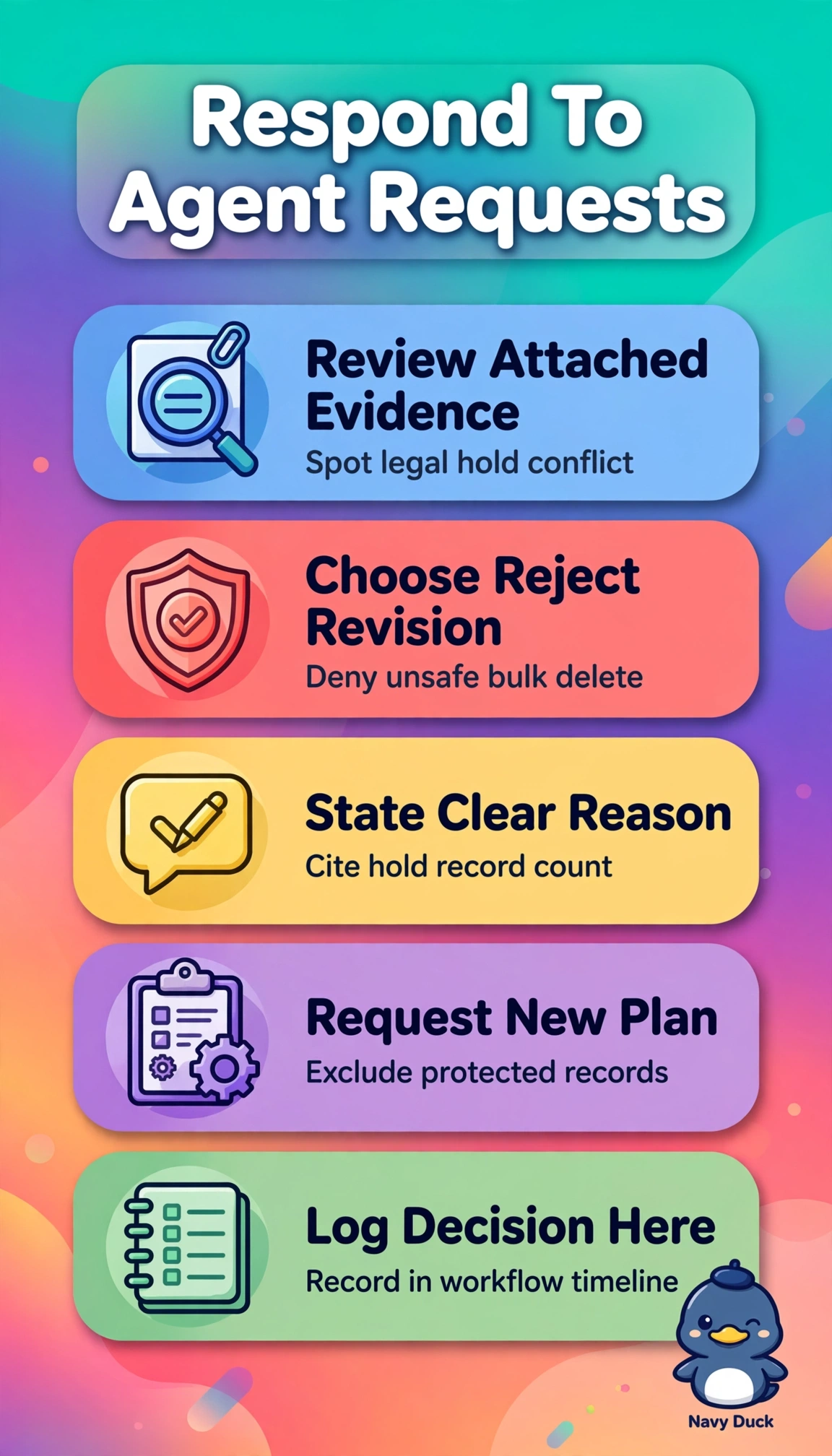
The correct response upholds both preservation and cleanup by formally rejecting the overbroad 400-record request while preserving a compliant path for the 360 eligible records, creating an auditable decision that prevents deletion of protected data and keeps accountability in the system of record. Approving only the 360 eligible records with documentation captures the right scope and record-keeping but fails as a decision control because the original bulk request stays unresolved, leaving the 40 hold items still requested and at risk of downstream execution. Rejecting all 400 with no resubmission path applies over-blocking and fails proportionality, since it protects the hold but discards legitimate value and ignores the duty to guide the agent toward a compliant retry. Requesting revisions while pre-approving the full set pending a later check fails precedence of legal constraint over efficiency, as conditional approval still authorizes prohibited action before verification. For exams, watch for explicit hold evidence, as any choice allowing hold records to proceed even conditionally is wrong despite strong audit language. As a practical check, confirm hold identifiers are explicitly excluded, the rejection with rationale is logged, and no execution proceeds until the revised plan is re-validated.