
A support operations lead wants to automate triaging 300 weekly GitHub Discussions, labeling product area, assessing urgency, drafting replies, and escalating defects. The workflow is currently vague and tangled. Which decomposition best prepares this use case for agentic processes and tasks?
Select an answer to reveal the explanation.
Short Explanation
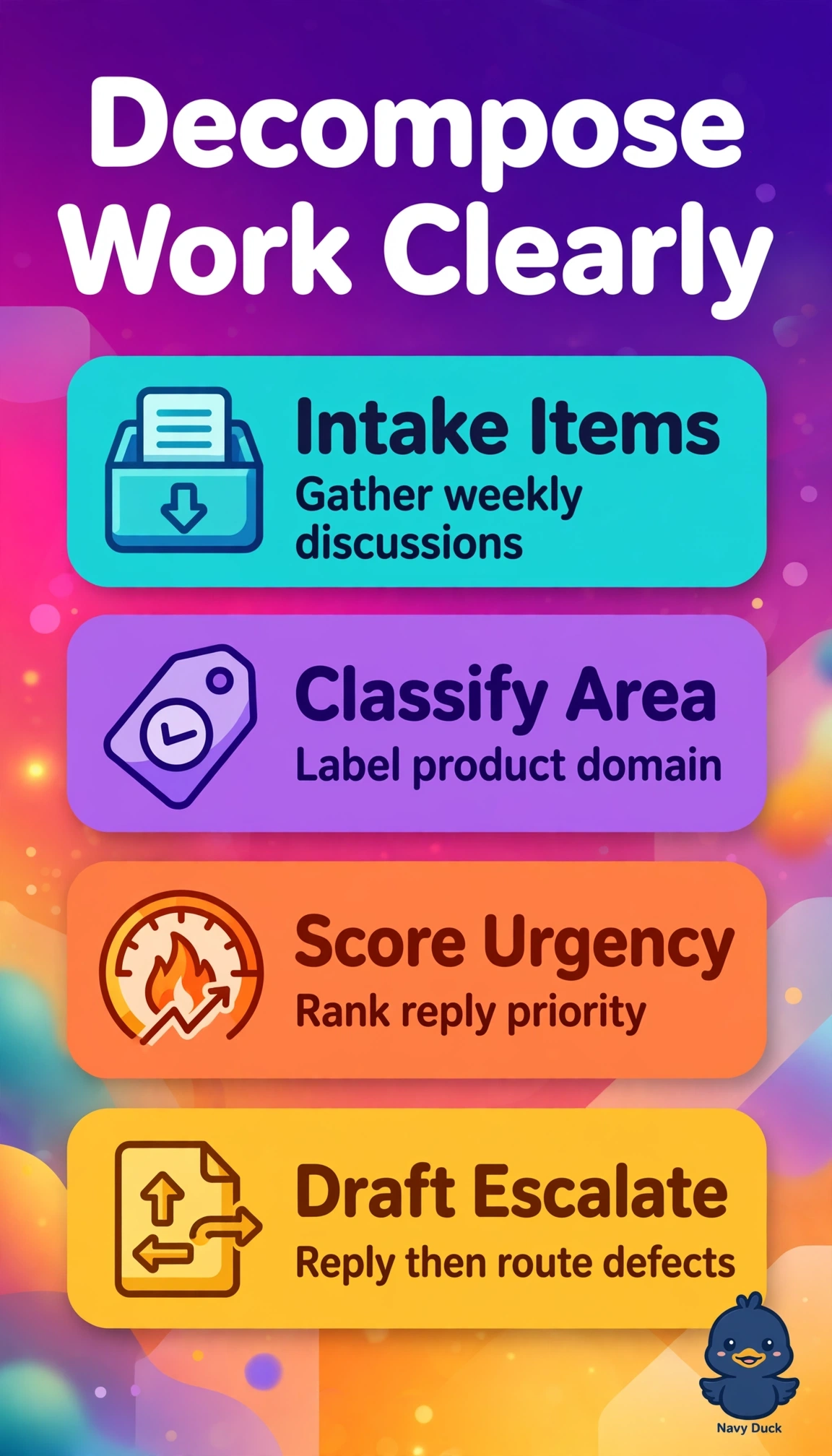
You turn the tangled workflow into clear steps that are easier to manage and hand off. Decomposition helps you cover every outcome without losing the details that matter.
Full Explanation
The decomposition that includes intake, product area classification, urgency scoring, reply drafting, and defect escalation is right because it covers the full workflow as distinct tasks with clear inputs, making it easier to prepare the work for agentic processes. Splitting triage into intake, classification, urgency scoring, and reply drafting but leaving out defect escalation fails by omission: a defect may receive a draft reply without being routed for action. Splitting triage into intake, urgency scoring, reply drafting, and defect escalation but omitting product area classification also fails by omission, since product ownership and area labeling are part of the requested work. Automating intake, classification, urgency scoring, reply drafting, and escalation on a schedule fails by concept: scheduling the whole workflow does not make its steps, inputs, or handoffs clear, so the original vagueness remains. Exam caveat: when a prompt emphasizes vague, tangled work and agentic readiness, favor complete task coverage and explicit interfaces over volume or scheduling language alone. Practical check: trace one Discussion through intake, area classification, urgency scoring, reply drafting, and defect escalation, confirming each task has a clear input and next destination.