
A program manager wants to automate vendor onboarding that currently involves legal review, security questionnaire scoring, procurement approval, and account provisioning across four tools. Progress stalls because the effort is treated as one large block. Which decomposition approach best breaks this use case into processes and tasks for agentic automation?
Select an answer to reveal the explanation.
Short Explanation
You're turning a tangled knot into neat, assignable steps. Task decomposition feels like slicing a big catering order into prepped stations with tickets. Clear inputs and handoffs show you exactly where agents can help.
Full Explanation
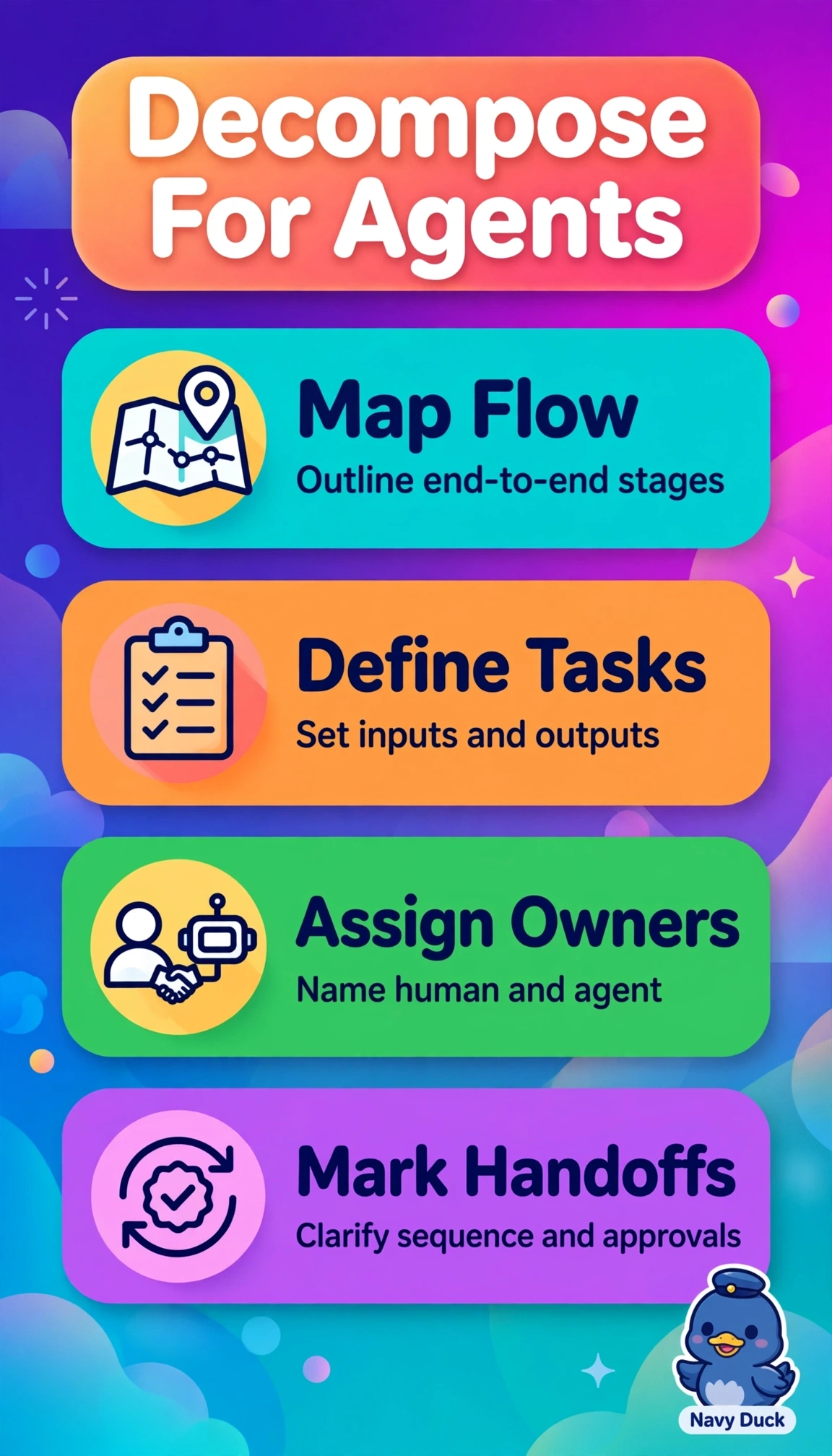
The correct approach works because agentic automation of a cross-functional, cross-tool workflow requires process decomposition before agent assignment, turning one stalled block into staged subprocesses for legal review, security scoring, procurement approval, and provisioning, each with defined inputs, outputs, owners, and handoffs so agents can execute, validate, and pass work reliably across systems. Deploying dedicated agents inside each tool to optimize tasks independently reflects sound domain specialization but fails on integration, since without a linked end-to-end flow and explicit handoffs agents cannot resolve dependencies, sequence reviews correctly, or prevent stalls across the four systems. Starting with provisioning for quick wins reflects sound incremental delivery but fails on dependency logic, since provisioning depends on prior legal, security, and procurement outcomes and automating it first inverts the required order and risks rework or unauthorized access. Building a shared dashboard for visibility reflects sound observability practice but fails on executability, since tracking status does not define discrete task boundaries, inputs, and required data needed for agents to act autonomously. For exam contexts, beware choosing plausible efficiency or visibility improvements when the stem asks for decomposition into assignable processes and tasks, and always favor stage-gate clarity over tool-level optimization. As a practical check, verify each subprocess can answer what triggers it, what data it needs, who owns it, and where its output goes next before assigning any agent.