
An orchestrated multi-agent pipeline that typically completes in 45 minutes ran for 6 hours before being manually terminated. The team wants to perform post-hoc analysis to determine where the pipeline stalled and why. The orchestration system logged start/end timestamps for each agent invocation and each tool call. Which analysis approach would MOST efficiently identify the stall point and its likely cause?
Select an answer to reveal the explanation.
Short Explanation
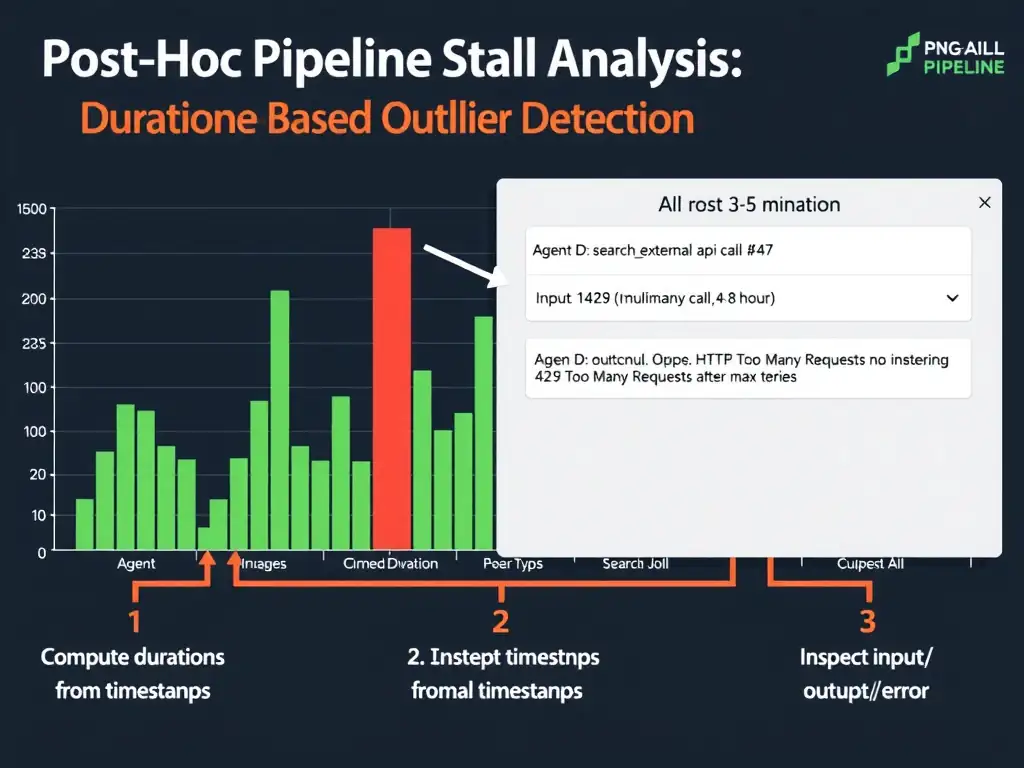
Don't read a 6-hour log from the start like you're picking through a haystack. Use the timestamps to sort by elapsed time, jump to the one invocation or tool call with the huge gap, then inspect its input, output, and error fields. That's where the stall is hiding.
Full Explanation
Post-hoc stall analysis is an exercise in signal extraction from timing data. The efficient approach is to compute elapsed time for each agent invocation and each tool call from the logged start and end timestamps, identify the single invocation or call with the largest duration gap, then examine the input, output, and error fields of that specific invocation to determine the cause. In a pipeline with a 45-minute baseline, a 6-hour runtime means roughly 5+ hours of excess time exists somewhere. Sorting all invocations by duration should reveal the outlier, likely a single agent invocation or tool call lasting hours while others last minutes or seconds. The deep-dive should ask what the agent was asked to do, what it returned if anything, and whether the error fields show a timeout, an infinite retry loop, or a blocking wait on an external resource. Common stall causes include an infinite retry loop on a failing tool, waiting on a human approval that was never provided, polling an external service that became unavailable, or an agent stuck in a reasoning loop. This targeted approach reduces analysis time from hours to minutes because it uses the timing data that already encodes the stall location. The chronological full review approach is inefficient for a 6-hour log. At typical agent verbosity levels, a 6-hour run produces thousands of log lines, and reading each agent's output from the beginning does not exploit the timestamps. The re-run-in-a-test-environment approach does not guarantee the same stall will reproduce; stalls caused by external service unavailability, human approval absence, or timing-specific race conditions may not reproduce there. It also takes 6+ more hours before yielding a result. The human-observation approach is the least reliable method; humans cannot observe internal agent reasoning or tool call latencies, and memory of a 6-hour background process is imprecise.