
How do Enterprise Managed Users (EMU) typically differ from ordinary GitHub.com users regarding collaboration outside the enterprise?
Select an answer to reveal the explanation.
Short Explanation
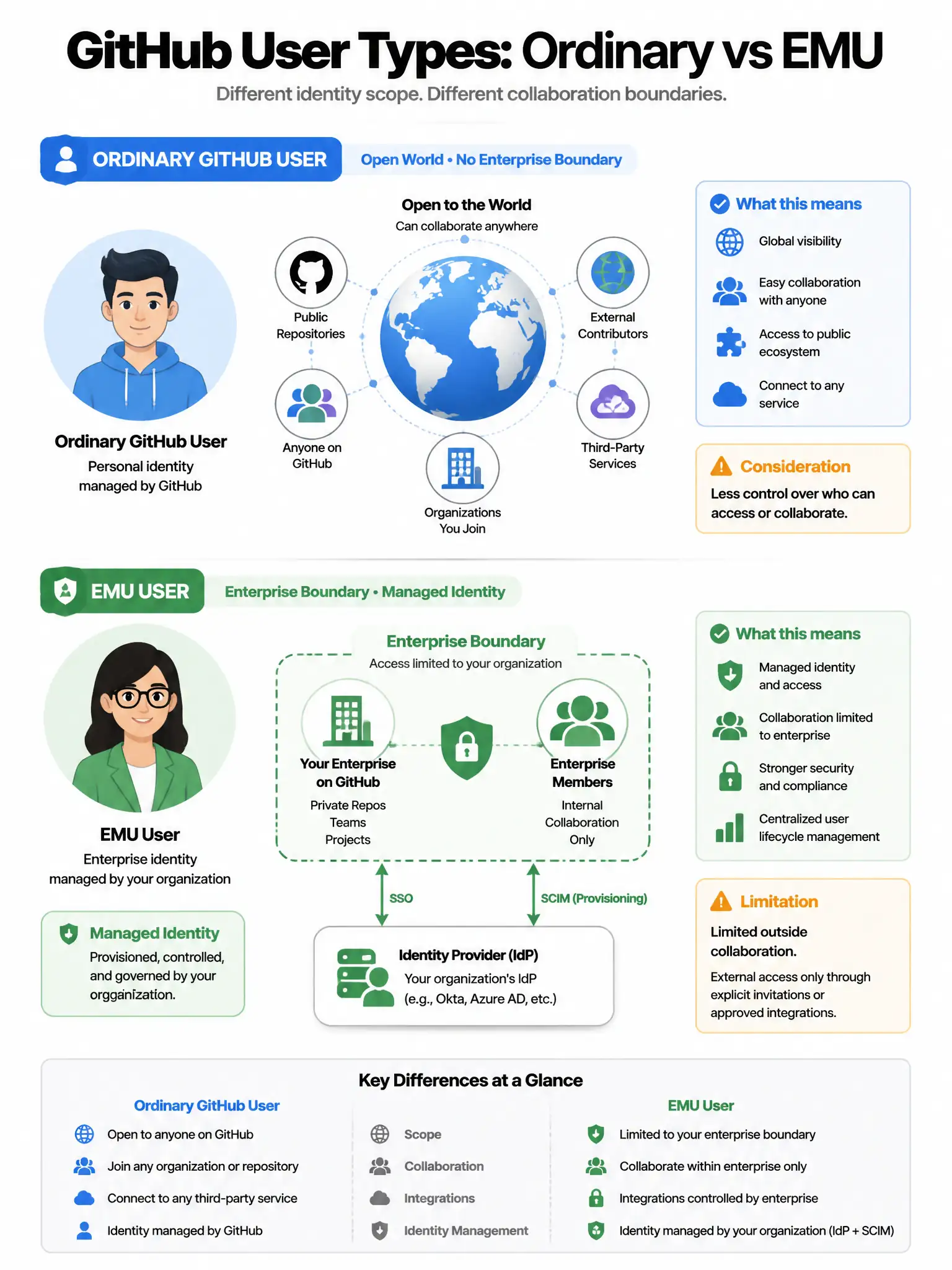
Enterprise Managed Users live inside your identity provider's managed land, so they collaborate under enterprise control instead of acting like free-range personal GitHub.com accounts. That tradeoff gives you stronger identity lifecycle, tighter perimeter, and fewer shadow identities.
Full Explanation
The correct answer is that Enterprise Managed User accounts are restricted to collaborating within the enterprise's managed environment rather than acting as independent consumer accounts. Enterprise Managed Users are provisioned and authenticated through the enterprise identity provider and SCIM model, and their ability to interact with the broader GitHub.com consumer ecosystem is intentionally constrained compared with ordinary user accounts. The option saying Enterprise Managed User accounts can freely own unlimited public personal repositories with no enterprise policy is incorrect because Enterprise Managed Users are designed to reduce unmanaged public personal sprawl under enterprise identity. The option saying Enterprise Managed User accounts cannot use HTTPS and must only use SVN is nonsense; Enterprise Managed Users still use standard Git protocols. The option saying Enterprise Managed User accounts automatically become enterprise owners on every organization is wrong because Enterprise Managed Users do not auto-grant enterprise ownership to every user. Admins should align identity provider groups, SCIM mappings, and enterprise policies before rollout, and communicate collaboration limits to developers early.