
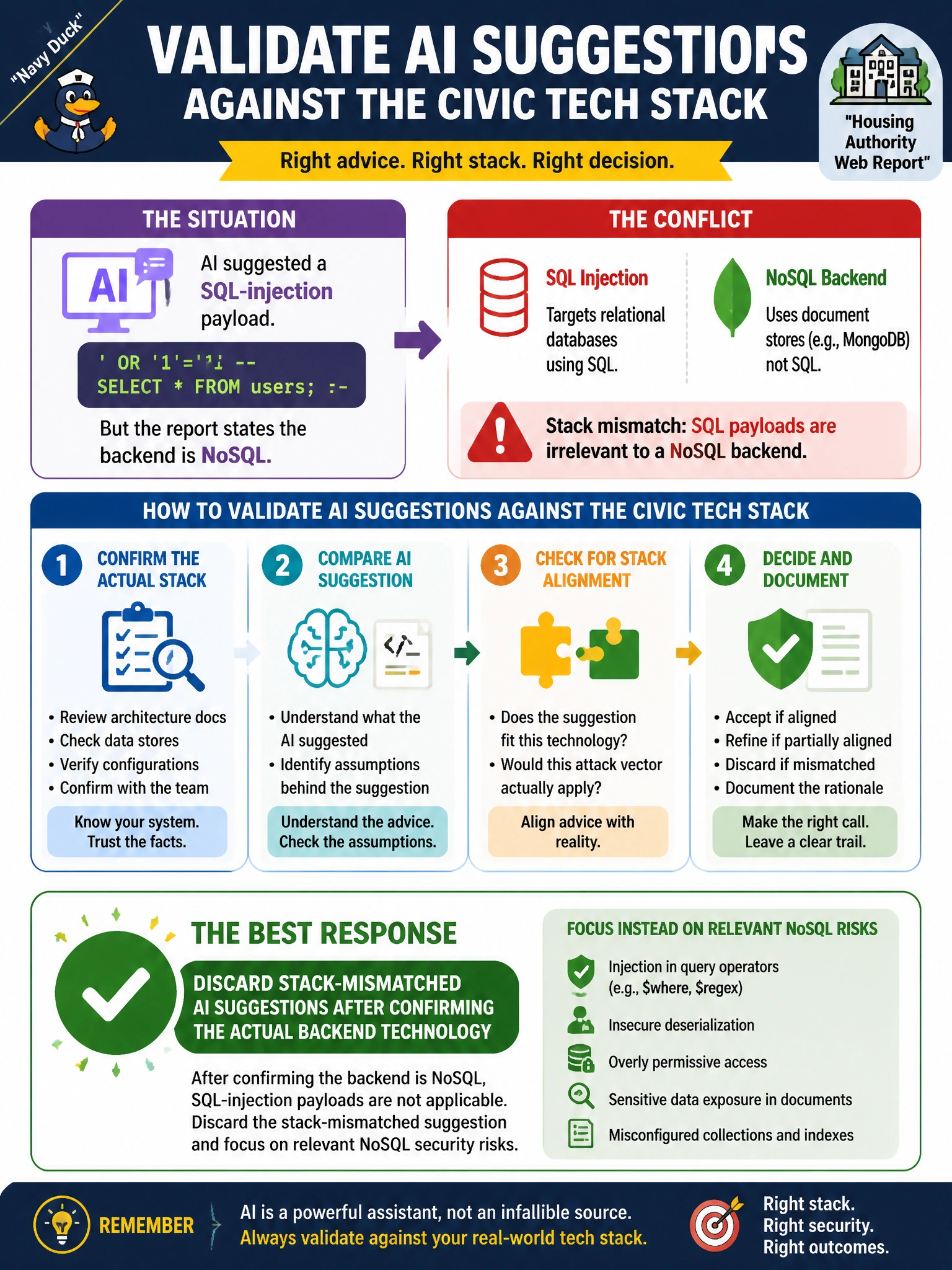
A housing-authority web report notes AI suggested a SQL-injection payload irrelevant to a NoSQL backend. Which response best validates AI suggestions against the civic tech stack?
Select an answer to reveal the explanation.
Short Explanation
If the app speaks NoSQL, a classic SQLi one-liner is the wrong dialect—toss it. Validate against the real stack before anything gets a production hall pass. Model guesses are not architecture truth.
Full Explanation
AI suggestions for web exploitation must be validated against the actual civic tech stack. When a housing-authority app uses a NoSQL backend, a classic SQL-injection payload is stack-mismatched: the query language, drivers, and injection grammar differ. The correct response discards stack-mismatched AI suggestions after confirming the real backend technology, then focuses testing on relevant NoSQL or application-logic issues. That validation step prevents wasted effort and unsafe 'try it anyway' behavior on production-adjacent systems.
Running the irrelevant SQLi payload on production 'to see what happens' ignores stack fit and change discipline. Marking any injection string as universally validated because it is an injection string fails technology specificity. Replacing architecture diagrams with whatever the model guesses mid-report elevates hallucination over inventory truth.
Exam caveat: stack-validation questions reward discarding mismatched AI payloads after confirming the backend, not universal injection myths. Operational check: confirm DB/API technology from reliable inventory or staging evidence, filter AI suggestions to matching families, and refuse production trials of irrelevant payloads.