
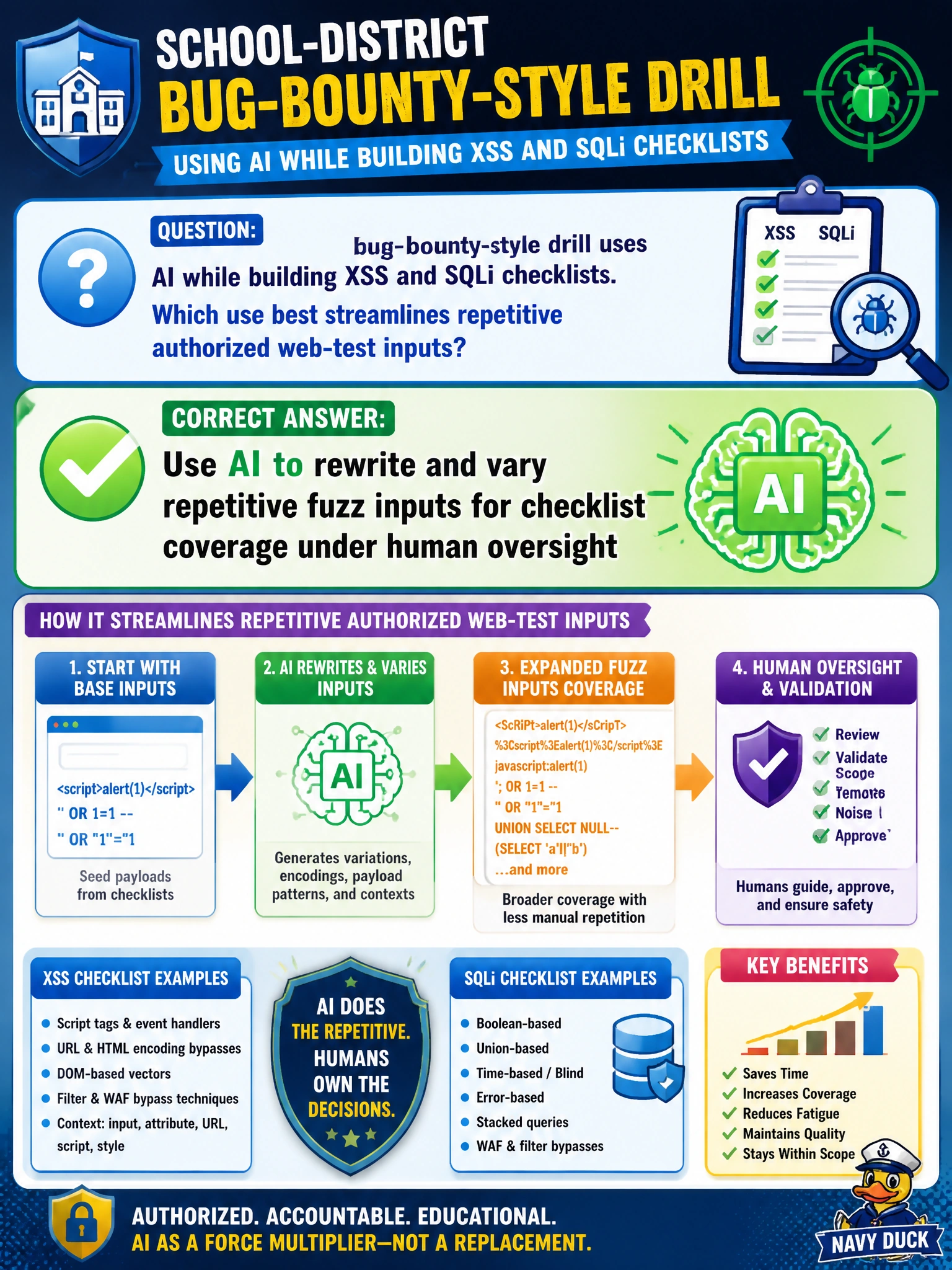
A school-district bug-bounty-style drill uses AI while building XSS and SQLi checklists. Which use best streamlines repetitive authorized web-test inputs?
Select an answer to reveal the explanation.
Short Explanation
Fuzz lists get boring—AI can remix the same idea into fresh checklist inputs while a human still holds the leash. Invented wins and student PII in public models are not clever shortcuts.
Full Explanation
In a school-district authorized web drill, AI is most useful for streamlining repetitive fuzz and checklist inputs: rewriting and varying payload shapes so coverage is broader without inventing results. Under human oversight, that use reduces tedium while keeping the engagement tied to real tests against the LMS or related apps. The correct choice pairs AI variation with human control and leaves student privacy intact. Variation helps cover encoding differences, parameter positions, and common filter bypass shapes that a static checklist often misses—but only when a human decides what is in scope to run.
Asking AI to invent successful breaches that never ran fabricates findings and corrupts tickets—checklist completion is not the same as demonstrated vulnerability. Disabling all fuzzing because AI already 'knows' the LMS is secure substitutes model opinion for testing and leaves real injection bugs undiscovered. Pasting student PII into public models to personalize payloads violates privacy, FERPA-adjacent expectations, and often district policy; personalization does not justify exfiltrating minors' data into consumer AI.
Exam caveat: AI-for-fuzz items want input variation under oversight, not fabricated wins or PII-into-public-models. Operational check: use AI to remix authorized fuzz lists, keep humans validating what runs and what is reported, quarantine any payload set that contains education PII, and never feed student identifiers into public LLM contexts.