
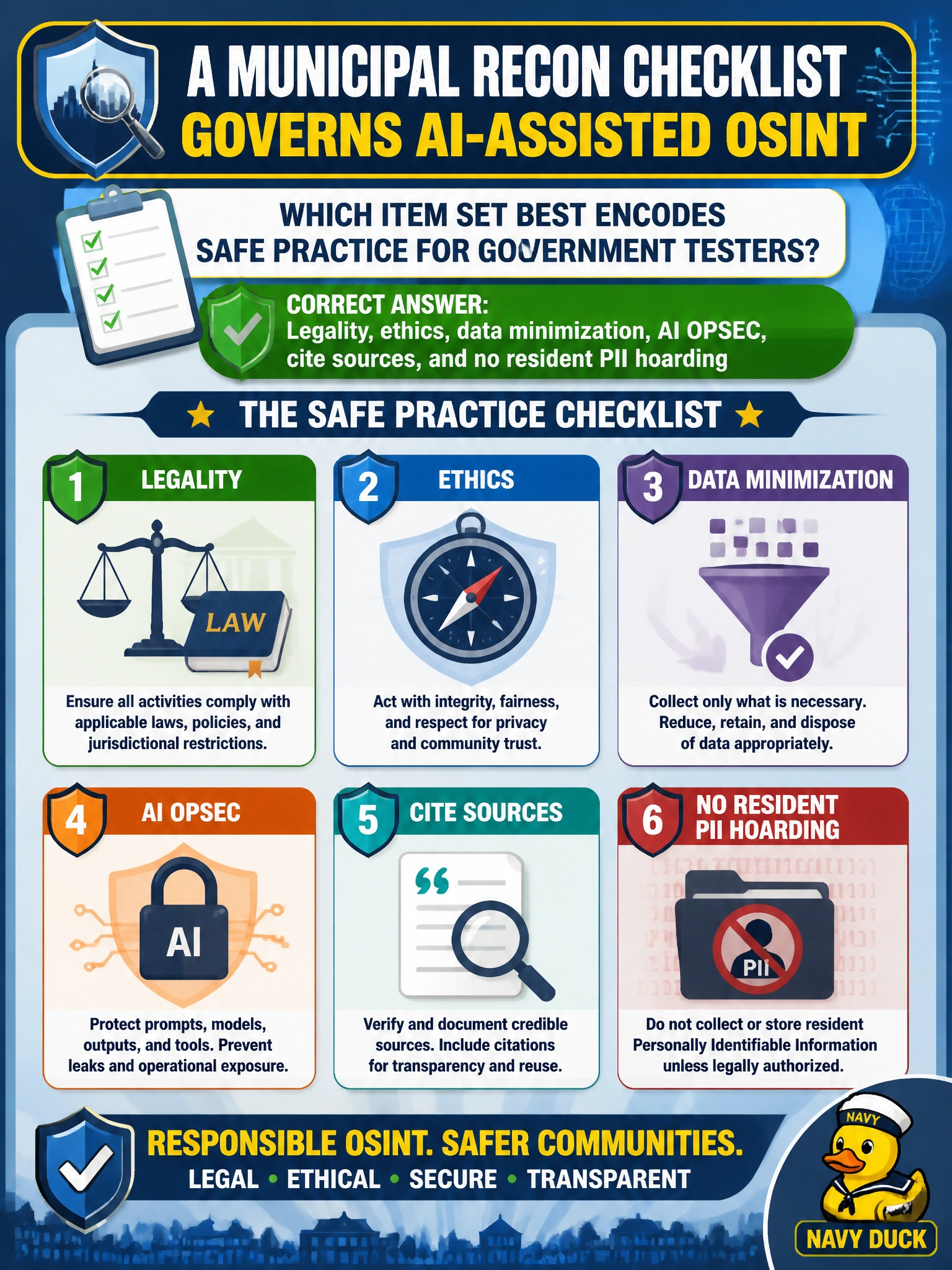
A municipal recon checklist governs AI-assisted OSINT. Which item set best encodes safe practice for government testers?
Select an answer to reveal the explanation.
Short Explanation
The good civic OSINT checklist reads like adult supervision: legal, ethical, minimize data, watch AI OPSEC, cite sources, and don't stockpile resident PII. Anything else is a shortcut into trouble.
Full Explanation
A municipal AI-assisted OSINT checklist that encodes safe practice for government testers includes legality, ethics, data minimization, AI OPSEC, citing sources, and prohibiting resident PII hoarding. Those controls keep recon useful for defenders while constraining harm, hallucination, and unlawful collection. GOAA Domain 9 expects this checklist mindset rather than maximizing sensitive harvest for convenience.
Maximizing resident PII collection and skipping citations to save time fails by concept: it rejects minimization and evidential integrity. Preferring illegal sources whenever they are faster than public records substitutes speed for authorization. Disabling OPSEC reviews whenever AI confidence scores look high confuses model confidence with operational safety and data-handling compliance.
Exam caveat: Checklists are ineffective if not enforced in tooling and review gates. Public collection can still violate platform rules or agency policy. Citations should point to primary sources, not to the AI chat that summarized them. Minimization includes retention limits—collecting less and deleting sooner both matter.
Operational check: Gate recon kickoff on a signed checklist acknowledging legality, ethics, minimization, AI OPSEC, citation, and no resident PII hoarding; reject work products that lack sources or that include unnecessary resident identifiers; and review AI tool configurations for OPSEC before analysts begin.