
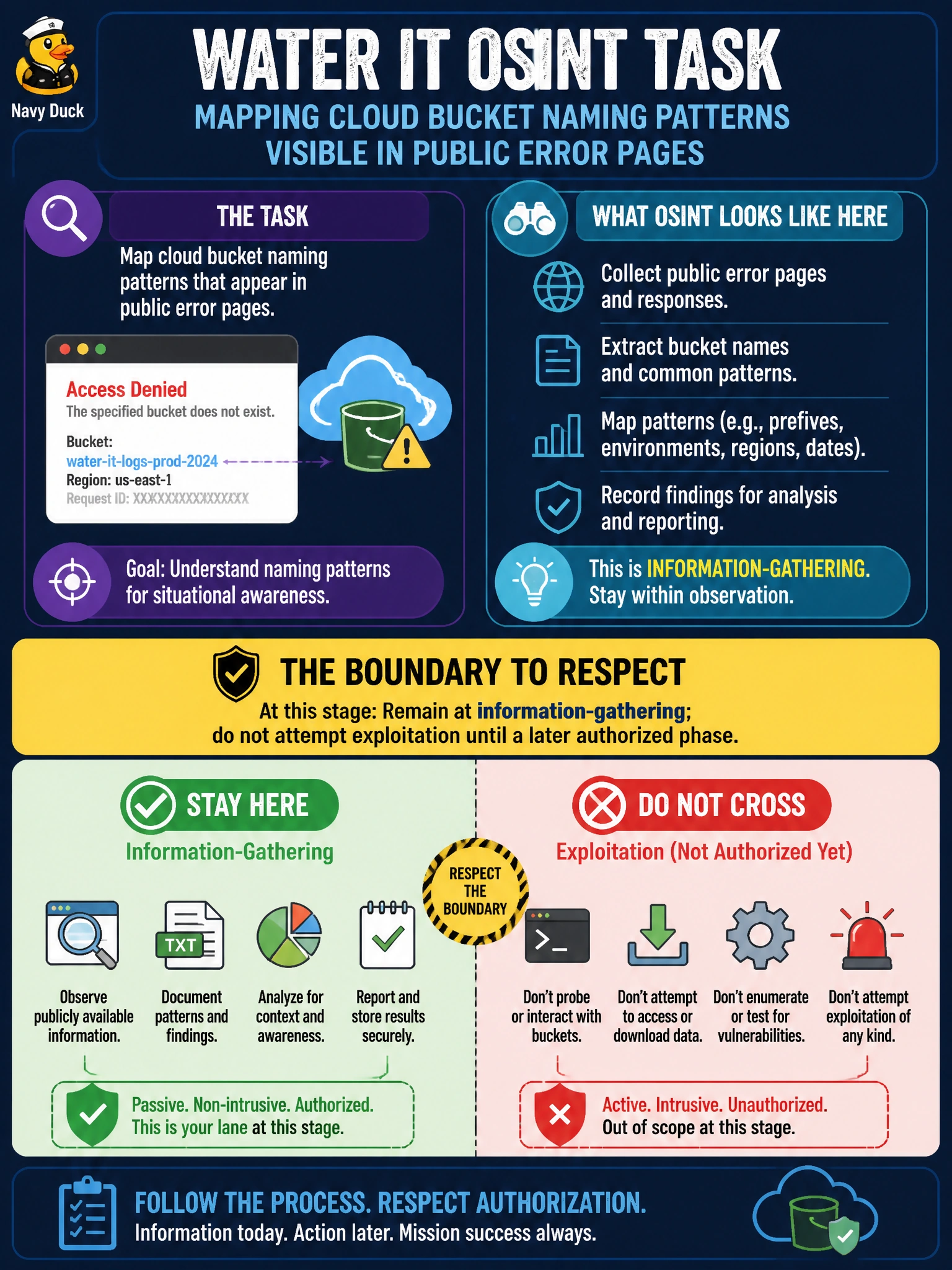
A water IT OSINT task maps cloud bucket naming patterns visible in public error pages. What boundary should the team respect at this stage?
Select an answer to reveal the explanation.
Short Explanation
You can use bucket-name patterns from public error pages as useful reconnaissance, but they do not authorize access. Stay in information-gathering until a later phase is explicitly approved for exploitation.
Full Explanation
When your water IT OSINT task maps cloud bucket naming patterns visible in public error pages, stay within information-gathering and do not attempt exploitation until a later phase is authorized. The patterns can help document potential exposure and inform defenders, but retrieving objects from guessed public buckets goes beyond observing public information: it actively accesses data and is not justified by reconnaissance alone. Error-page OSINT is evidence to assess, not proof that exploitation has been approved; authorization must come from the engagement’s rules of engagement (ROE), not from a finding. Skipping documentation also fails conceptually because naming patterns can help defenders understand and reduce exposure, while records let the team communicate what it observed. Exam caveat: an engagement may explicitly authorize limited bucket-access verification, but that permission must be stated for the relevant phase and targets; it cannot be inferred from publicly visible error pages. Practical check: record the observed patterns and error-page URLs, confirm that the current ROE phase is information-gathering, and defer any authorized access testing until its written scope and conditions are in place.