
A parks IT assessment wants scanner results joined to city asset-owner context so analysts see who owns each finding. Which approach best fits that goal?
Select an answer to reveal the explanation.
Short Explanation
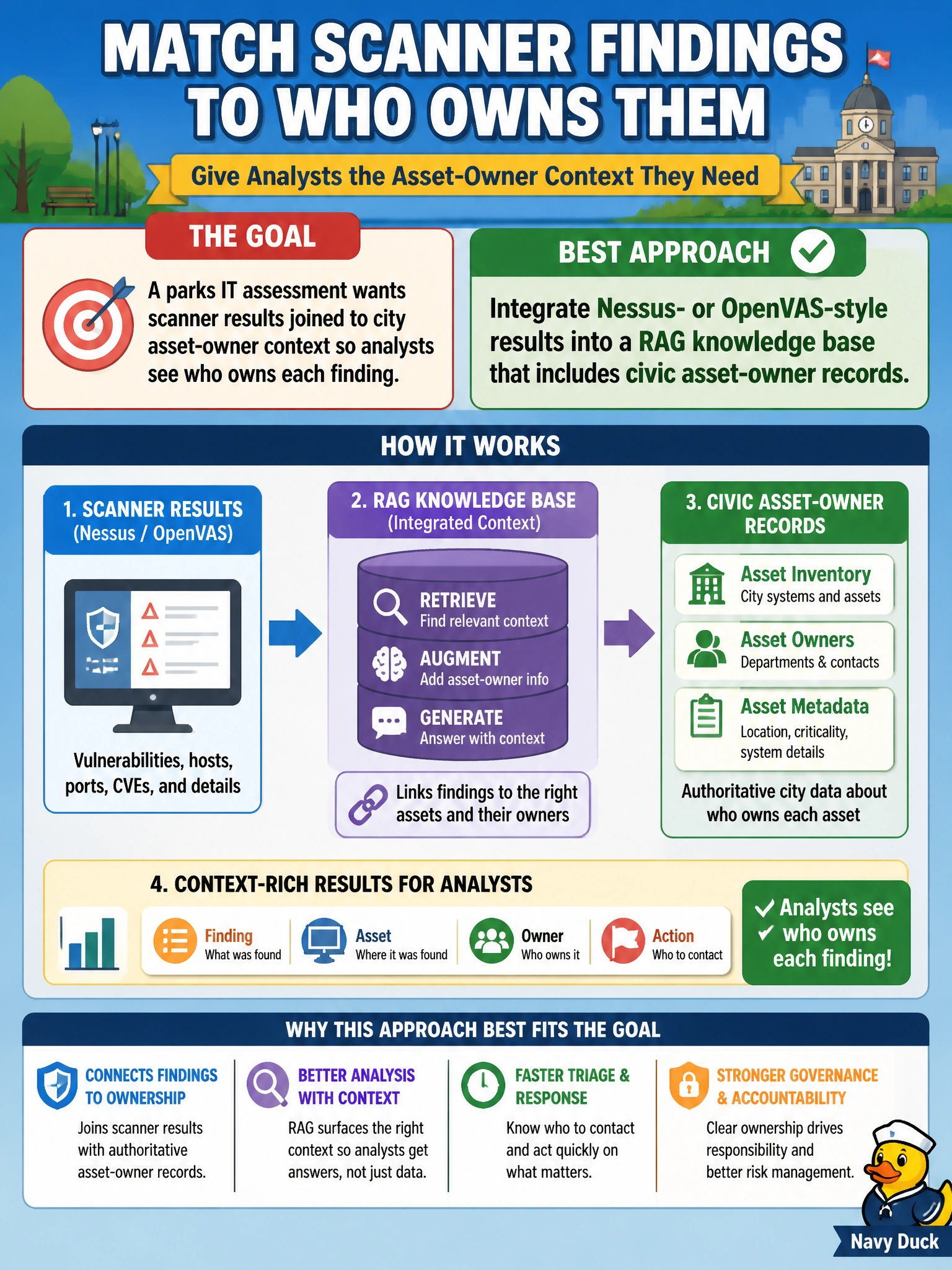
Feed the real scanner pile into a retrieval setup that also knows who owns the park cameras and ticket kiosks. Inventing owners from thin air, skipping scans, or burying findings in unlabeled screenshots leaves nobody accountable.
Full Explanation
A parks IT assessment that needs scanner results joined to city asset-owner context is solving an enrichment and retrieval problem, not a generation problem. Integrating Nessus- or OpenVAS-style results into a RAG knowledge base that also includes civic asset-owner records lets analysts retrieve who owns each camera, kiosk, or ticket terminal when reviewing findings. Grounding ownership in actual municipal records improves ticket routing, reduces orphan findings, and keeps AI assistance tied to evidence the city already trusts.
Deleting scanner XML and asking a generative model to invent asset owners from department names alone invents accountability without a source of truth and will misassign remediations across parks divisions. Skipping vulnerability scanning and only chatting with an LLM about theoretical park-network risks produces speculation without coverage evidence—useless for authorized assessment reporting. Storing findings only as unlabeled screenshots so AI cannot retrieve ownership metadata deliberately destroys the structured join that civic operations need between scan rows and CMDB-style owner fields.
Exam caveat: RAG and agent enrichment questions often tempt candidates toward generative invention. The correct pattern is retrieve-then-reason over real scanner artifacts plus authoritative civic ownership data, not invent owners to fill gaps.
Operational check: confirm the knowledge base contains both structured scan exports and authoritative owner fields; sample RAG answers for owner attribution and verify they match CMDB or parks asset records before analysts rely on the join in live triage.