
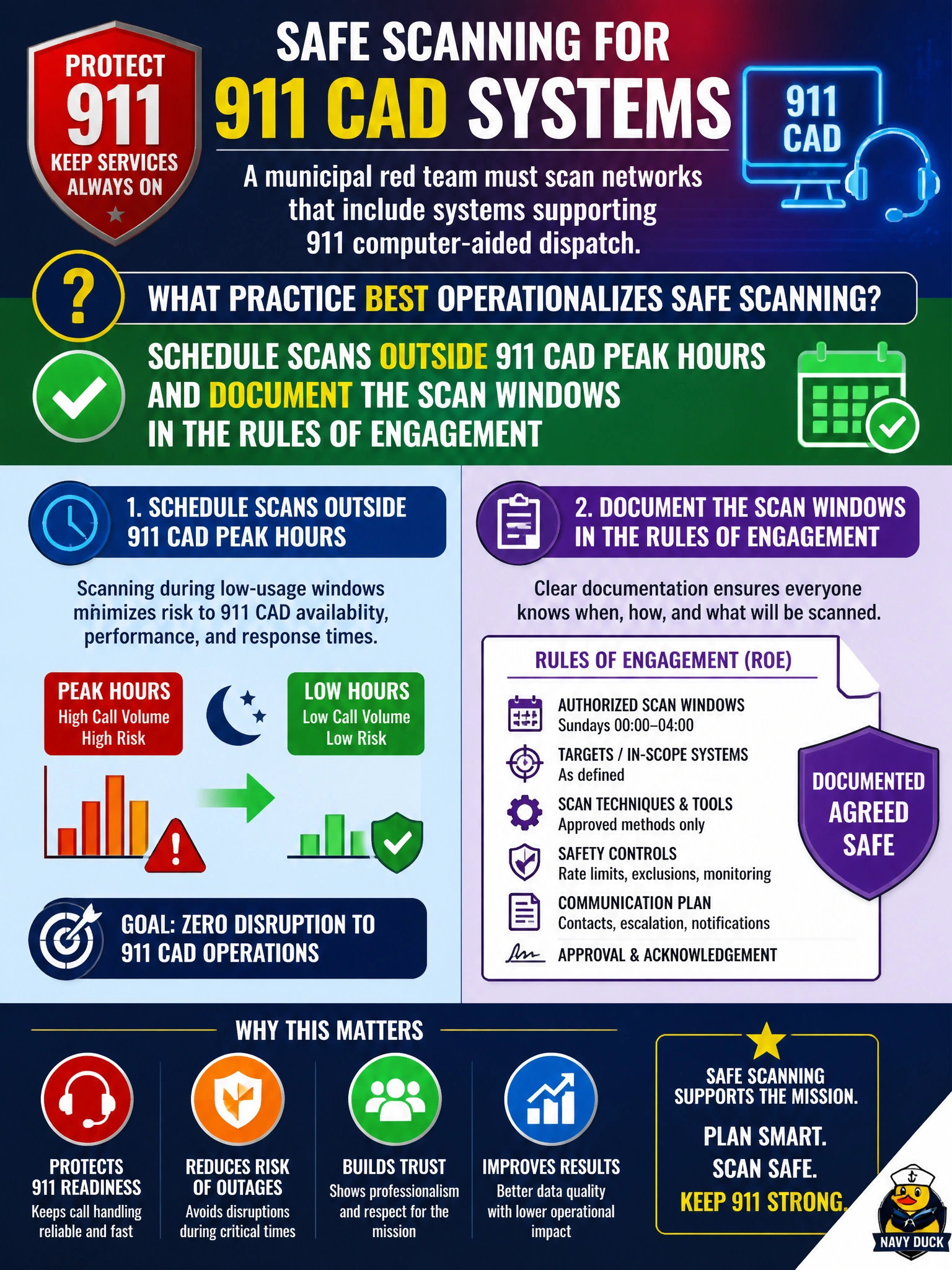
A municipal red team must scan networks that include systems supporting 911 computer-aided dispatch. What practice best operationalizes safe scanning?
Select an answer to reveal the explanation.
Short Explanation
Treat CAD like a heart monitor—you do not stress-test it during the rush. Put quiet windows in the ROE and stick to them. Letting an AI pick random times is how you earn an after-action nobody wants.
Full Explanation
Municipal red-team scanning against networks that support 911 computer-aided dispatch must treat availability as a first-class constraint. Scheduling scans outside 911 CAD peak hours and documenting those windows in the rules of engagement operationalizes safe scanning: it reduces collision with emergency workflows, gives operators a predictable maintenance-like window, and creates auditable ROE evidence if something degrades. For civic safety systems, timing is a control, not a convenience.
Running aggressive scans during peak emergency call volume to maximize realism prioritizes theatrical fidelity over public-safety continuity and is inappropriate under typical municipal authorization. Allowing AI agents to choose any scan time automatically without documenting ROE windows removes human accountability and can place load on CAD-supporting paths without operator awareness. Omitting scan timing from ROE because vulnerability tools never affect availability is factually wrong—credentialed and unauthenticated scans can spike CPU, fill logs, trip IPS, or disrupt fragile integrations that CAD depends on.
Exam caveat: safety-adjacent civic systems (CAD, SCADA-adjacent water, transit signaling support) often appear in GOAA scenarios to test whether candidates subordinate scan aggressiveness to ROE and availability. Realism does not override documented windows.
Operational check: before any probe against CAD-supporting segments, verify written ROE windows, confirm with 911/IT operations that the window is clear, configure scanner schedules accordingly, and retain logs showing scans did not run during prohibited peak periods.