
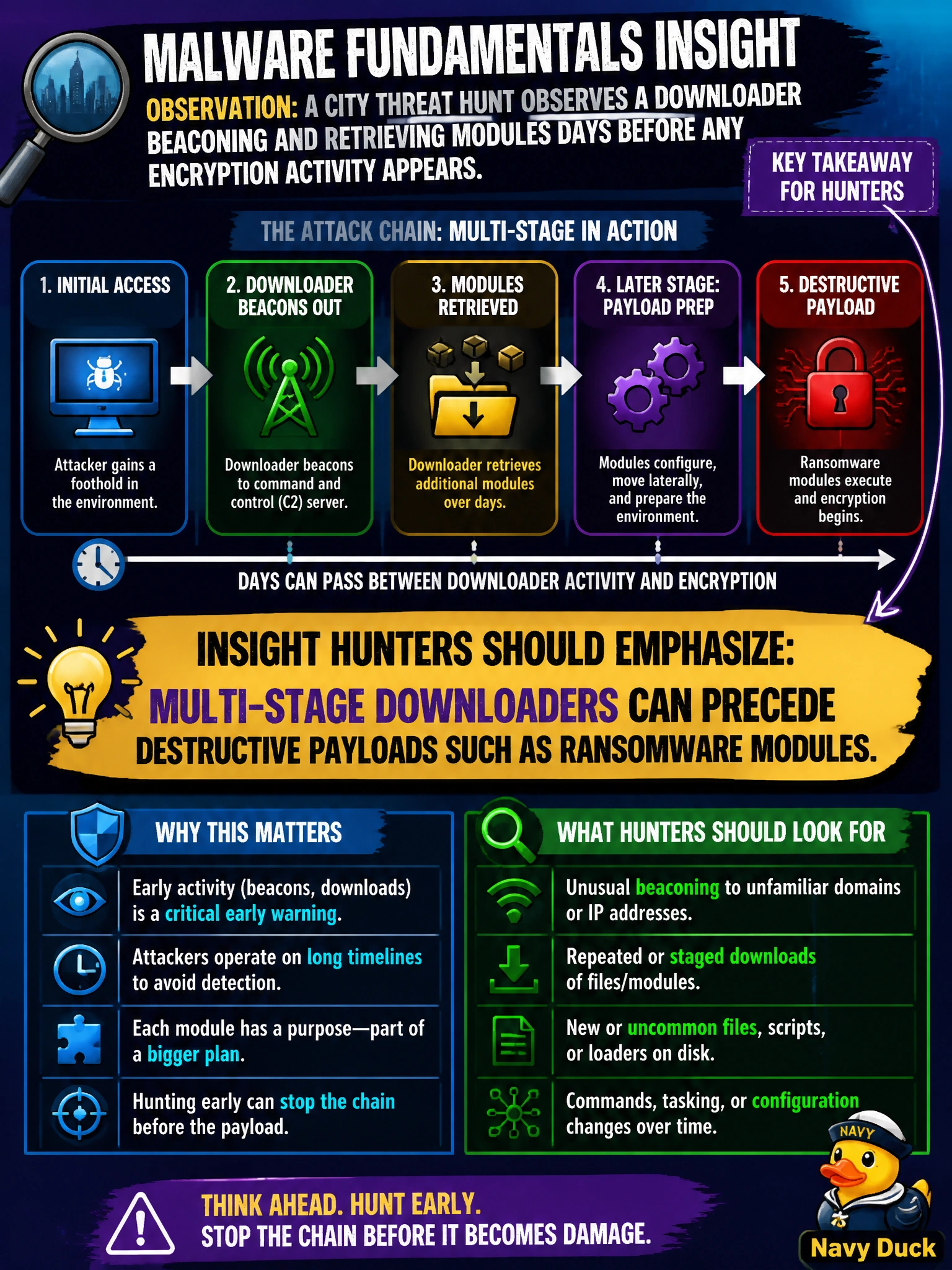
A city threat hunt observes a downloader beaconing and retrieving modules days before any encryption activity appears. What malware-fundamentals insight should hunters emphasize?
Select an answer to reveal the explanation.
Short Explanation
The downloader can chat and fetch for days before the encryption hammer drops—that’s multi-stage reality. City hunters who wait only for ransom notes miss the early beacon chapter. Catch the staging and you might stop the smash.
Full Explanation
Multi-stage malware often uses downloaders that beacon and retrieve modules well before any destructive objective such as encryption appears. When a city threat hunt observes a downloader beaconing and retrieving modules days before encryption activity, hunters should emphasize that staging can precede ransomware or other destructive payloads—waiting only for ransom notes misses the early chapter where interruption is still possible. Civic hunts that treat early beacon-plus-retrieval as actionable staging reduce blast radius across city departments.
Claiming encryption always occurs in the same process second as the first phishing click fails; real multi-stage timelines are often delayed by design. Asserting beaconing proves the sample is only a deepfake video dropper misreads C2/staging as a deepfake topic. Saying downloaders cannot appear in municipal networks that use MFA fails because MFA does not make downloader staging impossible on already-compromised or user-executed hosts.
Exam caveat: absence of encryption yet does not mean absence of serious malware. Downloader staging is itself a Domain 6-relevant finding.
Operational check for city hunters: alert on the downloader’s beacon destinations and retrieved module hashes immediately, isolate hosts showing retrieval, block staging infrastructure, hunt laterally for the same beacon pattern, and assume a destructive module may still arrive—do not defer response until encryption telemetry finally appears.