
A county purple team prepares a municipal attack-surface brief on how malware commonly arrives. Which set best represents common propagation vectors they should map?
Select an answer to reveal the explanation.
Short Explanation
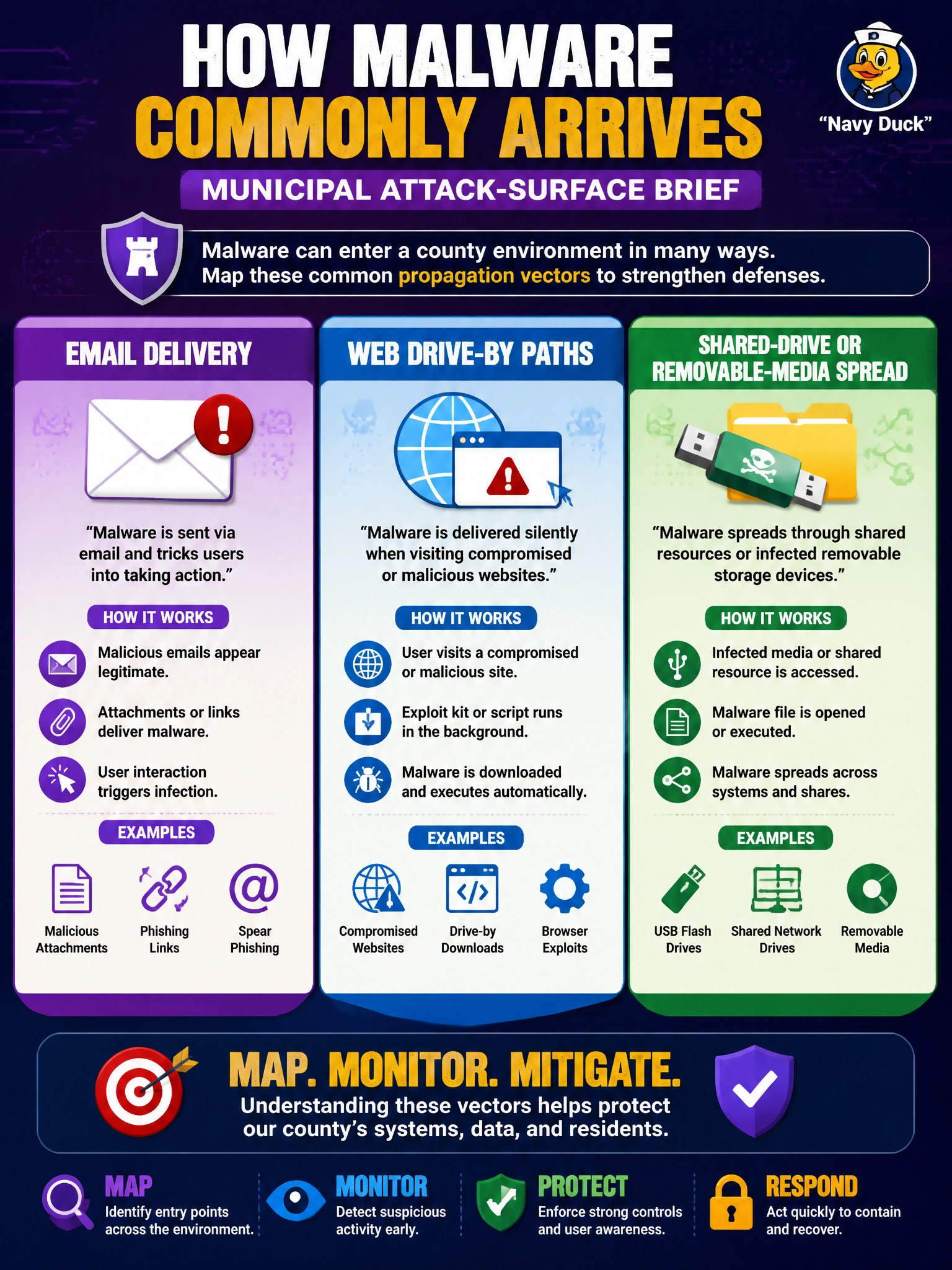
Malware shows up through mail, drive-bys, and shared or sneaker-net media—map those doors. County purple teams briefing the attack surface stick to propagation vectors, not exam logistics or RAG trivia. Know the doors; then harden them.
Full Explanation
Common malware propagation vectors in civic environments include email delivery, web drive-by paths, and spread via shared drives or removable media. A county purple team preparing a municipal attack-surface brief on how malware commonly arrives should map that set so defenders can harden the doors that actually show up in city, county, transit, and school incidents. Attack-surface briefs that stay grounded in Domain 6 propagation concepts support authorized readiness without drifting into unrelated exam logistics or AI trivia.
Only GAN training hyperparameters and vector-database chunk sizes fails because those are ML/AI implementation details, not malware arrival vectors. Only ProctorU exam settings and GIAC attempt windows fails; certification logistics are not propagation mapping for municipal estates. Only custom GPT plugin manifests with no host-to-host spread concepts fails because plugin manifests do not replace email, drive-by, share, and USB spread as the common malware arrival set.
Exam caveat: pick the operationally relevant vector set. GOAA Domain 6 is about malware fundamentals in civic contexts, not exam vendor settings or RAG tuning.
Operational check for the county purple team: for each vector, list municipal examples (phishing to clerks, drive-by on public browsers, USB in field ops, writeable shares in parks/public works), map existing controls and gaps, and brief leadership on prioritized hardening—without providing weaponization steps or expanding beyond approved ROE.