
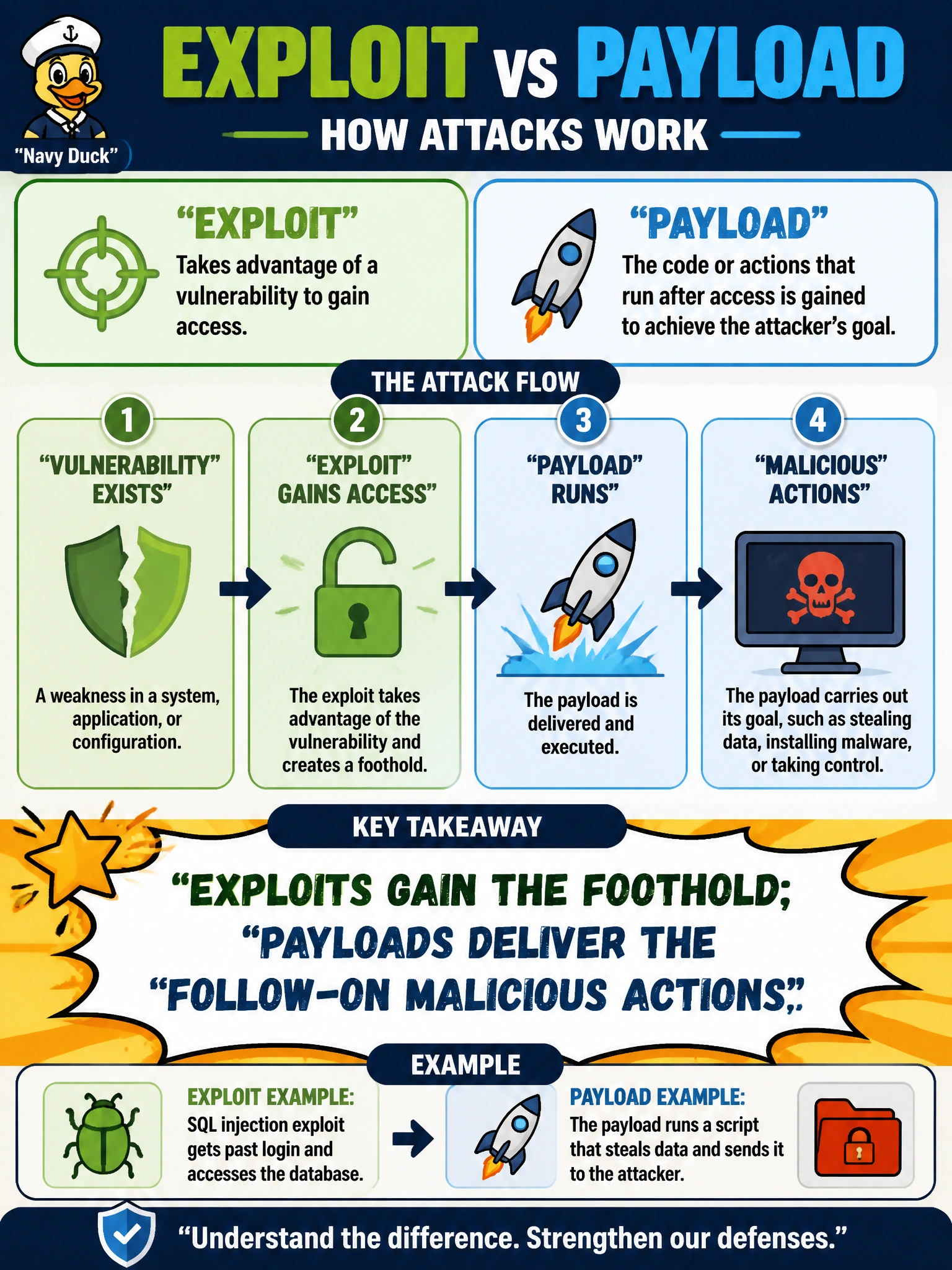
A school SOC trainer tells staff that an ‘exploit’ takes advantage of a vulnerability while a ‘payload’ is what runs afterward. Which statement best reinforces that teaching point?
Select an answer to reveal the explanation.
Short Explanation
Keep it coffee-simple: exploit opens the door; payload is what walks in and misbehaves. School SOC trainers who lock that vocabulary save hours of confused tickets. Interchangeable labels are how reports go fuzzy.
Full Explanation
An exploit takes advantage of a vulnerability to gain execution or privilege; a payload is the code or tooling that runs afterward to carry out follow-on malicious actions. A school SOC trainer who reinforces ‘exploits gain the foothold; payloads deliver the follow-on malicious actions’ is teaching the correct Domain 6 separation and reducing confused tickets where staff swap the terms. Municipal school estates see both browser/document exploitation and later RATs or stealers; vocabulary discipline keeps IR narratives usable for leadership and auditors.
Saying payloads are always the vulnerability and exploits are always scheduled tasks reverses definitions and confuses payload with persistence artifacts. Claiming the two terms are interchangeable in every municipal IR report undermines the teaching point and produces fuzzy documentation. Restricting exploits only to USB worms and never to browser flaws is false; exploits apply across vulnerability classes, including browsers, not only USB worms.
Exam caveat: exploit ≠ payload ≠ persistence. GOAA will punish synonym abuse even when all appear in one school-district incident.
Operational check for school SOC coaching: in each tabletop, require analysts to state which evidence is the exploit path (vulnerable component / crash / exploit indicator) versus which is the payload (RAT, stealer, encryptor), assign remediations accordingly (patch vs eradicate tooling), and reject report drafts that use the words interchangeably before the ticket closes.