
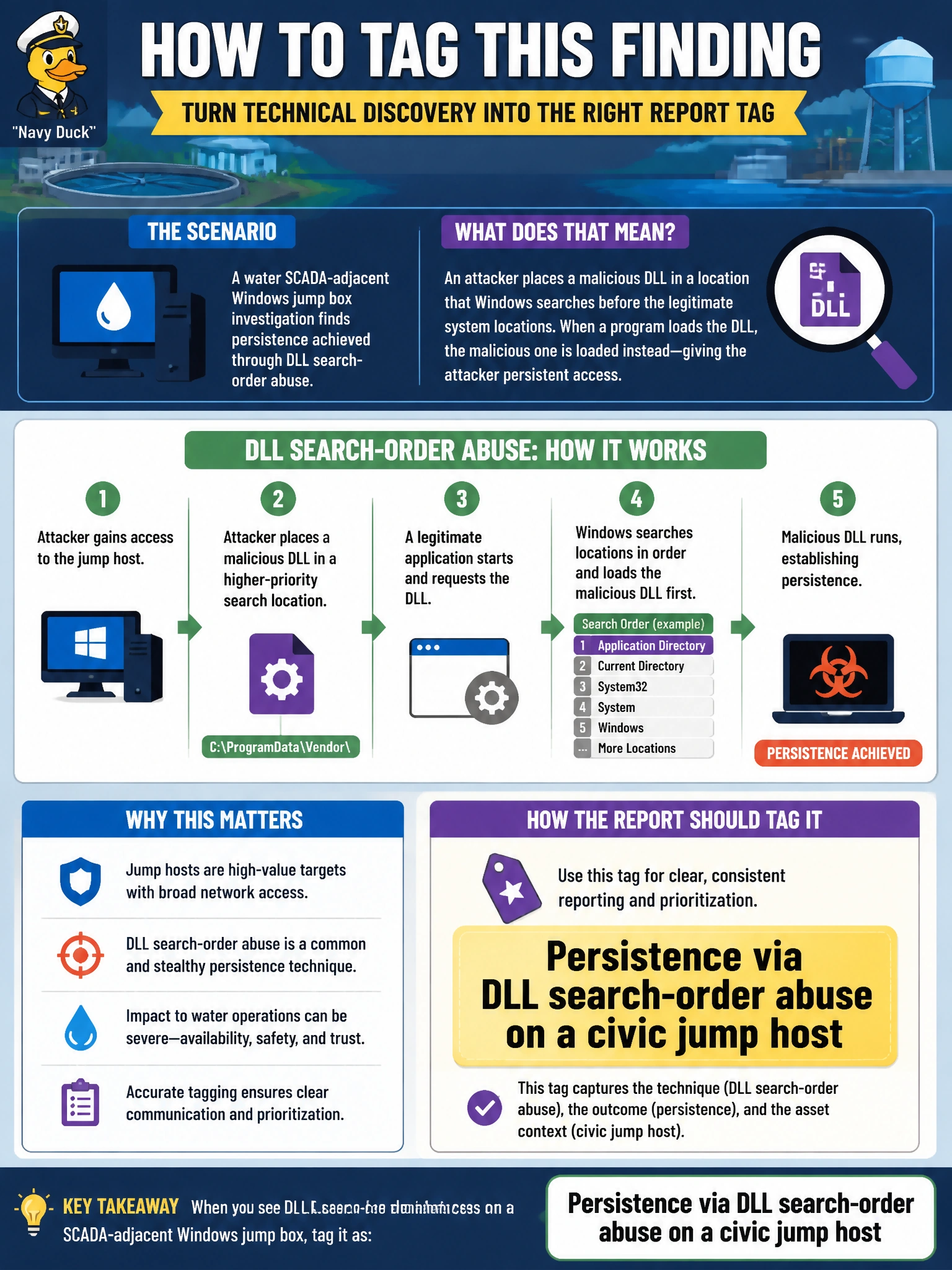
A water SCADA-adjacent Windows jump box investigation finds persistence achieved through DLL search-order abuse. How should the report tag that finding?
Select an answer to reveal the explanation.
Short Explanation
If malware leans on DLL search-order tricks to keep coming back, that’s persistence on the jump box—say so in the report. Water jump hosts are sensitive enough without fuzzy labels. Tag the mechanism; don’t call it ‘just phishing.’
Full Explanation
DLL search-order abuse can be used as a persistence and execution-concealment technique by causing Windows to load a malicious library when a legitimate application searches for a DLL in a predictable order or location. When a water SCADA-adjacent Windows jump box investigation finds persistence achieved through that mechanism, the report should tag the finding as persistence via DLL search-order abuse on a civic jump host—precise enough for eradication and for protecting sensitive IT-to-OT bridging systems. Fuzzy labels such as ‘phishing’ alone do not describe how the malware survives or relaunches on the jump box.
Initial email phishing lure wording only fails because lure wording is delivery content, not the persistence mechanism found on the host. AI agent summarization of Nmap XML fails; that is scan-contextualization workflow, not DLL search-order persistence. Speech-sample collection for deepfake awareness fails as a tag; it is unrelated to Windows DLL loading abuse on a water jump host.
Exam caveat: name the persistence class from evidence. Jump-box findings in water utilities are high impact even when OT controllers themselves are out of scan scope.
Operational check for water defenders: identify the abused application path and malicious DLL location/hash, remove the malicious library and any autorun partners, validate the legitimate application’s search paths and permissions, re-image if trust in the jump box is uncertain, restrict write access to application directories, and hunt other jump boxes for the same DLL name/hash—while still respecting charters that forbid probing OT controllers.