
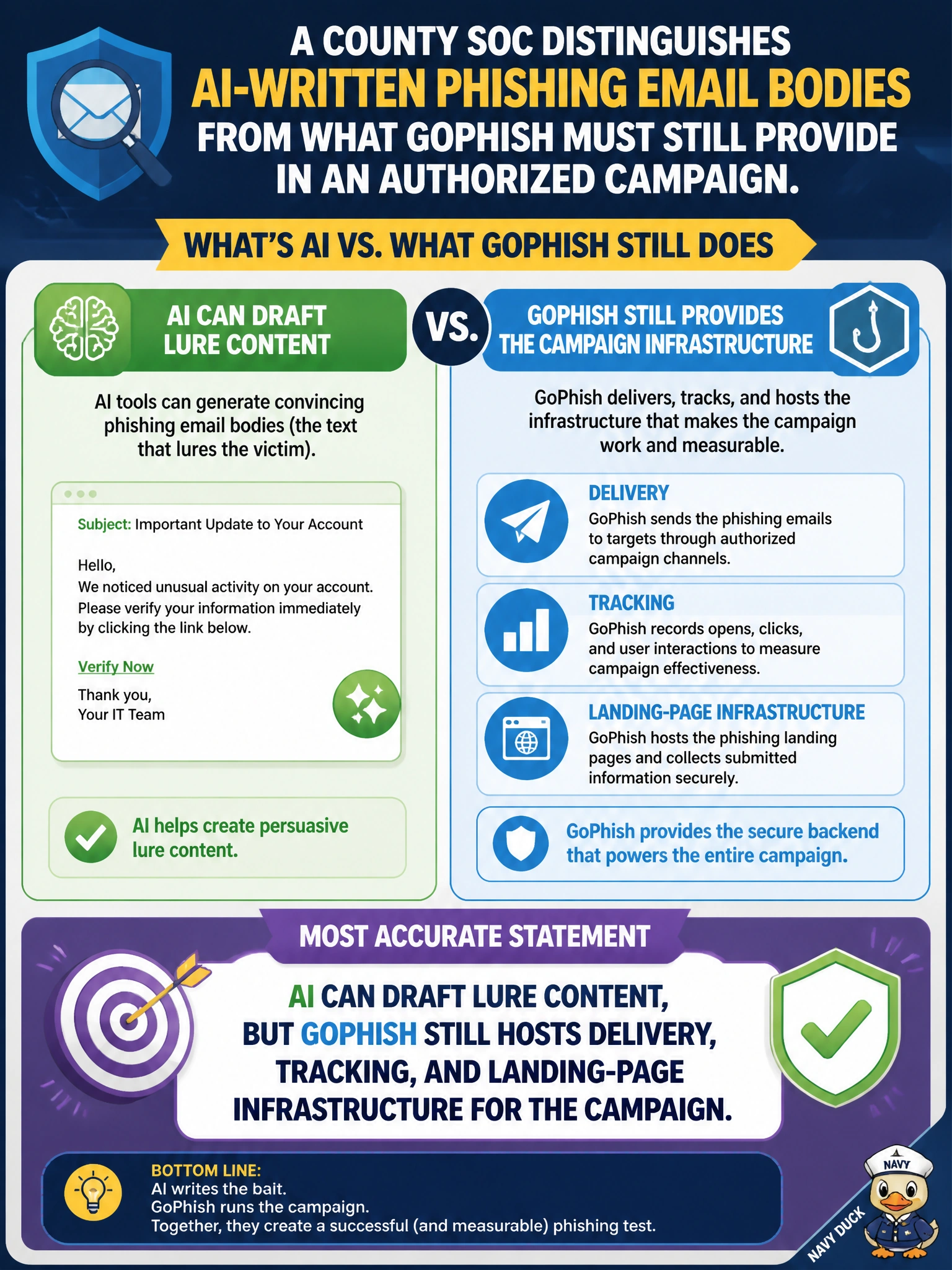
A county SOC distinguishes AI-written phishing email bodies from what GoPhish must still provide in an authorized campaign. Which statement is most accurate?
Select an answer to reveal the explanation.
Short Explanation
The LLM is the copywriter; GoPhish is the mailroom, tracker, and landing stage. Pretty paragraphs do not magically ship, attribute clicks, or host the teachable page. Keep those jobs straight in the runbook.
Full Explanation
A county SOC should distinguish AI-written phishing email bodies from the campaign infrastructure GoPhish must still provide in an authorized program. Generative models can draft lure text quickly, but they do not replace the delivery, tracking, landing-page hosting, and metrics layer that GoPhish (or an equivalent platform) supplies. Runbooks should keep content generation and campaign infrastructure as separate concerns so authorization, telemetry, and remediation workflows remain coherent. Claiming that once AI writes the body, GoPhish is unnecessary because generative models send and track mail themselves confuses drafting with SMTP campaign operations and attribution. Saying GoPhish only stores fonts while AI alone performs SMTP delivery, click attribution, and landing hosting inverts the actual division of labor. Treating content generation and campaign infrastructure as the same layer that should not be separated in runbooks hides ownership boundaries and makes ROE and metrics harder to audit. Exam caveat: GOAA AI-phishing tooling questions expect candidates to separate LLM copywriting from GoPhish-class campaign machinery. Operational check: use AI only in the content lane under human edit; operate sends, landers, and metrics in GoPhish under the county ROE; document both lanes in the runbook.