
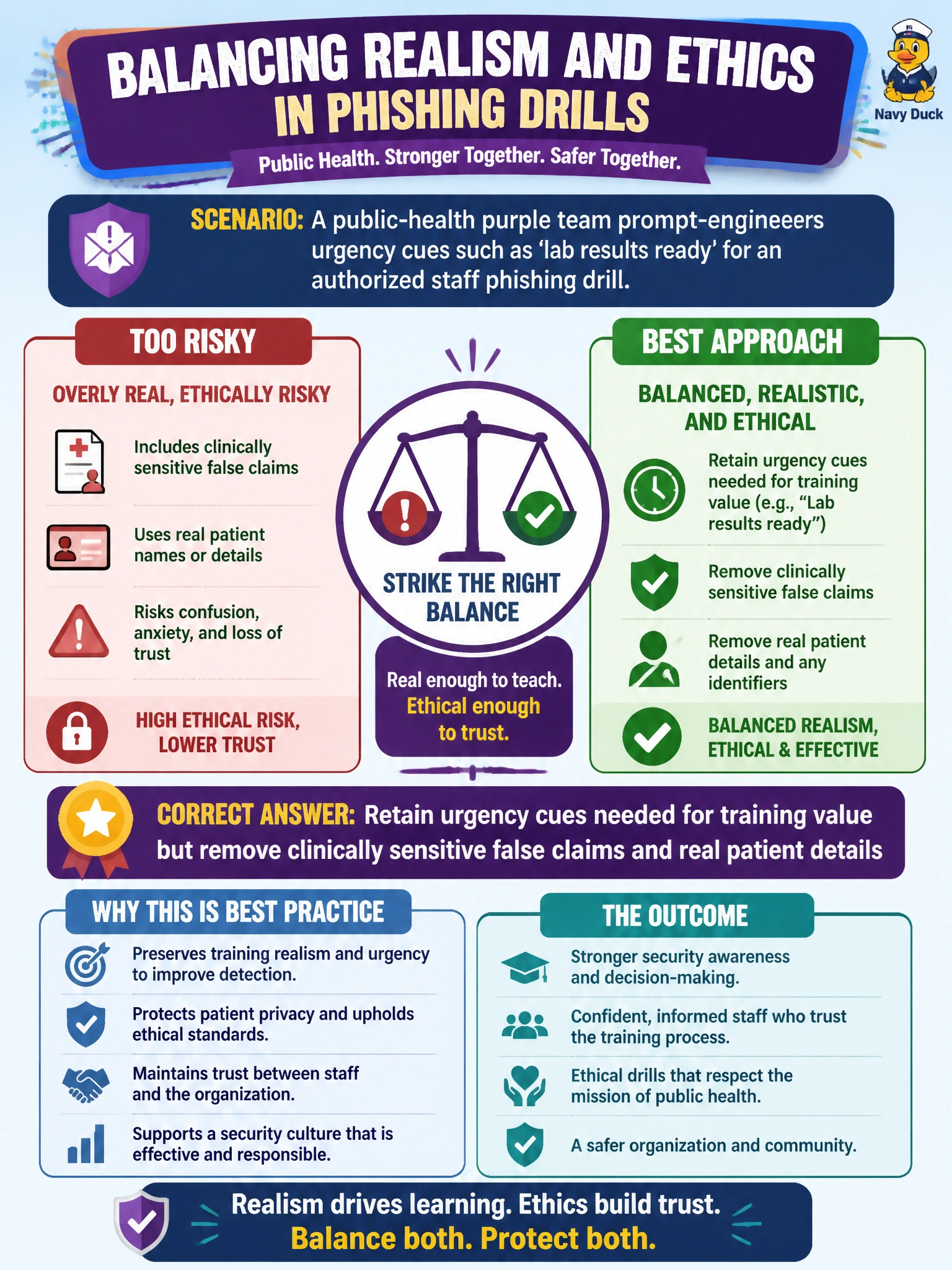
A public-health purple team prompt-engineers urgency cues such as ‘lab results ready’ for an authorized staff phishing drill. Which adjustment best balances realism and ethics?
Select an answer to reveal the explanation.
Short Explanation
You can teach urgency with “Results ready” without inventing frightening diagnoses or including real patient names. Edit the AI draft to keep the exercise useful without turning it into a mini medical drama. Ethics still matters more than shock value.
Full Explanation
For an authorized public-health phishing drill, the ethical balance is to retain urgency cues needed for training value while removing clinically sensitive false claims and real patient details. “Lab results ready” can feel realistic in a health workplace, but realism does not require inventing detailed diagnoses, using real patient names or specimen IDs from the laboratory information system, or skipping human review. Keeping clinically detailed false diagnoses to maximize emotional pressure prioritizes shock over ethics and may cause genuine distress. Naming real patients and using specimen IDs from the LIS to increase believability misuses protected health-related data in an awareness exercise. Omitting human review on the assumption that health urgency themes are automatically appropriate wrongly treats a theme’s subject as proof of policy compliance. The appropriate adjustment preserves training value without clinically sensitive fabrication or real identifiers. Exam caveat: GOAA public-sector AI phishing scenarios test humane, privacy-aware realism—not maximal emotional manipulation. Practical check: edit AI drafts to use generic urgency, with no fabricated clinical claims or real patient identifiers, and obtain public-health privacy and exercise-owner sign-off before sending.