
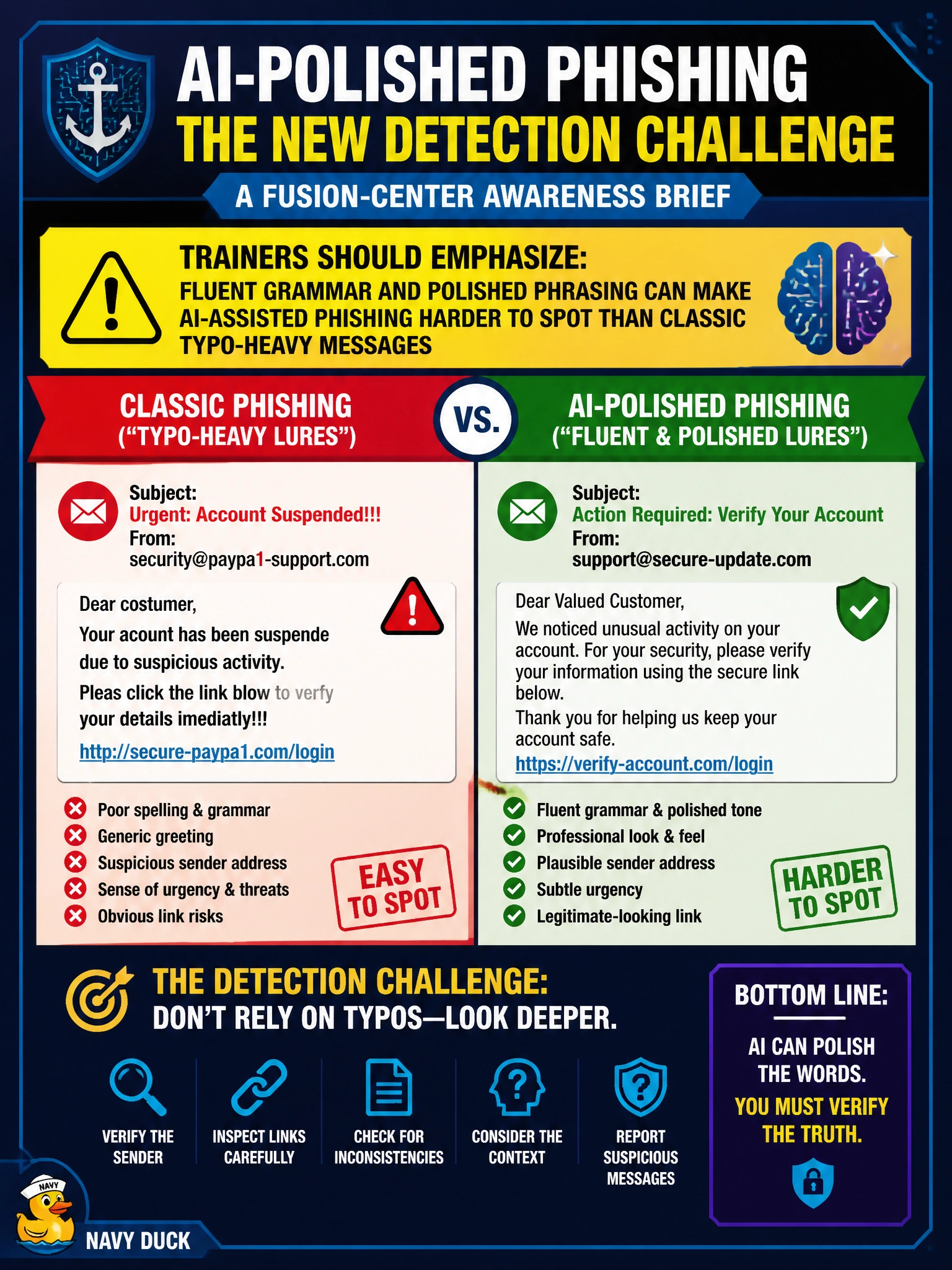
A fusion-center awareness brief warns staff that AI-polished phishing can differ from classic typo-ridden lures. Which detection challenge should trainers emphasize?
Select an answer to reveal the explanation.
Short Explanation
The old ‘spot the typo’ trick is getting lonely. AI can iron the wrinkles out of a lure so it reads like City Hall wrote it. Train people on urgency, odd requests, and verify-out-of-band—not just spelling bees.
Full Explanation
Fusion-center trainers should emphasize that fluent grammar and polished phrasing can make AI-assisted phishing harder to spot than classic typo-heavy messages. Many legacy awareness tips taught staff to hunt for misspellings and awkward phrasing; generative models can remove those tells while preserving urgency, authority spoofing, and malicious links or callbacks. Detection and coaching must therefore shift toward verifying unusual requests out of band, scrutinizing sender domains and reply paths, and treating polished writing as non-probative of legitimacy. Claiming AI always inserts obvious Unicode artifacts that make every lure trivial to filter overstates a fragile heuristic and will miss well-formed campaigns. Asserting that only attachments matter and body-text quality has no effect on municipal phishing success rates ignores how believable prose increases click and compliance rates for link- and callback-based lures. Treating polished writing as proof a message is legitimate because criminals never use generative AI is factually wrong and trains the exact complacency adversaries want. Exam caveat: GOAA AI-phishing recognition items target the loss of typo-based tells and the need for process verification over surface literacy checks. Operational check: update fusion-center awareness modules to de-emphasize ‘spot the typo’ as a primary control and drill out-of-band verification for payment, credential, and urgent directive requests.